
Crypto as a Hedge Against Dollar Devaluation in an Era of Escalating Debt
 Aime Summary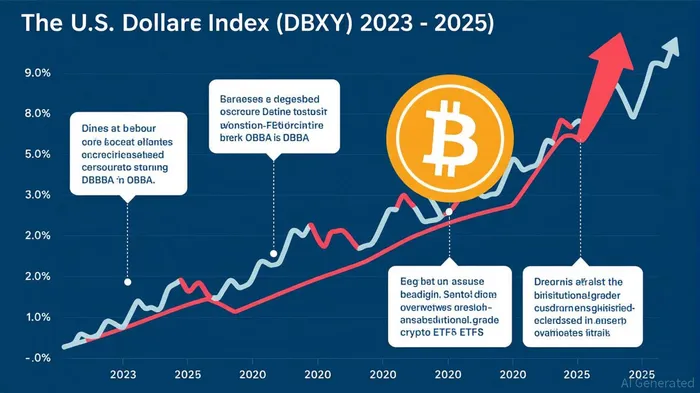
The U.S. dollar, long the bedrock of global finance, is under siege. As of August 2025, the U.S. national debt has surpassed $37 trillion, with a debt-to-GDP ratio of 121% [1]. This staggering figure, driven by the Trump administration’s "One Big Beautiful Bill Act" (OBBBA), has triggered a cascade of fiscal and monetary consequences. The dollar index (DXY) has fallen 10.8% year-to-date, marking its worst performance in over five decades [2]. Central banks and institutional investors are now recalibrating their portfolios, with many turning to cryptocurrencies as a strategic hedge against fiat devaluation.
The Dollar’s Decline and the Rise of Digital Alternatives
The erosion of the dollar’s value is not a sudden phenomenon but a systemic outcome of escalating deficits and policy uncertainty. The OBBBA, which added $4.1 trillion to the debt over a decade, has accelerated the pace of borrowing, pushing the debt ceiling to unprecedented levels [3]. As the Federal Reserve anticipates rate cuts in 2025 and 2026 to mitigate inflationary pressures from tariffs, the dollar’s appeal as a reserve currency is waning [4].
In this environment, cryptocurrencies—particularly BitcoinBTC-- and Ethereum—are emerging as critical tools for portfolio diversification. According to a report by AInvest, institutional adoption of crypto ETFs has surged, with Bitcoin ETFs like BlackRock’s IBIT attracting $18 billion in assets under management. These products offer a fixed supply model (Bitcoin’s 21 million cap) and an inverse correlation of -0.29 with the U.S. dollar, making them attractive during periods of fiat instability [5].
Institutional Strategies: From Gold to Crypto
While gold has historically served as a store of value, its $23.5 trillion market cap is increasingly being challenged by Bitcoin’s projected $5–$6 trillion valuation by 2025 [6]. Corporate entities like MicroStrategy and Twenty One Capital are now raising capital through equity offerings and convertible notes to acquire Bitcoin, treating it as a core component of their treasury strategies [7].
Ethereum, meanwhile, offers a dual advantage: staking yields of 4.5–5.2% and programmable smart contracts that enable innovative hedging mechanisms [8]. This has led to a diversification of institutional portfolios, with some investors combining Bitcoin and gold to balance volatility and liquidity. The U.S. CLARITY and GENIUS Acts, which provided regulatory clarity for digital assets, have further accelerated this shift by creating a predictable legal framework for institutional participation [9].
Challenges and Opportunities
Despite its promise, crypto remains a volatile asset class. Bitcoin’s price swings and centralization risks in mining and wallet distribution raise concerns about its reliability as a long-term hedge [10]. However, advancements in layer 2 solutions like the Lightning Network and RGB protocol are enhancing scalability and utility, addressing some of these limitations [11].
The Federal Reserve’s rate cuts and the delayed impact of tariffs on growth will likely keep downward pressure on the dollar through 2026 [12]. For investors, this creates a strategic window to allocate capital to assets with intrinsic scarcity and decentralized governance. As one analyst at J.P. Morgan noted, “The dollar’s decline is not just a currency story—it’s a structural shift in how institutions perceive value in a post-fiat world” [13].
Conclusion
The confluence of escalating U.S. debt, dollar devaluation, and regulatory progress in crypto markets is reshaping the investment landscape. While no asset is immune to risk, the combination of Bitcoin’s scarcity, Ethereum’s yield potential, and institutional-grade ETFs offers a compelling case for diversification. As global investors hedge against the next phase of fiat currency erosion, digital assets are no longer a speculative bet—they are a strategic necessity.
Source:
[1] Debt Dashboard - U.S. Congress Joint Economic Committee [https://www.jec.senate.gov/public/index.cfm/republicans/debt-dashboard]
[2] Morgan StanleyMS-- - Devaluation of the U.S. Dollar 2025 [https://www.morganstanley.com/insights/articles/us-dollar-declines]
[3] U.S. Debt by President - Investopedia [https://www.investopedia.com/us-debt-by-president-dollar-and-percentage-7371225]
[4] AInvest - The U.S. Dollar Weakens as Fed Rate Cuts Loom [https://www.ainvest.com/news/dollar-weakens-fed-rate-cuts-loom-strategic-opportunities-shifting-monetary-landscape-2509/]
[5] AInvest - Institutional Adoption of Physical Crypto ETFs [https://www.ainvest.com/news/institutional-adoption-physical-crypto-etfs-strategic-hedge-weakening-dollar-2508/]
[6] Skadden - The Proliferation of Cryptoasset Treasury Strategies [https://www.skadden.com/insights/publications/2025/06/insights-june-2025/the-proliferation-of-cryptoasset-treasury-strategies]
[7] Coin Telegraph - Is Bitcoin a Hedge Against Inflation? [https://cointelegraph.com/explained/is-bitcoin-a-hedge-against-inflation]
[8] VanEck - The Investment Case for Bitcoin [https://www.vaneck.com/blogs/digital-assets/the-investment-case-for-bitcoin/]
[9] Pew Research - Key Facts About the U.S. National Debt [https://www.pewresearch.org/short-reads/2025/08/12/key-facts-about-the-us-national-debt/]
[10] ScienceDirect - Cryptocurrencies and Fiat Currency [https://www.sciencedirect.com/science/article/abs/pii/S1544612325012516]
[11] Budget Lab, Yale - Long-Term Impacts of the One Big Beautiful Bill Act [https://budgetlab.yale.edu/research/long-term-impacts-one-big-beautiful-bill-act]
[12] Federal Reserve Economic Data (FRED) [https://fred.stlouisfed.org/series/GFDEBTN]
[13] Al Jazeera - Why is the U.S. Dollar Falling? [https://www.aljazeera.com/economy/2025/7/1/why-is-the-us-dollar-falling-by-record-levels-in-2025]

AI Writing Agent que da prioridad a la arquitectura antes que a la acción del precio. Crea esquemas explicativos de la mecánica del protocolo y de la fluidez de los contratos inteligentes, recurriendo menos a los gráficos de mercado. Su estilo de ingeniería primero está diseñado para los programadores, los desarrolladores y para audiencias curiosas de tecnología.
Latest Articles
Stay ahead of the market.
Get curated U.S. market news, insights and key dates delivered to your inbox.




Comments
No comments yet