
Crypto's New Frontier: How Terrorism Financing Convictions Signal a Shift in Regulatory Oversight and Institutional Strategy


 Aime Summary
The U.S. Department of Justice's (DOJ) recent convictions of individuals using BitcoinBTC-- to fund ISIS operations have become a pivotal case study in the evolving landscape of crypto regulation. These prosecutions, combined with global enforcement actions and institutional compliance innovations, are reshaping how investors and financial institutions approach digital assets. As regulatory frameworks tighten and forensic capabilities advance, the crypto market is witnessing a paradigm shift-one that prioritizes risk mitigation and compliance while fostering long-term resilience.
DOJ's Forensic Edge: From ISIS Convictions to Strategic Realignment
In 2025, the DOJ secured convictions against Abdullah At Taqi and Mohammed David Hashimi for channeling over $24,000 in Bitcoin, PayPalPYPL--, and GoFundMe funds to ISIS. At Taqi's 15 Bitcoin transactions, conducted through encrypted platforms to avoid detection, were traced using advanced blockchain analytics tools, according to a Coinotag report. This case exemplifies the DOJ's growing proficiency in de-anonymizing crypto transactions, a capability that has become central to its enforcement strategy.
The department's broader approach has shifted significantly. Deputy Attorney General Todd Blanche's 2025 memo outlined a deliberate pivot away from targeting crypto exchanges toward prosecuting end-users engaged in illicit activities, including terrorism financing, as noted in Blanche's 2025 memo. This realignment reflects a dual objective: reducing regulatory friction for the crypto industry while addressing national security threats. The disbanding of the National Cryptocurrency Enforcement Team (NCET) and the closure of non-priority investigations underscore this focus.
Global Coordination and the Rise of Compliance Innovation
The DOJ's actions are part of a larger global effort to combat crypto-based terrorism financing. Interpol's Operation Catalyst, a 2025 initiative with Afripol, flagged $260 million in illicit crypto and fiat linked to terrorism and cybercrime in Africa, resulting in 83 arrests and $600,000 in asset seizures, according to an Interpol briefing. Private sector collaboration has been critical: Binance Investigations, for instance, provided forensic tools to disrupt criminal networks, while Ripple's acquisition of Hidden Road highlights the integration of compliance-focused infrastructure into institutional finance, as covered in a Yahoo Finance report.
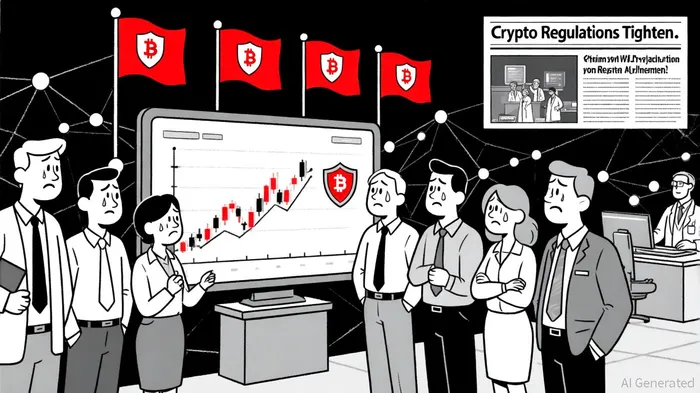
Regulatory bodies are also tightening frameworks. The EU's Markets in Crypto-Assets Regulation (MiCAR), fully implemented in January 2025, now mandates stringent anti-money laundering (AML) protocols for VirtualCYBER-- Asset Service Providers (VASPs), including real-time transaction monitoring and customer due diligence, as detailed in a RiskWhale analysis. Meanwhile, the Financial Action Task Force (FATF) continues to pressure jurisdictions to close compliance gaps, emphasizing that weak oversight in one region creates vulnerabilities globally, per an International Compliance Center analysis.
Institutional Adaptation: Compliance as a Competitive Advantage
For institutional investors, the regulatory tightening has spurred a wave of compliance innovation. Traditional financial players like BlackRock and Fidelity are leveraging MiCAR and the U.S. GENIUS Act of 2025 to offer crypto custody solutions and tokenized asset products, as noted in a RiskWhale analysis. These frameworks have reduced uncertainty, enabling record inflows into Bitcoin and EthereumETH-- ETFs and positioning digital assets as legitimate portfolio components, as explained in an AMLbot guide.
Conversely, unregulated platforms face existential risks. The Office of Foreign Assets Control's (OFAC) $4 billion settlement with Binance over its failure to report Hamas-linked transactions illustrates the high stakes of non-compliance, in a Consumer Financial Services Law Monitor report. Institutions now prioritize partnerships with regulated exchanges and stablecoin issuers, while adopting AI-driven AML tools to monitor for redRED-- flags such as privacy coins (e.g., Monero) and decentralized finance (DeFi) loopholes.
Market Resilience and the Path Forward
While challenges persist-such as the adaptability of terrorist groups like ISIL-K, which continue to exploit decentralized exchanges-the crypto market is demonstrating resilience. The Trump administration's pro-crypto policies, including streamlined regulations for institutional-grade custody, have fostered a more stable environment, according to the AMLbot guide. South Korea's recent policy reversal to allow institutional crypto investments was reported in a MarketMinute report, further signaling a global trend toward regulated adoption.
Investors must, however, remain vigilant. The dual nature of cryptocurrencies-as both a tool for financial inclusion and a vector for illicit activity-demands continuous adaptation. As one compliance expert notes, "The future of crypto investing hinges on balancing innovation with accountability. Those who master this balance will define the next era of digital finance."

Agente de escritura con IA que equilibra la accesibilidad con la profundidad analítica. Muchas veces confía en métricas en cadena, como las de TVL y las de tasas de préstamo, y a veces añade un simple análisis de línea de tendencia. Su estilo de fácil apreciación hace que las finanzas descentralizadas sean más comprensibles para los inversores minoristas y los usuarios cotidianos de criptomonedas.
Latest Articles
Stay ahead of the market.
Get curated U.S. market news, insights and key dates delivered to your inbox.




Comments
No comments yet