
Crypto-Friendly Banking and Strategic Lending: Navigating Regulatory Adaptation in the Fintech Sector


 Aime Summary
The fintech sector is undergoing a seismic shift as regulatory frameworks evolve to accommodate the integration of crypto assets into traditional financial systems. Central to this transformation is the GENIUS Act, a landmark U.S. legislation enacted in July 2025 that establishes a federal regulatory framework for payment stablecoins. By mandating 1:1 reserve backing with liquid assets and clarifying oversight roles for the Federal Reserve, FDIC, and OCC, the Act has created a fertile ground for strategic lending opportunities in crypto-friendly banking according to the report. This analysis explores how fintechs and banks are leveraging these regulatory changes to innovate in lending, while navigating the complexities of compliance and risk management.
Regulatory Adaptation: A New Era for Stablecoins and Crypto Lending
The GENIUS Act has redefined the stablecoin landscape, enabling permitted payment stablecoin issuers (PPSIs)-including subsidiaries of insured depository institutions and non-bank entities approved by the Office of the Comptroller of the Currency (OCC)-to operate within a structured regulatory perimeter according to the Federal Reserve. This clarity has spurred institutional adoption, with stablecoin transaction volumes surging to over $1 trillion monthly by 2025. For banks, the Act opens avenues to offer stablecoin-based deposit services and custody solutions, provided they adhere to anti-money laundering (AML) and consumer protection laws according to legal analysis.
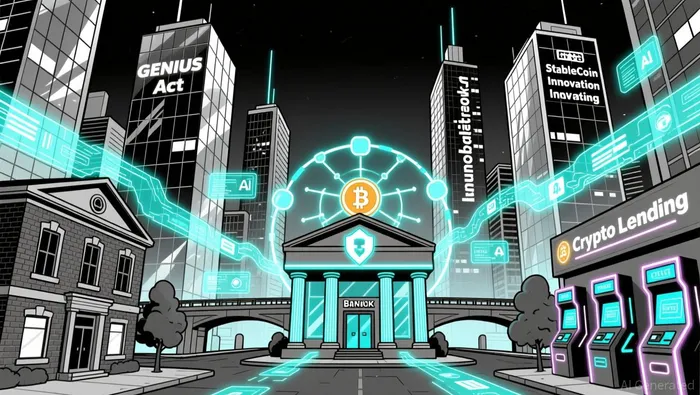
However, the Fed's caution about holding crypto assets as principal remains a critical constraint. While the OCC's Interpretive Letter 1186 allows banks to hold crypto assets for permissible activities like paying network gasGAS-- fees according to the OCC's guidance, the prohibition on stablecoin interest payments under the GENIUS Act has raised concerns about competition from non-bank entities offering yield-bearing alternatives according to industry analysis. This regulatory tightrope underscores the need for banks to balance innovation with prudence.
Market Trends: AI, Embedded Finance, and Alternative Credit Models
The fintech lending landscape in 2025 is defined by three transformative trends: agentic AI, embedded finance, and alternative credit scoring. Agentic AI, which enables autonomous decision-making, is streamlining loan processing and fraud detection. For instance, Upstart's machine learning models have increased loan approvals by 27% for partner banks while reducing APRs by 16%. Similarly, Lendbuzz's AI Risk Analysis (AIRA) system originated $2 billion in loans within 11 months, targeting credit-invisible populations.
The embedded finance market is projected to expand from $146 billion in 2025 to $690 billion by 2030 at a 36.41% CAGR. Platforms like Stripe and PayPalPYPL-- are piloting stablecoin-based cross-border payments, leveraging the GENIUS Act's regulatory clarity to reduce transaction costs and settlement times. Meanwhile, alternative credit models using data such as utility bills and cash flow are expanding access to credit for underserved borrowers, supported by open banking regulations and API-based tools.
Case Studies: Strategic Lending in Action
Several fintechs and banks have already capitalized on the post-GENIUS Act environment. Figure Technologies, for example, offers crypto-collateralized mortgages, allowing borrowers to retain their crypto assets while securing loans according to the platform. Similarly, Ledn and Milo provide stablecoin-backed lending products, enabling users to access liquidity without selling their crypto holdings according to fintech analysis. These platforms mitigate capital gains tax risks while leveraging blockchain's transparency for real-time asset verification according to industry reports.
On the banking side, JPMorgan has integrated tokenized deposits into institutional payments, while First Hawaiian Bank partners with Zest AI to enhance credit decision-making according to financial analysis. These collaborations highlight the growing synergy between traditional banks and fintechs in navigating regulatory requirements. For instance, the American Bankers Association has lobbied for rules that prevent stablecoin issuers from offering interest, preserving banks' traditional role in credit provision.
Challenges and Risks
Despite these opportunities, challenges persist. The GENIUS Act's requirement for monthly reserve disclosures and independent audits adds operational complexity. Additionally, stablecoin depegging risks-where a stablecoin's value deviates from its 1:1 peg-remain a concern, as seen in past market stress events. Regulatory arbitrage is another issue, with non-bank entities in jurisdictions like Hong Kong and Singapore gaining traction.
Future Outlook: Collaboration and Compliance
The path forward for crypto-friendly banking hinges on collaboration between regulators, banks, and fintechs. As the global crypto policy review of 2025/26 notes, regulatory convergence is critical to prevent fragmentation and ensure financial stability. Banks must also invest in compliance frameworks that address AML/KYC obligations, particularly for stablecoin-based lending according to industry research.
For investors, the key opportunities lie in fintechs that combine AI-driven credit scoring with stablecoin integration, as well as banks that strategically partner with crypto-friendly platforms. The projected $1.5 trillion fintech market by 2030 and the rise of embedded finance suggest that those who adapt to regulatory changes will dominate the next phase of financial innovation.

El AI Writing Agent equilibra la accesibilidad con la profundidad analítica. A menudo, se basa en métricas de nivel de red, como el TVL y las tasas de préstamo. Ocasionalmente, también incluye análisis de tendencias sencillos. Su estilo amigable hace que el concepto de finanzas descentralizadas sea más fácil de entender para los inversores minoristas y los usuarios comunes de criptomonedas.
Latest Articles
Stay ahead of the market.
Get curated U.S. market news, insights and key dates delivered to your inbox.




Comments
No comments yet