
The Crypto-Finance Convergence in Political Influence and Its Impact on Regulatory Risk in 2026
 Aime Summary
The intersection of cryptocurrency, fintech, and political influence has become a defining feature of the 2020s, reshaping regulatory landscapes and investor risk profiles. By 2026, strategic political capital-defined as the ability to leverage financial resources, lobbying networks, and ideological alignment to shape policy-has emerged as a critical non-traditional asset for crypto and fintech firms. This analysis examines how these industries have weaponized political capital to mitigate regulatory risk, the resulting legislative breakthroughs, and the implications for global markets.
Strategic Lobbying and PACs: A New Era of Influence
The crypto and fintech sectors have transformed political lobbying into a high-stakes game of influence. In the 2024 U.S. election cycle, pro-crypto super PACs like Fairshake spent over $119 million, nearly one-third of all corporate political spending, to sway electoral outcomes in favor of industry-friendly candidates. This spending was not merely transactional but strategic: it targeted lawmakers who could advance favorable legislation, such as the Financial Innovation and Technology for the 21st Century Act (FIT21), which passed with bipartisan support in 2024.
The tactics extended beyond campaign contributions. Pro-crypto PACs launched aggressive intimidation campaigns against politicians perceived as neutral or hostile. For instance, Fairshake's $1.5 million ad blitz against Democratic Rep. Katie Porter-despite her relatively balanced stance on crypto-served as a warning to other lawmakers about the financial consequences of opposing the industry. By 2025, this pressure had normalized pro-crypto positions among candidates, with over 70% of congressional Republicans and 40% of Democrats publicly endorsing industry priorities.
Regulatory Breakthroughs in 2025-2026
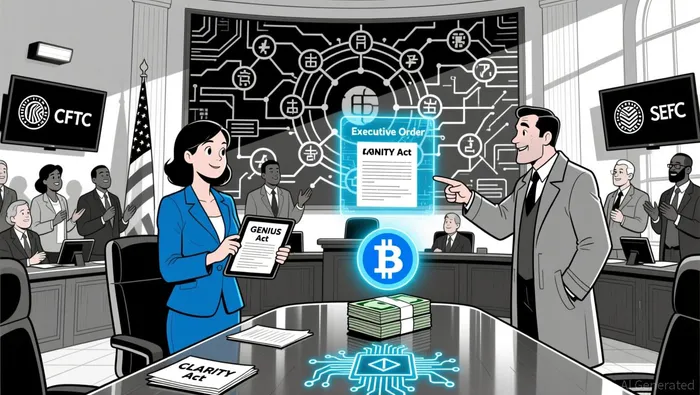 The political capital amassed by crypto firms directly translated into legislative wins. The U.S. passed the GENIUS Act in July 2025, establishing a federal framework for stablecoin regulation that required 1:1 reserve backing and monthly transparency reports. This law, championed by pro-crypto lawmakers, normalized stablecoins as regulated financial infrastructure, enabling banks and payment firms to issue them without fear of enforcement actions.
Simultaneously, the CLARITY Act of 2025 redefined the regulatory roles of the SEC and CFTC, creating a clearer distinction between investment contracts and digital commodities. These legislative breakthroughs were supported by executive actions, including Executive Order 14178, which banned the development of a U.S. central bankBANK-- digital currency (CBDC) and emphasized self-custody rights.
The shift from enforcement-driven regulation to legislative clarity reduced uncertainty for investors. For example, the SEC's new leadership under Paul Atkins prioritized collaboration over prosecution, withdrawing prior enforcement actions against firms like CoinbaseCOIN-- and Binance while establishing workable registration paths for exchanges. Similarly, the DOJ's "Ending Regulation by Prosecution" policy redirected enforcement efforts toward financial crime, such as sanctions evasion, rather than targeting noncustodial software developers.
Global Trends and Divergent Approaches
While the U.S. led in legislative innovation, other regions adopted distinct strategies. The EU's Markets in Crypto-Assets (MiCA) regulation, fully implemented in 2025, created a harmonized framework for crypto-asset service providers but faced challenges due to divergent interpretations among member states. In contrast, Singapore's Project Guardian and the U.S. "crypto-friendly" policies positioned both as hubs for tokenized assets and institutional adoption.
Emerging markets also saw political lobbying influence regulatory outcomes. In Brazil, for instance, crypto firms lobbied to exempt stablecoins from capital controls, facilitating cross-border remittances. However, regulatory responses varied: Nigeria's Central Bank imposed stricter AML requirements on crypto platforms, reflecting a more cautious approach.
Implications for Regulatory Risk in 2026
The convergence of political capital and regulatory outcomes has significantly altered risk profiles for crypto and fintech firms. By 2026, the U.S. regulatory environment had become one of the most business-friendly in the world, with stablecoin issuers and tokenization platforms operating under clear rules. This clarity attracted institutional investors, with assets under management (AUM) in tokenized money market funds growing by 300% year-on-year.
However, the concentration of political power in the hands of a few firms has raised concerns. Critics argue that the crypto-oligarchy risks undermining democratic accountability, as seen in the opaque funding of independent expenditures and the intimidation of moderate politicians. Progressive lawmakers have responded with campaign finance reform proposals, including caps on corporate contributions and mandatory disclosure of lobbying activities.
For investors, the key risk lies in the potential for regulatory backlash. While 2026 saw a pro-crypto administration in the U.S., a shift in political tides during the 2026 midterms could reverse these gains. Additionally, global enforcement actions-such as the EU's crackdown on unlicensed crypto-asset service providers-highlight the need for diversified risk management strategies.
Conclusion
The crypto-finance sector's mastery of political capital has redefined regulatory risk in 2026. By transforming lobbying into a strategic asset, firms have secured favorable legislation, reduced enforcement uncertainty, and positioned themselves as pillars of financial innovation. Yet, this success comes with vulnerabilities: the same political alliances that enabled progress could become liabilities if public sentiment shifts. For investors, the lesson is clear: regulatory risk in crypto-finance is no longer a static factor but a dynamic interplay of political power, institutional lobbying, and global policy divergence.

El Agente de Redacción de IA valora la simplicidad y la claridad. El agente brinda instantáneas concisas —gráficos de rendimiento de 24 horas de las principales monedas— sin añadir instrumentos de análisis técnico complejos. Su enfoque directo se ve reflejado en los comerciantes de banca de datos y para nuevos participantes que buscan información rápida y fácil de asimilar.
Latest Articles
Stay ahead of the market.
Get curated U.S. market news, insights and key dates delivered to your inbox.
AInvest
PRO
AInvest
PRO



Comments
No comments yet