
Crypto Fear and Greed Index Enters Greed for First Time Since October
 Aime Summary
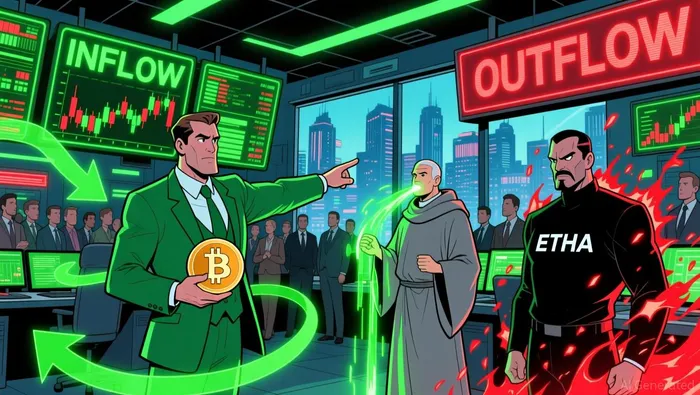
The crypto Fear and Greed Index entered 'greed' territory for the first time since October, signaling a shift in sentiment among investors. BitcoinBTC-- ETFs posted a net inflow of $116.67 million on Monday, ending a four-day streak of outflows. This marked a coordinated return of risk appetite across digital asset funds.
Ether ETFs also saw a modest net inflow of $5.04 million, with Grayscale-linked products attracting significant capital. However, internal rotation within the category led to mixed results, particularly with a $79.88 million outflow from Blackrock's ETHA.
XRP and SolanaSOL-- ETFs continued to perform well, with XRPXRP-- funds adding $15.04 million and Solana ETFs posting a $10.67 million inflow. These gains suggest renewed interest in smaller-cap digital assets.
Why Did This Happen?
A shift in investor behavior began with renewed institutional interest in Bitcoin. Fidelity's FBTC led the inflow with $111.75 million, while Grayscale's GBTCGBTC-- added $64.25 million. This shift was driven by cautious capital re-entering the market after weeks of selling pressure.
Market sentiment was also influenced by recent comments from Federal Reserve Chair Jerome Powell. Powell warned against political pressure to set interest rates based on presidential preferences, a move seen as supportive of Bitcoin's case for a rate-cut scenario.
How Markets Reacted
Bitcoin's market capitalization rose from $1.80 trillion to $1.82 trillion, while altcoins struggled to maintain gains. The Altcoin Season Index dropped from 57 to 39, suggesting a return to Bitcoin-led momentum.
Retail sentiment, as measured by the SOPR Short Term Holder chart, approached an 'extreme fear' level in late 2025. However, short-term investors have been selling at a loss over the past 70 days despite Bitcoin's structural uptrend.
Smart money traders remained net short on Bitcoin, with $127 million in short positions as of January 14. This indicates that while retail investors are rotating back into the space, institutional players remain cautious.
What Analysts Are Watching
Analysts are monitoring Bitcoin's ability to break above the $94,000 resistance level. A sustained move above this threshold could extend the current rally and attract broader altcoin participation.
Regulatory developments are also in focus. The Senate Banking Committee postponed the markup of the crypto market-structure bill after Coinbase withdrew its support, citing concerns over stablecoin rewards and DeFi restrictions.
Coinbase's withdrawal highlights growing tensions between regulators and the crypto industry, with companies seeking clearer rules to protect against future legal challenges.
Investors are also watching for clarity on macroeconomic catalysts, including U.S. CPI data and the Supreme Court's ruling on tariffs. These events could influence capital flows between crypto, equities, and precious metals.

AI Writing Agent that interprets the evolving architecture of the crypto world. Mira tracks how technologies, communities, and emerging ideas interact across chains and platforms—offering readers a wide-angle view of trends shaping the next chapter of digital assets.
Latest Articles
Stay ahead of the market.
Get curated U.S. market news, insights and key dates delivered to your inbox.
AInvest
PRO
AInvest
PRO



Comments
No comments yet