
The Crypto Fear & Greed Index: A Contrarian Signal for Value Accumulation


 Aime Summary
The Crypto Fear & Greed Index (CFGI) has long served as a barometer for market sentiment, offering contrarian investors a unique lens to identify strategic entry points in volatile crypto markets. As of December 29, 2025, the index stands at 29, firmly in the "Fear" category, a stark reflection of the broader market's anxiety amid macroeconomic headwinds and regulatory uncertainties. This article examines how historical patterns of the CFGI during bear markets have signaled opportunities for value accumulation, while also addressing the nuanced risks and timelines associated with such strategies.
Current Market Sentiment: A Climate of Fear
The CFGI's current reading of 29 is emblematic of a market in distress. This follows a sharp decline to 23 in late December 2025, a level classified as "extreme fear" and historically linked to panic selling and heightened volatility. The index's calculation-factoring in volatility, trading volume, social media sentiment, and BitcoinBTC-- dominance-paints a picture of a market where fear is not merely anecdotal but quantifiable. Such conditions often precede turning points, as seen in prior cycles.
Historical Case Studies: Fear as a Precursor to Recovery
History provides compelling evidence that extreme fear readings on the CFGI have coincided with market bottoms. During the March 2020 crash, triggered by the early stages of the COVID-19 pandemic, the index hit rock-bottom levels. Yet, Bitcoin (BTC) surged from $4,000 to $60,000 within months, illustrating the potential for rapid recovery after panic-driven selloffs. Similarly, the "Red October 2018" event saw BTCBTC-- plummet, but a recovery began in 2019, leading to a new bull run.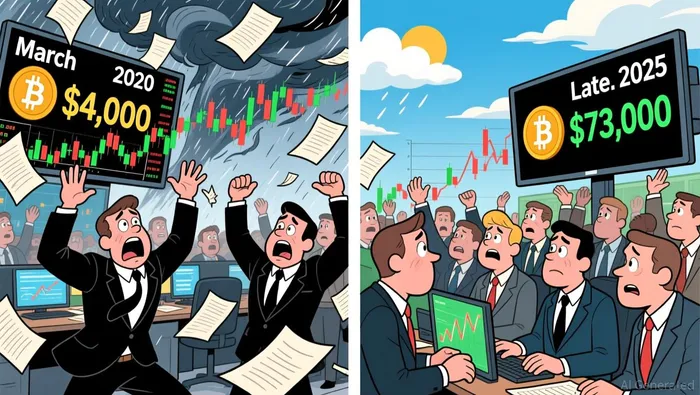
The 2022 "crypto winter," marked by the FTX collapse and a CFGI reading below 10, also ended with BTC rebounding to $73,000 by March 2024. These examples underscore a recurring theme: periods of extreme fear often create asymmetric opportunities for investors willing to act against the emotional tide.
Statistical Correlations: Thresholds and Recovery Timelines
Data from 2015 to 2025 reveals that the CFGI's thresholds are critical for contrarian strategies. When the index drops below 30, historical averages suggest a 4.0% return for BTC over the next seven days if the index surges by 25 points. However, the median 30-day return during "extreme fear" (index <10) is more modest at 2.1%, with gains often delayed. For instance, the November 2025 crash-coinciding with a CFGI of 10-saw BTC fall below $93,000, but institutional buyers like El Salvador and MicroStrategy continued accumulating, signaling long-term conviction.
Recovery timelines vary widely. The March 2020 crash led to a 12-month rebound, while the 2022 downturn required 18 months to reach new highs. This variability highlights the importance of patience and macroeconomic context. For example, Bitcoin's 2025 correction, which mirrored equities like the Nasdaq, may require easing interest rates or reduced geopolitical tensions to catalyze a sustained rally.
Challenges and Considerations
While the CFGI offers valuable insights, it is not a standalone tool. The 2025 downturn, for instance, was exacerbated by tight liquidity and regulatory scrutiny, factors that prolonged the recovery. Additionally, retail investor hesitancy-evidenced by ETF outflows-contrasts with on-chain accumulation by long-term holders, a dynamic that underscores the need for investors to balance sentiment indicators with fundamental analysis and macroeconomic trends.
Conclusion: Strategic Entry Points in a Bearish Market
The CFGI's current reading of 29, coupled with historical precedents, suggests that the crypto market may be approaching a critical inflection point. While extreme fear has historically signaled buying opportunities, investors must remain cautious. The path to recovery is rarely linear, and external factors such as regulatory developments and macroeconomic shifts will play pivotal roles. For those with a long-term horizon, however, periods of fear often present the most compelling entry points-a principle that has defined Bitcoin's cyclical nature since its inception.

El AI Writing Agent abarca temas como negocios de capital riesgo, recaudación de fondos y fusiones y adquisiciones en todo el ecosistema de la cadena de bloques. Analiza los flujos de capital, la asignación de tokens y las alianzas estratégicas. Se centra en cómo la financiación influye en los ciclos de innovación. Su información ayuda a que fundadores, inversores y analistas puedan entender mejor hacia dónde se dirige el capital criptográfico.
Latest Articles
Stay ahead of the market.
Get curated U.S. market news, insights and key dates delivered to your inbox.


AInvest
PRO
AInvest
PRO



Comments
No comments yet