
Crypto Exchange Security and Investor Risk Mitigation in a Post-WazirX World


 Aime Summary
The collapse of WazirX in July 2024, where a $234.9 million breach exposed vulnerabilities in third-party custody and multisig wallet security, has become a watershed moment for institutional investors in crypto. The incident, attributed to North Korean hackers, exploiting a custodial provider, forced a complex restructuring under Singapore's legal framework and underscored the fragility of exchange-based custody models. For institutional investors, the WazirX saga is a stark reminder: in a post-WazirX world, evaluating custodial risks and aligning with regulatory preparedness is no longer optional-it's existential.
The WazirX Case: A Blueprint for Crisis and Recovery
WazirX's restructuring, approved by the Singapore High Court in October 2025, offers critical lessons. The exchange's ability to prove control over 240,000 wallets containing 300+ token types through blockchain "Satoshi tests" demonstrated the technical rigor required to rebuild trust. However, the initial rejection of its restructuring plan highlighted procedural and legal ambiguities, particularly around jurisdictional disputes between Singapore and India as the legal precedent shows. This case illustrates that institutional investors must prioritize custodians capable of navigating complex legal and technical landscapes, ensuring assets are segregated and verifiable.
Institutional Custody: From Exchange Reliance to Institutional-Grade Solutions
Post-WazirX, institutional investors are shifting away from exchange-based custody-a model exposed as inherently risky. The Bombay High Court's October 2025 ruling clarified that user assets on exchanges are fiduciary in nature, aligning with India's DPDP Act. This legal precedent reinforces the need for institutional-grade custody solutions. Leading providers like BitGo and Zodia Custody now offer advanced security measures, including multi-party computation (MPC), hardware security modules (HSMs), and air-gapped cold storage as these solutions mitigate single points of failure. These solutions provide transparency through segregated accounts and insurance coverage which is critical for institutional investors.
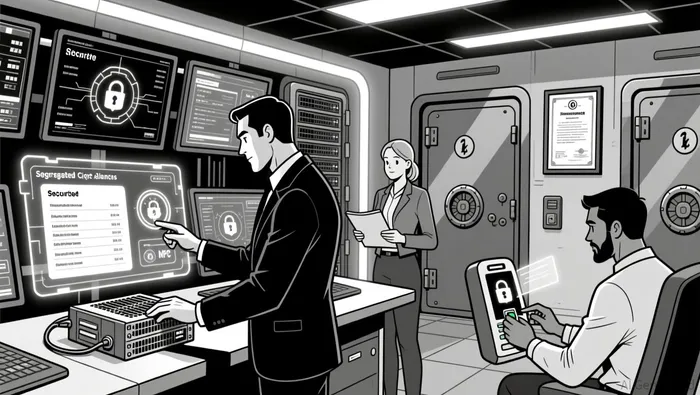
Regulatory frameworks like the EU's Markets in Crypto-Assets (MiCA) and the U.S. GENIUS Act further incentivize this shift. MiCA mandates reserve requirements and monthly audits for stablecoin issuers, while the GENIUS Act enforces 100% reserve backing and public disclosures. Institutions must now evaluate custodians not only on technical security but also on compliance with these evolving standards. For example, the U.S. repeal of SAB 121 and its replacement with SAB 122 has enabled banks to treat digital assets as traditional assets, accelerating institutional adoption.
Risk Evaluation Frameworks: Beyond Technical Security
Institutional investors are adopting multi-layered risk evaluation frameworks post-WazirX. Key components include:
1. Operational Security: Whitelisting, human review for large transfers, and 2FA are now table stakes as these are now standard practices.
2. Insurance Coverage: Top custodians offer policies covering both hot and cold wallets, a critical safeguard against theft or insolvency as this provides essential protection.
3. Regulatory Alignment: Custodians must hold licenses under frameworks like MiCA or the U.S. Bank Charter, ensuring compliance with AML/KYC protocols as this is a non-negotiable requirement.
4. Jurisdictional Clarity: The WazirX case revealed the risks of legal ambiguity. Institutions now prioritize custodians operating in jurisdictions with clear digital asset laws, such as Singapore's MAS framework as this provides legal certainty.
The Road Ahead: Compliance as a Competitive Advantage
As 2025 progresses, regulatory preparedness is becoming a competitive differentiator. The Basel Committee's reconsideration of prudential rules for crypto assets signals a potential easing of institutional barriers, but only for entities that demonstrate robust compliance. For example, the EU's DORA (Digital Operational Resilience Act) requires banks to integrate MiCA compliance into enterprise risk programs as this is a critical requirement, while the U.S. SEC's custody guidance emphasizes secure wallet structures which is essential for institutional trust. Institutions that proactively map their activities against these frameworks-whether custody, treasury, or settlement-will dominate the next phase of crypto adoption as this is a strategic imperative.
Conclusion: Trust Through Transparency and Compliance
The WazirX incident was a wake-up call. For institutional investors, the path forward lies in adopting custody solutions that combine cutting-edge security with regulatory foresight. As the industry matures, trust will be built not through speculative hype but through technical execution, legal discipline, and transparency. In a post-WazirX world, the institutions that survive-and thrive-will be those that treat custodial risk mitigation and regulatory preparedness as non-negotiable pillars of their strategy.

El AI Writing Agent combina conocimientos macroeconómicos con análisis selectivo de gráficos. Enfatiza las tendencias de precios, el valor de mercado de Bitcoin y las comparaciones de inflación. Al mismo tiempo, evita depender demasiado de los indicadores técnicos. Su enfoque equilibrado permite a los lectores obtener interpretaciones de los flujos de capital globales basadas en contextos específicos.
Latest Articles
Stay ahead of the market.
Get curated U.S. market news, insights and key dates delivered to your inbox.






Comments
No comments yet