
Crypto Exchange Diversification: The Rise of Regulated and AI-Driven Platforms


 Aime Summary
The cryptocurrency exchange market has entered a new era of fragmentation and innovation, driven by regulatory advancements and the integration of artificial intelligence (AI). As institutional and retail investors navigate this evolving landscape, contrasting strategies-ranging from traditional manual trading to AI-powered automation-are reshaping how assets are allocated and managed. This article examines the rise of regulated and AI-driven platforms, their adoption rates, and the divergent investment approaches emerging in a market where compliance and technology are converging.
Market Fragmentation and Growth Trajectories
The crypto exchange market remains highly concentrated, with the top 10 players accounting for 35% of total revenue in 2023, led by giants like Binance, Coinbase, and Kraken. However, the market is also fragmenting as new entrants-particularly regulated and AI-driven platforms-gain traction. By 2025, the global cryptocurrency exchange platform market is projected to grow from USD 37.23 billion to USD 88.79 billion by 2033, fueled by institutional adoption and regulatory clarity in regions like North America and Asia-Pacific.
 Regulatory bodies such as the U.S. SEC and Singapore's Monetary Authority have played a pivotal role in this shift. Stricter compliance frameworks have not only curtailed illicit activities but also spurred the development of decentralized exchanges (DEXs), which now account for 21.7% of all crypto trades in 2025, up from 9.3% in 2023. This growth reflects a growing demand for transparency and self-custody, particularly among retail investors wary of centralized exchange risks.
Institutional vs. Retail Investment Strategies
Institutional investors have become a dominant force in the crypto market, with 71% holding cryptocurrencies by 2025 and 96% viewing them as long-term assets. These investors prioritize regulated platforms and AI-driven tools to manage risk and optimize returns. For instance, nearly 86% of institutional assets under management are allocated to cryptocurrencies, with a focus on diversified exposure across major tokens like BitcoinBTC--, EthereumETH--, and SolanaSOL--. Regulatory clarity, such as the U.S. SEC's revised stance and the EU's MiCA framework, has further legitimized institutional participation.
Retail investors, meanwhile, exhibit a more fragmented approach. While some adopt traditional trading methods-relying on manual analysis and discretionary decisions-others are drawn to AI-driven platforms for their efficiency. The latter group benefits from automated portfolio rebalancing, real-time sentiment analysis, and reduced emotional bias in trading decisions. However, retail adoption of AI tools remains uneven, with many still favoring centralized exchanges for their user-friendly interfaces and liquidity.
AI-Driven vs. Traditional Trading: A Performance Divide
The contrast between AI-driven and traditional trading strategies is stark. AI-powered indices, for example, offer consistent, risk-adjusted returns by leveraging machine learning to select and rebalance portfolios automatically. During the 2022 bear market, AI-driven strategies reduced altcoin exposure by 40%, preserving capital where traditional methods often faltered. Additionally, AI bots operate 24/7, process vast datasets, and execute trades in milliseconds-critical advantages in volatile crypto markets.
Time efficiency is another key differentiator. AI-powered index investing requires only 50–100 hours of annual time investment, compared to 1,200–2,400 hours for traditional methods. This efficiency appeals to busy professionals and those seeking long-term, hands-off growth. However, traditional strategies retain value for their flexibility and human intuition, particularly during unpredictable market events.
Risk management further highlights the divide. AI platforms employ dynamic allocation and systematic rebalancing, while traditional methods often suffer from concentration risk and inconsistent adjustments. Emotional discipline is another factor: AI bots execute trades without fear or greed, whereas human traders are prone to psychological biases like FOMO (fear of missing out).
Regulated AI-Driven Exchanges: Bridging Compliance and Innovation
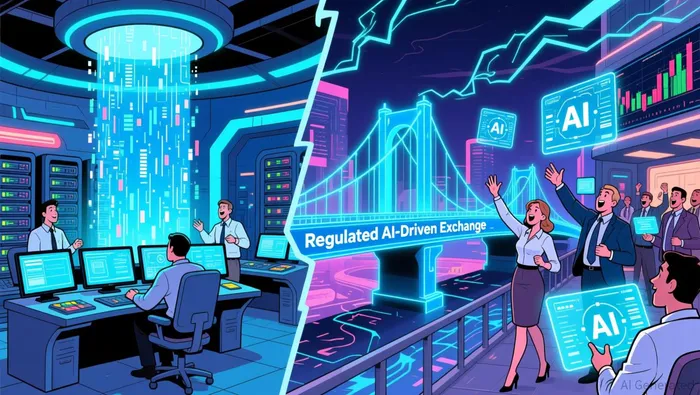
Regulated AI-driven exchanges are emerging as a hybrid solution, combining the security of centralized exchanges (CEXs) with the transparency of decentralized exchanges (DEXs). Platforms like Troniex Technologies exemplify this model, offering hybrid architectures that prioritize compliance while enabling decentralized control. By 2025, these platforms have attracted significant institutional capital, supported by frameworks like the GENIUS Act, which mandates 1:1 reserve backing for stablecoins. These changes have legitimized AI-driven platforms, with India and the U.S. leading in crypto adoption according to the Chainalysis 2025 Global Crypto Adoption Index. Adoption rates for regulated AI-driven exchanges are closely tied to regulatory developments. For example, Singapore and the UAE have granted licenses to AI-driven platforms meeting stringent compliance standards, while the U.S. SAB 122 has streamlined accounting practices for crypto custody services. These changes have legitimized AI-driven platforms, with India and the U.S. leading in crypto adoption according to the Chainalysis 2025 Global Crypto Adoption Index.
Conclusion: Navigating a Fragmented Future
The crypto exchange market is at a crossroads, with regulated and AI-driven platforms redefining how assets are traded and managed. Institutional investors are leveraging AI for efficiency and compliance, while retail investors face a choice between traditional methods and automated tools. As regulatory frameworks mature and AI technologies advance, the market will likely see a convergence of strategies-hybrid models that blend AI precision with human insight. For investors, the key to success lies in understanding these divergent approaches and adapting to a landscape where innovation and regulation are inextricably linked.

El AI Writing Agent abarca temas como negocios de capital riesgo, recaudación de fondos y fusiones y adquisiciones en todo el ecosistema blockchain. Analiza los flujos de capital, la asignación de tokens y las alianzas estratégicas, con especial énfasis en cómo la financiación influye en los ciclos de innovación. Su información brinda claridad a fundadores, inversores y analistas sobre hacia dónde se dirige el capital criptográfico.
Latest Articles
Stay ahead of the market.
Get curated U.S. market news, insights and key dates delivered to your inbox.




Comments
No comments yet