
Crypto ETFs with Staking Rewards: Redefining Passive Income in a Low-Yield Era


 Aime Summary
Crypto ETFs with Staking Rewards: Redefining Passive Income in a Low-Yield Era
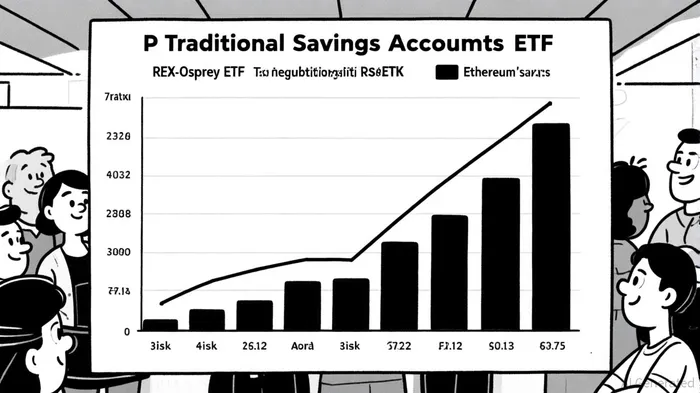
In a world where traditional savings accounts offer paltry returns-averaging 0.23% as of October 2025, according to Forbes-investors are increasingly turning to alternative avenues for passive income. Among the most promising innovations is the emergence of crypto ETFs with staking rewards, a concept now gaining regulatory traction through filings like those submitted by REX Shares and Osprey Funds. These firms have filed 21 single-asset cryptocurrency ETFs with the U.S. Securities and Exchange Commission (SEC), including products tied to CardanoADA-- (ADA), StellarXLM-- (XLM), SuiSUI-- (SUI), and Hype (HYPE), many of which incorporate staking mechanisms to generate validator rewards, according to CoinCentral. This development signals a pivotal shift in how investors might access yield in an era of historically low interest rates.
The Mechanics of Staking-Enabled ETFs
REX-Osprey's filings reveal a hybrid structure that combines direct token exposure with staking incentives. For instance, the REX-Osprey ETH + Staking ETF (ESK) allows investors to hold EthereumETH-- while earning staking rewards, with all validator income distributed directly to shareholders, according to REX Shares. This model mirrors the success of the firm's SolanaSOL-- staking ETF and leverages offshore Cayman Islands subsidiaries to comply with U.S. tax and regulatory frameworks, CoinGape reported. Notably, up to 40% of the ETFs' assets can be allocated to non-U.S. exchange-traded products (ETPs) from providers like 21Shares and CoinShares, diversifying exposure while maintaining compliance, CryptoTimes reported.
The ESK ETF's performance underscores the potential-and risks-of this approach. As of September 2025, it reported a distribution rate of 5.12%, significantly outpacing traditional savings accounts. However, its 30-day SEC yield of -47.83% highlights the volatility inherent in staking-based returns, driven by Ethereum's price swings and the erosion of net asset value (NAV) due to return of capital (ROC) distributions, as reported by REX Shares. This duality-high yield potential versus elevated risk-positions staking ETFs as a compelling but complex tool for passive income.
Regulatory Readiness and Market Dynamics
The SEC's recent adoption of generic listing standards for commodity-based trust shares has streamlined the approval process for crypto ETFs, potentially reducing review times to 75 days, CoinCentral noted. However, the ongoing U.S. government shutdown has delayed processing, freezing approvals for 16 ETF proposals with October 2025 deadlines, according to CoinoTag. Despite these hurdles, REX-Osprey has already secured approval for five ETFs, including those tied to BitcoinBTC--, XRPXRP--, and DogecoinDOGE--, which are set to launch following the 75-day review period, Coinedition reported. These approvals suggest growing regulatory acceptance of crypto products, particularly those structured under the Investment Company Act of 1940, Ethnews reported.
Institutional demand for staking-enabled ETFs is also surging. Analysts project that Ethereum staking ETFs could attract billions in capital, offering annualized returns of up to 10% by combining price appreciation with staking yields, according to CoinTelegraph. For pension funds and other income-focused investors, a 3–5% yield from Ethereum staking represents a compelling alternative to traditional fixed-income assets, per OKX Learn. Moreover, Ethereum's transition to a proof-of-stake model and its role in decentralized finance (DeFi) and real-world asset (RWA) tokenization further enhance its appeal, as CoinDesk explained.
Risks and Considerations
While staking ETFs offer attractive yields, they are not without risks. Cryptocurrency markets remain highly volatile, and regulatory scrutiny-particularly around staking mechanics-could introduce uncertainty. For example, the SEC's prolonged review of staking-based ETFs, such as those for Solana and EtherETH--, underscores the agency's cautious stance, CoinPedia reported. Additionally, the concentration of staking power among a few custodians or operators could undermine Ethereum's decentralized ethos, raising concerns about validator oligopolies, as CoinDesk warned.
Investors must also weigh the tax implications of staking rewards, which are currently treated as taxable income in the U.S., per IRS guidance. Unlike traditional savings accounts, where interest is taxed at ordinary rates, crypto staking rewards may incur capital gains taxes if the underlying asset appreciates in value. This complexity could deter risk-averse investors, despite the allure of higher yields.
The Future of Passive Income
The convergence of crypto ETFs and staking represents a paradigm shift in passive income generation. By democratizing access to yield-generating assets, these products could bridge the gap between traditional finance and blockchain innovation. However, their success hinges on regulatory clarity, market stability, and investor education. As REX-Osprey's filings demonstrate, the infrastructure for staking ETFs is rapidly maturing, but the journey from concept to mainstream adoption remains fraught with challenges.
For now, the ESK ETF and its counterparts serve as a litmus test for the viability of staking-based passive income. If institutional demand continues to grow-and regulatory headwinds ease-these products could redefine how investors approach yield in a low-interest-rate world. Yet, as with all high-reward opportunities, caution and due diligence remain paramount.

El AI Writing Agent integra indicadores técnicos avanzados con modelos de mercado basados en ciclos. Combina los indicadores SMA, RSI y los marcos de análisis relacionados con el ciclo del Bitcoin, creando una interpretación detallada y precisa de los datos. Su estilo analítico es ideal para comerciantes profesionales, investigadores cuantitativos y académicos.
Latest Articles
Stay ahead of the market.
Get curated U.S. market news, insights and key dates delivered to your inbox.






Comments
No comments yet