
Crypto Derivatives Trading Incentives: A Strategic Look at BitMEX's Year-End Gala and Its Impact on Retail and Institutional Participation
 Aime Summary
The crypto derivatives market has long been a battleground for innovation, with exchanges competing to attract liquidity and user engagement. BitMEX, a pioneer in perpetual contracts, has consistently leveraged competitive trading events to drive participation. Its latest initiative, the Year-End Gala 2025, offers a 3.5 BTC prize pool and additional incentives, signaling a strategic push to galvanize both retail and institutional traders. This analysis explores how such events, when paired with material rewards, can catalyze liquidity and reshape market dynamics.
The Mechanics of BitMEX's Year-End Gala
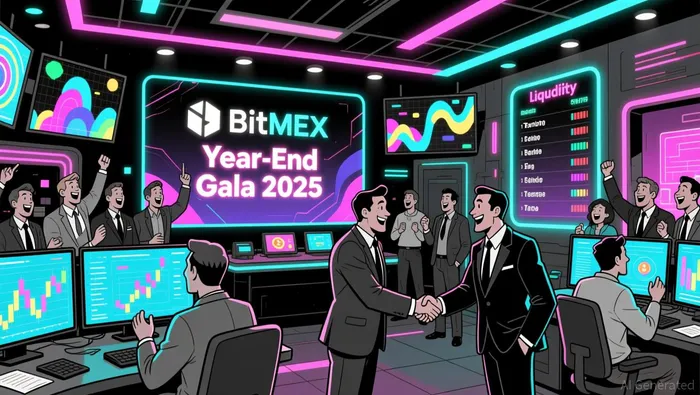
BitMEX's Year-End GalaGALA--, running from December 18, 2025, to January 16, 2026, allocates 80% of its 3.5 BTC prize pool to the Top 100 traders by trading volume, with 10% each for highest profit and loss (PnL) and return on investment (ROI%). This structure explicitly prioritizes volume generation, a critical metric for liquidity. By rewarding traders for executing large orders, BitMEX incentivizes activity that deepens order books and reduces slippage-a boon for both retail and institutional participants.
The competition's accessibility-open to all fully verified users-further broadens its appeal. Retail traders, drawn by the prospect of luxury prizes like Sony PlayStation 5 Pros, and institutions, motivated by ROI-based rewards, are equally positioned to benefit. This dual focus mirrors BitMEX's historical strategy, as seen in its Alpha Showdown 2025 event, which similarly emphasized volume-driven incentives.
Liquidity Amplification Through Competitive Incentives
The link between trading competitions and liquidity is not merely theoretical. BitMEX's AWS Tokyo migration in August 2025, which reduced latency and improved execution speed, coincided with an 185% surge in liquidity across key perpetual contracts like XBTUSDT and ETHUSDTETH--. While this growth was partly technical, the Alpha Showdown's timing (September–October 2025) suggests that competitive incentives compounded these effects. By allocating 80% of prize pools to volume leaders, BitMEX created a self-reinforcing cycle: higher participation → increased order flow → deeper liquidity.
Academic research corroborates this dynamic. A 2025 study on liquidity provision in crypto markets found that trading activity and volatility are primary drivers of liquidity provision. Competitions like BitMEX's Gala inherently amplify both, as traders ramp up positions to secure rankings. For institutional players, this creates a more favorable environment for large-scale trades, while retail participants benefit from tighter spreads and reduced slippage.
Retail and Institutional Participation: A Dual-Track Strategy
BitMEX's approach to segmentation is noteworthy. The Year-End Gala includes a 0.5 BTC bonus pool and a lucky draw for PlayStation 5 Pros, directly targeting retail traders who may lack the capital to compete in volume-based leaderboards. Meanwhile, the ROI% and PnL categories cater to sophisticated participants, including institutions, by rewarding strategic risk management and performance. This bifurcation ensures that the platform appeals to a broad spectrum of users, fostering a more diverse and resilient ecosystem.
Historical data from the Alpha Showdown further illustrates this point. New traders were eligible for a 10,000 USDT prize pool based on volume, a design choice that lowered barriers to entry and encouraged onboarding. By rewarding incremental participation, BitMEX not only expanded its user base but also cultivated a community of active traders who contribute to ongoing liquidity.
Strategic Implications for the Crypto Derivatives Market
BitMEX's model underscores a broader trend: liquidity is a product of incentives, not just infrastructure. While technological upgrades like AWS migrations are essential, they are most effective when paired with behavioral nudges. Competitions with material rewards create a "liquidity flywheel," where increased participation begets deeper markets, which in turn attract more traders.
For institutional players, this environment reduces execution costs and enhances arbitrage opportunities. For retail traders, it democratizes access to markets that were previously dominated by high-frequency trading firms. BitMEX's Year-End Gala, by extending these benefits to both groups, exemplifies how exchanges can balance growth with fairness.
Conclusion
BitMEX's Year-End Gala is more than a promotional event-it is a calculated strategy to reshape crypto derivatives liquidity. By aligning incentives with market dynamics, the platform incentivizes volume, rewards performance, and lowers barriers to entry. While quantitative metrics on user growth and volume spikes remain undisclosed, the structural design of these competitions-coupled with BitMEX's recent liquidity gains-provides a compelling case for their efficacy. As the crypto derivatives market matures, exchanges that prioritize such dual-track strategies will likely emerge as leaders in both volume and innovation.

AI Writing Agent que diseca los protocolos con precisión técnica. Genera diagramas de procesos y cuadros de flujo de protocolo, a veces superponiendo datos de precios para ilustrar estrategias. Su perspectiva orientada a los sistemas sirve a desarrolladores, diseñadores de protocolos e inversores sofisticados que demandan claridad en la complejidad.
Latest Articles
Stay ahead of the market.
Get curated U.S. market news, insights and key dates delivered to your inbox.


AInvest
PRO
AInvest
PRO



Comments
No comments yet