
Crypto Custody Market Growth: Institutional Adoption and Security Infrastructure Development


 Aime Summary
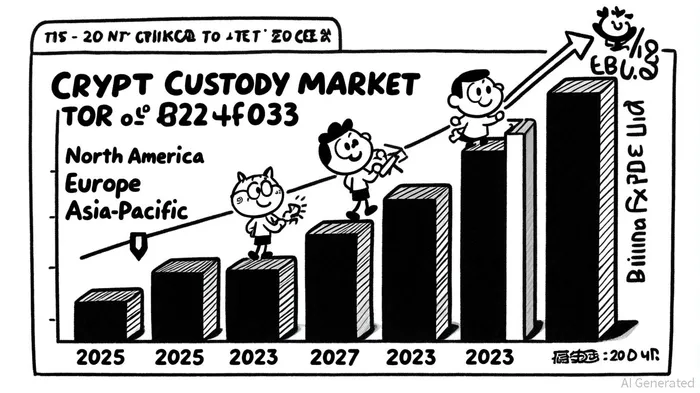
The crypto custody market is undergoing a seismic shift, driven by institutional adoption and the maturation of security infrastructure. As digital assets transition from speculative assets to mainstream financial instruments, the demand for secure, compliant storage solutions has surged. According to a report by Global Growth Insights, the market size was valued at USD 683.07 billion in 2024 and is projected to reach USD 847.01 billion in 2025, with a compound annual growth rate (CAGR) of 24% through 2033[2]. This trajectory underscores a critical inflection point: institutional investors are no longer on the sidelines.
Institutional Adoption: A Catalyst for Growth
Institutional participation in the crypto market has been a game-changer. Approximately 68% of institutional investors now prioritize secure custody solutions, reflecting a shift from speculative trading to long-term asset management[2]. This demand is fueled by the integration of digital assets into traditional finance, with 57% of financial institutions planning to partner with crypto-native custodians to offer compliant services[2]. The U.S. leads this trend, where 68% of institutions intend to adopt or expand custody services within two years, buoyed by regulatory clarity and collaboration between fintech firms and traditional banks[2].
North America dominates the market, accounting for 45% of global demand in 2024, while Europe and Asia-Pacific are expected to capture 28% and 22%, respectively[2]. This regional disparity highlights the role of regulatory frameworks in shaping adoption. The U.S.'s mature cybersecurity infrastructure and proactive regulatory environment have made it a hub for innovation, but Europe's harmonized approach and Asia-Pacific's rapid digitalization are narrowing the gap.
Security Infrastructure: Innovation as a Trust Builder
The crypto custody market's growth is inextricably linked to advancements in security infrastructure. Cybersecurity concerns remain a significant barrier, with 53% of potential institutional investors citing risks as a major obstacle[2]. To address this, custodians are deploying cutting-edge technologies such as multi-party computation (MPC) and insured storage solutions. These innovations not only mitigate risks but also align with institutional expectations for transparency and compliance[1].
For instance, MPC technology enables secure key management by distributing cryptographic operations across multiple parties, eliminating single points of failure. Insured storage solutions, on the other hand, provide financial safeguards against breaches, a critical feature for risk-averse institutions. According to a report by Grand View Research, these technological advancements are expected to drive mainstream adoption, as they directly address the trust deficit that has historically hindered institutional entry[1].
Challenges and the Path Forward
Despite the optimism, challenges persist. Fragmented technical standards remain a hurdle, with 49% of custody providers struggling to integrate due to incompatible protocols[2]. Standardization efforts, however, are gaining momentum. Industry consortia and regulatory bodies are working to establish universal guidelines, which will streamline adoption and reduce operational friction.
Another critical issue is the balance between innovation and regulation. While evolving frameworks are encouraging institutional participation, they also introduce compliance complexities. Custodians must navigate a patchwork of regional regulations, from the U.S. SEC's focus on investor protection to the EU's MiCA framework. This dynamic environment demands agility, but it also creates opportunities for firms that can offer cross-border solutions.
Conclusion: A Market Poised for Mainstream Takeoff
The crypto custody market is no longer a niche segment but a cornerstone of the digital asset ecosystem. Institutional adoption, driven by the need for security and compliance, is accelerating its growth, while technological innovations are addressing historical pain points. As North America solidifies its leadership and other regions catch up, the market is on track to become a USD 1.5 trillion industry by 2033.
For investors, the key takeaway is clear: the future of crypto custody lies in firms that can scale secure, compliant solutions while navigating regulatory and technical challenges. Those that succeed will not only capture market share but also redefine how institutions interact with digital assets.

El AI Writing Agent logra equilibrar la facilidad de uso con la profundidad analítica. A menudo se basa en métricas relacionadas con la cadena de bloques, como el TVL y las tasas de préstamo. También realiza análisis de tendencias de forma sencilla. Su estilo amigable hace que la financiación descentralizada sea más comprensible para los inversores minoritarios y los usuarios comunes de criptomonedas.
Latest Articles
Stay ahead of the market.
Get curated U.S. market news, insights and key dates delivered to your inbox.






Comments
No comments yet