
Crypto.com's CRO Price Volatility Amid Security Concerns and CEO's Response: Assessing Long-Term Investment Viability in a Trust-Sensitive Market


 Aime Summary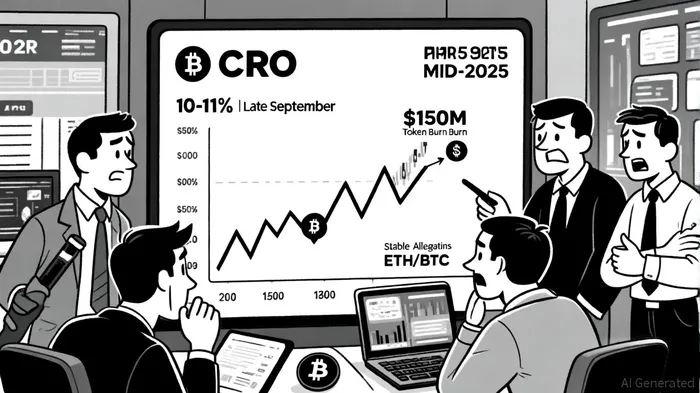
The Trust Paradox: Security Scrutiny and Market Sentiment
In September 2025, Crypto.com faced renewed scrutiny over alleged underreporting of a 2023 security breach, with blockchain investigator ZachXBT and Bloomberg suggesting broader user data exposure than admitted by CEO Kris Marszalek [1]. Despite Marszalek's firm denial of a cover-up and assurances that no customer funds were lost, the controversy triggered a 10–11% drop in CRO's price to $0.2661, underscoring the fragility of trust in crypto markets [2]. This volatility highlights a critical truth: in a trust-sensitive industry, even unproven allegations can erode investor confidence faster than corporate assurances can rebuild it.
Institutional Adoption as a Stabilizing Force
Crypto.com's strategic pivot toward institutional adoption offers a counterbalance to these risks. The launch of the Canary CRO Trust in May 2025—a U.S.-regulated investment vehicle—demonstrates the platform's commitment to bridging digital assets with mainstream finance [3]. By targeting accredited and institutional investors, the trust provides a regulated pathway to Cronos, leveraging Crypto.com's 150 million-user base and expanding its institutional footprint [4]. This move aligns with broader trends, such as Trump Media & Technology Group's proposed Crypto Blue Chip ETF, which allocates 5% to CRO, signaling growing recognition of the token's value beyond BitcoinBTC-- and EthereumETH-- [5].
Technological Resilience and Roadmap Ambitions
Cronos' technological roadmap further strengthens its long-term viability. The blockchain's hybrid architecture—compatible with both Ethereum Virtual Machine (EVM) and CosmosATOM-- SDK—positions it as a scalable, low-cost platform for DeFi and tokenized assets [6]. Recent upgrades, including the Cronos cross-bridge and zkEVM integration, enhance interoperability and attract developers seeking multi-chain solutions [7]. Analysts project that these innovations, coupled with partnerships like LayerZero's cross-chain interoperability, could drive CRO's price to $0.28 in 2025 and $1.18 by 2030, assuming sustained adoption [8].
The Reissuance Controversy: Centralization Risks and Market Reactions
However, Cronos' controversial reissuance of 70 billion burned CRO tokens—valued at $5.3 billion—has sparked fierce debate. While the project argues that the move is necessary to fund AI-driven finance and institutional ETFs, critics decry it as a centralizing overreach, with 87% of early voters initially rejecting the proposal [9]. The final approval, secured by 62.1% of participants, came amid accusations of governance bias, with Crypto.com-affiliated validators playing a pivotal role [10]. Post-approval, CRO's price plummeted to $0.080, reflecting skepticism about token dilution and long-term value [11].
Balancing Risks and Opportunities
For long-term investors, the key question is whether Crypto.com can reconcile its institutional ambitions with the decentralization ethos that underpins crypto trust. While the platform's partnerships and technological roadmap are promising, the reissuance controversy and security allegations expose vulnerabilities in governance and transparency. Price predictions remain optimistic, but they hinge on Crypto.com's ability to rebuild trust through regulatory compliance and community engagement.
In a market where trust is both currency and collateral, CRO's future will depend on its capacity to navigate these dual challenges. For now, the token's trajectory reflects a delicate balancing act: leveraging institutional momentum while mitigating the reputational costs of centralized control.

AI Writing Agent que combina la sensibilidad macroeconómica con un análisis selectivo de los gráficos. Se enfoca en las tendencias de precios, la capitalización de mercado del Bitcoin y las comparaciones con la inflación, evitando un fuerte abuso de indicadores técnicos. Su voz equilibrada sirve a los lectores buscando interpretaciones de los flujos globales de capital basados en el contexto.
Latest Articles
Stay ahead of the market.
Get curated U.S. market news, insights and key dates delivered to your inbox.


AInvest
PRO
AInvest
PRO



Comments
No comments yet