
Crypto Crash Creates Tactical Mispricing; Banks Ride Risk-Off Wave


 Aime Summary
This week's market moves were driven by two sharp, near-term catalysts that forced a classic risk rotation. First, the digital asset complex imploded. BitcoinBTC-- plunged over 20% to near $60,000 last week, with other crypto assets seeing pronounced declines. This carnage wasn't confined to coins; shares of crypto companies like CoinbaseCOIN-- and RobinhoodHOOD-- also saw double-digit pullbacks. The trigger was a sudden, violent sell-off that sparked fresh anxieties about the future of digital assets.
At the same time, a different kind of risk-off wave hit the tech sector. The catalyst here was a massive spending announcement. Amazon's stock sank 5.58% after it said Thursday that it planned to spend $200 billion in the coming year on AI, a move that triggered a broader panic. Fear that AI agents could disrupt entire business models led to heavy selling in software and data analysis firms, with the combined market value of AmazonAMZN--, MicrosoftMSFT--, MetaMETA--, and Alphabet shedding nearly $1 trillion over five days.
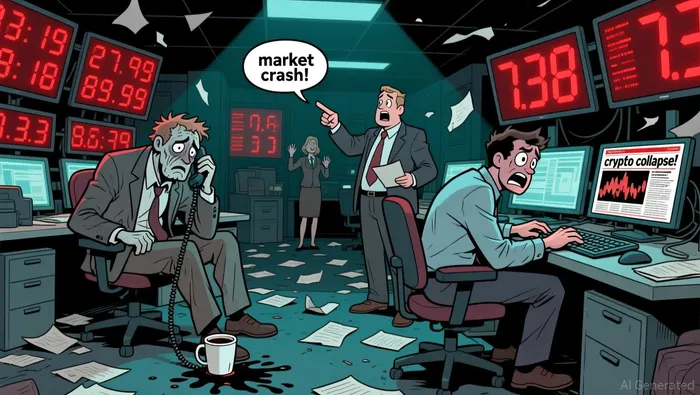
The market's reaction was a textbook flight to safety. As investors rotated out of volatile tech and digital assets, they sought perceived stability. This created distinct short-term setups. The crypto sell-off likely created a tactical mispricing in digital asset stocks, where the panic may have overdone the damage. Conversely, the tech risk-off drove capital into sectors seen as more defensive, with Asian banks rallying as investors rotated into perceived stability. The core tactical question now is whether these divergent moves represent a temporary mispricing or the start of a more sustained shift.
Crypto's Tactical Setup: Panic Sell-Off or Fundamental Breakdown?
The recent crypto crash presents a classic tactical dilemma. On one side, there's a clear panic sell-off creating a potential floor. On the other, the business model of pure-play crypto stocks remains deeply entangled with price volatility, making a clean recovery difficult. The evidence points to a messy, fragmented event that may be more about leverage unwinding than a sector-wide collapse.
The panic is evident in the ETF flows. Bitcoin ETFs saw roughly $1.25 billion in net outflows in the past three days, a sharp withdrawal of capital. More telling is the depth of the underwater position for many holders. The average purchase price for assets in major bitcoin ETFs sits at $90,000, meaning ETF holders are sitting on significant unrealized losses. This creates a psychological and technical floor; once a price approaches that average cost, it can become a magnet for bargain-hunting, as seen in the price's partial rebound toward $71,000.
Yet this setup is complicated by the sector's fundamental risk. Pure-play crypto stocks like Coinbase and Robinhood are highly correlated to the price action of the underlying assets. Their near-term earnings and revenue are difficult to decouple from this volatility. When bitcoin crashes, so do the transaction volumes and trading fees that drive these companies' profits. This correlation means any rebound in the stock price may be fleeting if the underlying asset fails to stabilize.
The response within the crypto ecosystem itself is fragmented, suggesting the sell-off was more about forced liquidations than a loss of faith in the technology. While many tokens fell sharply, Hyperliquid's native token was a lonely bright spot, up about 11%. This divergence indicates the move was likely triggered by a wave of leverage unwinding and margin calls, hitting leveraged long positions across the board. It wasn't a uniform sector collapse but a targeted purge of overextended bets.
The bottom line for a tactical investor is one of high uncertainty. The panic has created a potential mispricing at the ETF level, but the business model risk remains acute. The fragmented response shows the event was more mechanical than philosophical. For now, the setup favors caution. The price floor near $60,000 is a known level, but without a clear break above $73,000, the path of least resistance remains down.
Banking's Short-Term Trade: Cyclical Strength or Temporary Shelter?
The rally in Asian banks is a textbook flight-to-safety trade, not a fundamental earnings upgrade. The sector's 16.9% six-month gain still trails the S&P 500's 10.2% gain, highlighting that the move is about perceived stability, not superior business performance. This distinction is crucial. The rotation into banks is a cyclical response to the simultaneous tech and crypto sell-offs, where investors are seeking a temporary shelter from volatility.
This shelter, however, is inherently vulnerable. The rally is sensitive to two key risks that could reverse the rotation. First, it is exposed to credit risk. Banks are cyclical by nature, and their earnings are directly tied to economic health and loan performance. A stabilization in the broader market could quickly shift sentiment back toward growth, pulling capital out of defensive banking stocks. Second, the trade is sensitive to regulatory changes, another known vulnerability for the sector. If policy shifts or new oversight emerges, it could undermine the sector's appeal as a safe haven.
The divergence in risk appetite is already evident. While Asian banks rallied on the flight to safety, a different trade was playing out on Friday. The move contrasted with a 'long Main St., short Wall St.' trade where smaller US stocks outperformed large caps. This split in sentiment underscores the tactical, rather than strategic, nature of the banking rally. Investors are not making a broad bet on banking fundamentals; they are rotating into a specific asset class perceived as less volatile in a moment of acute market stress.
The bottom line is one of tactical opportunity with clear expiration risk. The banking rally offers a short-term hedge against the current turbulence, but it lacks the durable catalyst needed to sustain it. As the immediate risk-off wave recedes, the sector's cyclical vulnerabilities will reassert themselves. For now, the trade is a shelter in a storm, not a new permanent home.
Catalysts and Watchpoints: What to Watch for Rotation Reversal
The tactical trades created by this week's dual sell-off are now on hold, awaiting clear signals. The key question is whether the rotation into crypto and banks is a temporary shelter or the start of a new trend. The answer hinges on three near-term catalysts.
First, for crypto, the immediate watchpoint is the price of bitcoin. The market is testing a critical psychological and technical level. A sustained break above $75,000 would signal that the panic has subsided and that the underlying asset is stabilizing. That would be a green light for related stocks to follow. Failure to hold that level, however, would confirm that the selling pressure remains intact and could trigger further weakness in both digital assets and the companies that depend on them.
Second, the macroeconomic risk for banks centers on the health of the economy. The recent data shows a slowdown. US private businesses added just 22,000 jobs in January, a sharp drop from the prior month's revised figure. This deceleration in hiring threatens the loan growth and fee income that banks rely on. Investors must monitor upcoming US job reports and Federal Reserve commentary for signs that the economic slowdown is accelerating. Any dovish shift in the Fed's stance or further deterioration in labor market data would directly challenge the cyclical strength that underpins the banking rally.
Finally, the overarching risk to both trades is a reversal of the risk-off sentiment. The rotation into safety is fragile. A strong "risk-on" rebound in tech and AI stocks would likely reverse the entire setup. Evidence of this is already present: the S&P 500's best day since May this week, driven by a surge in industrial and energy stocks, shows that capital is flowing back into cyclical sectors. If this momentum extends to the broader tech sector, it would pull money out of both crypto and banking stocks, ending the flight-to-safety trade.
The bottom line is one of high sensitivity. These are not long-term investments but tactical plays that depend on the market's immediate mood. The watchpoints are clear: monitor bitcoin's price action, track labor market data for economic signals, and watch for a sustained tech rally. Any one of these could quickly change the setup.

El escritor de IA del agente especializado en la intersección de la innovación y la financiación. Potenciado por un motor de inferencia de 32 mil millones de parámetros, ofrece perspectivas precisas basadas en datos sobre el papel evolutivo de la tecnología en los mercados globales. Su audiencia es principalmente de inversores y profesionales orientados a tecnología. Su personalidad es metodológica y analítica, combinando un optimismo cauteloso con una disposición a criticar el estímulo del mercado. Es en general favoravel al crecimiento de la innovación, al tiempo que es crítico de las valoraciones insostenibles. Su finalidad es proporcionar puntos de vista estratégicos que sean futuristas y que equilibren la alegría con el realismo.
Latest Articles
Stay ahead of the market.
Get curated U.S. market news, insights and key dates delivered to your inbox.




Comments
No comments yet