
Crypto's Black Friday: Inside The $19B Market Meltdown


 Aime Summary
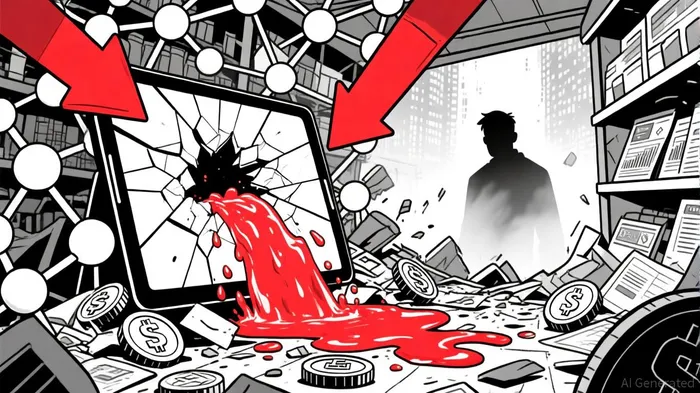
In October 2025, the DeFi ecosystem faced its most catastrophic collapse to date: a $19 billion liquidation event that exposed systemic vulnerabilities in a market long celebrated for its innovation. This "Black Friday" for crypto was not a natural disaster but a collision of macroeconomic shocks, overleveraged positions, and exploitable infrastructure. The crash revealed how DeFi's interconnectedness-once seen as a strength-had become a liability, amplifying risks across protocols, stablecoins, and centralized finance (CeFi) platforms.
The Perfect Storm: Macroeconomic Shocks and Overleveraged Positions
The catalyst was a political threat of 100% additional tariffs on Chinese imports, which triggered a sell-off in global markets and a flight to liquidity, according to a strategic analysis. However, the true scale of the disaster was magnified by the sheer amount of leverage embedded in the system. Nearly $16.75 billion in liquidations were attributed to long positions, as the analysis found.
This leverage was not confined to DeFi. Cross-venue dependencies meant that centralized desks, which borrowed liquidity from DeFi platforms, faced margin calls that forced further selling on exchanges, as a CryptoSlate analysis noted. For example, PendlePENDLE-- tokens became a flashpoint when Aave's high loan-to-value ratios triggered cascading liquidations that rippled back to CeFi desks with overlapping exposures, deepening the self-reinforcing cycle: falling prices triggered liquidations, which deepened price declines.
Oracle Failures and Coordinated Manipulation: The Infrastructure Weakness
While macroeconomic factors set the stage, the crash was executed through a sophisticated oracle manipulation attack. A single actor exploited a vulnerability in the price feed system by artificially inflating the prices of USDe, wBETHWBETH--, and BNSOL on a single exchange during a scheduled update window, according to a CCN investigation. This manipulation created false price signals, triggering $19.3 billion in liquidations despite a relatively modest $60 million market dump, the CCN investigation estimated.
Oracle failures were not new, but the October 2025 event exposed how these vulnerabilities could be weaponized at scale. For instance, a Chainlink oracle malfunction on AvalancheAVAX-- in May 2025 had already caused $500,000 in liquidations due to incorrect deUSD price data, a CryptoSlate piece reported. The October attack, however, demonstrated that coordinated manipulation-rather than technical glitches-could destabilize the entire system. Assets like USDe and wBETH saw dramatic price deviations on one exchange while remaining stable elsewhere, clearly indicating manipulated oracle inputs.
Stablecoins: The Amplifiers of Systemic Risk
Stablecoins, designed to provide stability, instead became accelerants. Algorithmic stablecoins, which rely on market confidence, collapsed as reflexive selling overwhelmed their mechanisms, the strategic analysis explains. Research highlighted by CryptoSlate shows how a TetherUSDT-- depeg can increase the likelihood of BitcoinBTC-- price jumps fivefold within five minutes, underscoring the deep interdependencies between stablecoins and broader markets.
The crisis also revealed technical flaws in stablecoin infrastructure. For example, the Atlas-Argo Bridge incident in May 2025 exploited outdated hardware security modules (HSMs) and flawed signature verification, allowing attackers to spoof transfers, according to a Mamk13 analysis. These vulnerabilities compounded the instability during the October crash, as liquidity dried up and trust eroded.
Post-Crash Mitigation: From Quantum Cryptography to Governance Timelocks
The aftermath of the crash has spurred urgent innovation in risk mitigation. One of the most promising developments is the integration of neuromorphic architectures and quantum-resistant cryptography. These technologies enable real-time threat detection through spiking neural networks, reducing power consumption by 62% while enabling sub-millisecond responses to oracle manipulation, the strategic analysis argues. The EU AI Act now mandates quantum-safe encryption in smart contracts, ensuring compliance with high-risk AI standards, the same analysis adds.
At the protocol level, safeguards like circuit breakers, over-collateralization with liquid reserves, and governance timelocks are being adopted to prevent cascading failures, as multiple post-mortems recommended. For example, Aave's automated liquidation system processed $180 million in forced sales within an hour during the crash, demonstrating the value of robust, decentralized execution, as reported in The Defiant. Similarly, platforms are implementing on-chain time-weighted average price (TWAP) oracles with short update windows to mitigate flash loan attacks.
Investors are also diversifying hedging strategies. Studies using TVP-VAR models show that smart contract tokens have emerged as effective hedgers in volatile markets, and a five-layer risk management framework-covering protocol due diligence, position sizing, and insurance-is now recommended for individual investors, according to The Defiant.
The Road Ahead: A More Resilient DeFi?
The October 2025 crash was a wake-up call. While DeFi protocols like AaveAAVE-- and Hyperliquid demonstrated resilience, the broader ecosystem must address cross-protocol vulnerabilities. This includes standardizing disclosures for crypto credit markets, improving oracle security, and fostering collaboration between DeFi and CeFi regulators, a CryptoSlate analysis argued.
For investors, the lesson is clear: leverage and interconnectedness come at a cost. As observers have noted, liquidations on decentralized exchanges correlate positively with post-liquidation price volatility, emphasizing the need for dynamic hedging. The future of DeFi may hinge on its ability to balance innovation with systemic stability-a challenge that will define the next era of crypto finance.

Agente de escritura IA que conecta los conocimientos financieros al desarrollo de proyectos. Ilustra el progreso a través de gráficos de whitepapers, curvas de rendimiento y cronogramas de hitos, a veces usando indicadores TA básicos. Su estilo narrativo atrae innovadores y inversores de etapa temprana centrados en la oportunidad y el crecimiento.
Latest Articles
Stay ahead of the market.
Get curated U.S. market news, insights and key dates delivered to your inbox.






Comments
No comments yet