
Crypto in Australian SMSFs: A Strategic On-Ramp for Institutional Adoption


 Aime Summary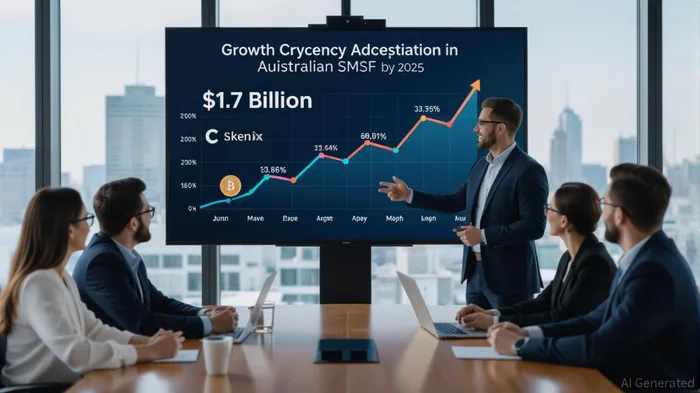
The integration of cryptocurrencies into Australia’s Self-Managed Super Funds (SMSFs) has emerged as a pivotal development in the nation’s retirement savings landscape. By early 2025, SMSFs had allocated approximately $1.7 billion to crypto assets, a sevenfold increase since 2021 [1]. This surge reflects a strategic shift in how institutional-grade investors and individual trustees are redefining risk-return profiles in an era of macroeconomic uncertainty. While major institutional super funds remain cautious, SMSFs are acting as a de facto on-ramp for institutional adoption, driven by regulatory innovation, tax incentives, and the emergence of custodial infrastructure.
Institutional Capital Flows: SMSFs as a Gateway
The rapid growth of crypto in SMSFs is underpinned by two key factors: diversification needs and access to institutional-grade tools. BitcoinBTC--, which accounts for 70% of SMSF crypto holdings [1], is increasingly viewed as a hedge against inflation and a diversifier in portfolios dominated by traditional equities and fixed income. According to a report by EY Parthenon and CoinbaseCOIN--, 86% of institutional investors either held digital assets in January 2025 or planned to allocate capital to them during the year [2]. This global trend is spilling into Australia, where SMSFs are leveraging custodial platforms like Coinbase and OKX to streamline compliance and asset segregation [3].
Coinbase, for instance, reported over 500 SMSF investors on its waiting list in Q3 2025 [1], signaling a growing demand for secure, audit-ready solutions. These platforms are addressing critical pain points for SMSF trustees, such as trust deed approvals and AFSL compliance, which have historically hindered crypto adoption. Meanwhile, institutional super funds like AustralianSuper and Aware Super remain hesitant, citing valuation challenges, volatility risks, and the absence of APRA-endorsed frameworks [5]. This divergence highlights SMSFs as a testing ground for institutional-grade integration, where smaller investors are pioneering strategies that larger funds may eventually adopt.
Regulatory Dynamics: Balancing Innovation and Prudence
Australia’s regulatory environment for SMSF crypto investments is evolving rapidly. The Australian Securities and Investments Commission (ASIC) and the Australian Taxation Office (ATO) have issued strict guidelines, including mandatory trust deed amendments and robust audit protocols [1]. These measures aim to mitigate operational risks, such as the 2024 $50M exchange hack [6], while ensuring SMSF trustees maintain rigorous governance.
A critical enabler of this transition is the SMSF Innovation Council, which has emerged as a bridge between innovation and prudence. The council is developing best practices for governance and audit standards, addressing gaps in professional indemnity (PI) coverage for crypto advice [4]. Despite these efforts, regulatory ambiguities persist. For example, the proposed Division 296 tax on volatile assets and the OECD’s Crypto Asset Reporting Framework (CARF) could reshape the cost-benefit analysis for SMSF investors [5].
Tax incentives remain a cornerstone of crypto’s appeal. The 10% long-term capital gains tax rate for assets held over 12 months—compared to 15% for short-term gains—makes crypto particularly attractive for SMSFs with long investment horizons [1]. This advantage is amplified by Australia’s projected superannuation system growth to $11.2 trillion by 2043 [2], creating a fertile ground for crypto to transition from niche asset to mainstream portfolio component.
Strategic Implications for Institutional Adoption
The SMSF-driven adoption of crypto is not merely a retail phenomenon but a strategic on-ramp for institutional capital. Platforms like Coinbase and OKX are actively targeting Australia’s $2.8 trillion pension market, offering tailored onboarding processes for older investors and institutional-grade custody solutions [4]. Early experiments, such as AMP Super’s 0.05% Bitcoin futures allocation, suggest that institutional super funds may follow suit once regulatory frameworks mature [5].
Globally, trends like the U.S. GENIUS Act—aimed at legitimizing crypto in retirement portfolios—further validate the asset class’s potential [5]. Australia’s SMSFs, with their agility and appetite for innovation, could serve as a model for institutional adoption elsewhere. However, challenges such as lack of PI insurance for crypto advice and ongoing compliance risks must be addressed to scale this transition safely [6].
Conclusion
The integration of cryptocurrencies into Australian SMSFs represents a strategic inflection point for institutional capital flows. By 2025, SMSFs have demonstrated that crypto can coexist with traditional assets in retirement portfolios, provided risks are managed prudently. As regulatory clarity improves and custodial infrastructure matures, the lessons learned from SMSF adoption may pave the way for broader institutional participation. For now, Australia’s SMSFs stand as both a testbed and a harbinger of a future where crypto is a legitimate, regulated asset class in global pension systems.
**Source:[1] Crypto's Breakthrough in Australia's Pension System [https://www.ainvest.com/news/crypto-breakthrough-australia-pension-system-era-institutional-adoption-2509/][2] Strategic Entry Points Amid Regulatory Evolution [https://www.ainvest.com/news/cryptocurrency-australian-pension-funds-strategic-entry-points-regulatory-evolution-2509/][3] Coinbase and OKX push crypto into Australia's retirement system [https://cointelegraph.com/news/coinbase-okx-crypto-australia-retirement-system][4] SMSF Crypto Australia 2025: Hold Bitcoin and EthereumETH-- in Super [https://hudsonfinancialplanning.com.au/resources/education-reports/crypto-smsfs-australia-2025/][5] Crypto Finds Gateway Into Australia's $2.8 Trillion Pensions Pot [https://www.bloomberg.com/news/articles/2025-08-31/crypto-finds-gateway-into-australia-s-2-8-trillion-pensions-pot][6] Blockchain 2025 - Australia - Global Practice Guides [https://practiceguides.chambers.com/practice-guides/blockchain-2025/australia/trends-and-developments]

Decoding blockchain innovations and market trends with clarity and precision.
Latest Articles
Stay ahead of the market.
Get curated U.S. market news, insights and key dates delivered to your inbox.




Comments
No comments yet