
Crypto in Australian SMSFs: A New Avenue for Retirement Wealth?


 Aime Summary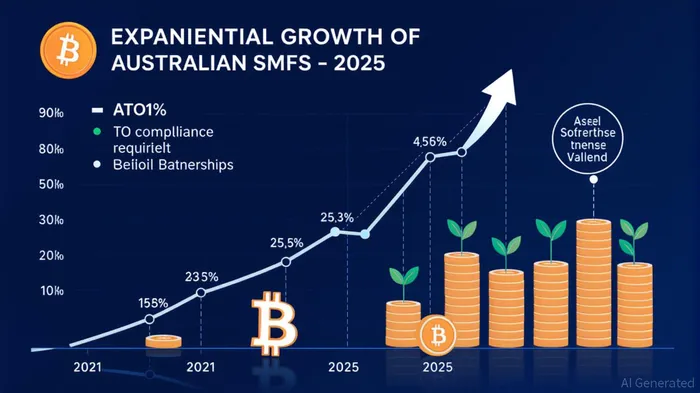
The integration of cryptocurrencies into Australian Self-Managed Superannuation Funds (SMSFs) has emerged as a compelling trend, reshaping retirement wealth strategies. By Q3 2025, SMSFs held approximately $1.7 billion in crypto assets, a sevenfold increase since 2021 [1]. This surge reflects a strategic shift among younger investors, who allocate 4–10% of their SMSF portfolios to digital assets, with 70% of these holdings in BitcoinBTC-- [2]. The rise of SMSFs as a vehicle for crypto adoption is not merely speculative; it signals a potential pathway for institutional investors to scale exposure to digital assets within a regulated retirement framework.
Institutional Partnerships and Scalability
The growth of crypto in SMSFs has been catalyzed by institutional players offering tailored solutions. Platforms like CoinbaseCOIN-- and OKX have launched SMSF-specific services, including custodial solutions and compliance tools, to streamline onboarding [3]. These services address key barriers such as asset segregation and audit requirements, which are critical for ATO compliance [4]. For instance, Coinbase reported over 500 investors on its SMSF waiting list, while OKX’s June 2025 product launch underscores the sector’s momentum [5].
The SMSF Innovation Council, formed in June 2025, further accelerates this trend by fostering collaboration between industry leaders and regulators. Chaired by OKX Australia CEO Kate Cooper, the council aims to establish best practices for governance and audit standards, ensuring scalability without compromising compliance [6]. Meanwhile, institutional-grade products like regulated Bitcoin ETFs from VanEck and Global X provide SMSFs with diversified, low-cost access to crypto [7].
Regulatory Challenges and Tax Incentives
Despite the optimism, regulatory scrutiny remains a hurdle. ASIC and the ATO have repeatedly warned about crypto’s volatility and the risks of non-compliance, particularly with the proposed Division 296 tax, which could complicate the holding of volatile assets in SMSFs [8]. Compliance costs, including ASIC-accredited audits and asset segregation, also deter smaller funds [9]. However, tax incentives mitigate some risks: long-term gains on crypto in SMSFs are taxed at 10% after 12 months, compared to 15% for short-term gains, and potentially 0% in pension phase [10]. These advantages make crypto an attractive addition for investors with a long-term horizon.
The Institutional Perspective
Institutional adoption of crypto via SMSFs is gaining traction globally. A joint EY Parthenon and Coinbase report found that 86% of institutional investors either had exposure to digital assets in January 2025 or planned to allocate capital during the year [11]. In Australia, platforms like AMP Super have introduced Bitcoin futures, while VanEck’s regulated ETFs offer SMSFs a sanctioned route to crypto [12]. Yet, major super funds like AustralianSuper and Aware Super remain cautious, avoiding public disclosures of crypto holdings [13]. This duality highlights the tension between innovation and regulatory caution.
Conclusion
The adoption of crypto in Australian SMSFs represents a unique intersection of retail and institutional investment. While regulatory challenges persist, the sector’s scalability is evident in the rapid growth of holdings and the emergence of institutional-grade solutions. For SMSFs, crypto offers diversification and tax advantages, but the path to mainstream adoption will require balancing innovation with compliance. As the SMSF Innovation Council and platforms like Coinbase continue to refine their offerings, the Australian retirement system may well become a global testbed for institutional crypto integration.
Source:
[1] Crypto Finds Gateway Into Australia's $2.8 Trillion Pensions Pot [https://www.bloomberg.com/news/articles/2025-08-31/crypto-finds-gateway-into-australia-s-2-8-trillion-pensions-pot]
[2] SMSF Crypto Australia 2025: Hold Bitcoin and EthereumETH-- in Super [https://hudsonfinancialplanning.com.au/resources/education-reports/crypto-smsfs-australia-2025/]
[3] Coinbase, OKX Target Australia's $2.8T Pension Market [https://www.livebitcoinnews.com/coinbase-okx-target-australias-2-8t-pension-market-with-crypto-offerings/]
[4] Complexity and Cost Hold Back Self-Managed Super Fund [https://www.nasdaq.com/articles/moomoo-australia-reveals-investor-trends-complexity-and-cost-hold-back-self-managed-super]
[5] Australian SMSFs Break Barriers, Embrace Crypto for ... [https://www.ainvest.com/news/australian-smsfs-break-barriers-embrace-crypto-retirement-futures-2509/]
[6] New “SMSF Innovation Council” Unites Industry Leaders to Drive Digital Transformation of Australia's $1T Retirement Sector [https://www.fintechaustralia.org.au/newsroom/new-smsf-innovation-council-unites-industry-leaders-to-drive-digital-transformation-of-australias-1t-retirement-sector]
[7] Crypto's Emerging Role in Australia's Superannuation System [https://www.ainvest.com/news/crypto-emerging-role-australia-superannuation-system-2509/]
[8] The Strategic Case for Allocating SMSFs to Cryptocurrencies in Australia’s Retirement System [https://www.ainvest.com/news/strategic-case-allocating-smsfs-cryptocurrencies-australia-4-3-trillion-retirement-system-2509/]
[9] SMSFs Fuel Crypto's Push Into Retirement Portfolios, Defying Risk Warnings [https://www.ainvest.com/news/smsfs-fuel-crypto-push-retirement-portfolios-defying-risk-warnings-2509/]
[10] The Ultimate Australian Crypto Tax Guide for 2025 [https://corporatealliance.com/blog/dce/the-ultimate-australian-crypto-tax-guide-for-2025/]
[11] Professional investors to add more crypto to portfolios in ... [https://axis.ausiex.com.au/articles/professional-investors-to-add-more-crypto-to-portfolios-in-2025/]
[12] Crypto's Emerging Role in Australian Pension Strategies [https://www.ainvest.com/news/crypto-emerging-role-australian-pension-strategies-2509/]
[13] SMSF Crypto Australia 2025: Hold Bitcoin and Ethereum in Super [https://hudsonfinancialplanning.com.au/resources/education-reports/crypto-smsfs-australia-2025/]

Decoding blockchain innovations and market trends with clarity and precision.
Latest Articles
Stay ahead of the market.
Get curated U.S. market news, insights and key dates delivered to your inbox.




Comments
No comments yet