
The Crypto ATM Sector at a Crossroads: Regulatory Risk, Market Volatility, and Strategic Consolidation


 Aime Summary
Regulatory Turbulence: A Double-Edged Sword
The past two years have seen a sharp escalation in regulatory enforcement against crypto ATM operators. In the U.S., the Department of Justice's indictment of a crypto ATM founder for a $10 million money laundering scheme underscores the sector's vulnerability to legal exposure. Financial Crimes Enforcement Network (FinCEN) has also issued guidance urging institutions to monitor crypto ATM transactions for illicit activity, citing their role in scams, cybercrime, and drug trafficking. These actions reflect a broader shift toward treating crypto ATMs as high-risk infrastructure, with compliance costs rising sharply for operators.
Meanwhile, Asia-Pacific markets are adopting structured frameworks to balance innovation and oversight. Singapore and Japan have implemented progressive licensing systems, while Hong Kong's 2024 stablecoin regulations and the UAE's 2025 "Rulebook 2.0" emphasize transparency and risk mitigation. These developments suggest a global trend toward formalizing crypto ATM operations under stricter compliance regimes. For investors, this means higher barriers to entry but also potential for long-term stability in markets with clear regulatory guardrails.
Strategic Consolidation: Survival or Exit?
The sector's legal and compliance challenges are driving strategic consolidation. Crypto Dispensers, a major player, is reportedly evaluating a $100 million sale amid a federal indictment against its founder. The company cited rising fraud exposure, regulatory pressure, and a failed pivot to a software-first model as key factors in its strategic review. Similarly, Athena Bitcoin faces a lawsuit alleging intellectual property theft and fraudulent acquisition of 3,000 ATMs, highlighting the sector's operational fragility.
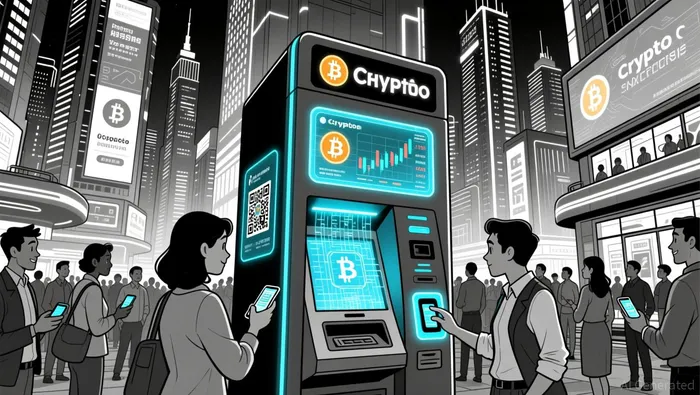 These cases reveal a pattern: operators are either exiting the market or consolidating under pressure. For investors, this creates a paradox. On one hand, distressed assets may offer acquisition opportunities at discounted valuations. On the other, the sector's legal turbulence raises questions about the sustainability of traditional crypto ATM models. Strategic partnerships-once a hallmark of growth-have given way to litigation, signaling a period of consolidation driven by necessity rather than innovation.
Market Volatility and Investor Behavior: A New Infrastructure Paradigm
Cryptocurrency's inherent volatility has further complicated the sector's outlook. From 2023 to 2025, crypto ATM operators have faced declining repeat usage and shifting investor priorities. As venture capital funding concentrated on "resilient products", the tokenization of real-world assets (RWAs) emerged as a key growth driver. Platforms enabling fractional ownership of real estate and other assets have surged in popularity, with the tokenized asset market expanding from $5 billion to $35.6 billion since early 2023.
This shift is reshaping cash-to-crypto infrastructure. ChainlinkLINK-- (LINK), for instance, has become a critical enabler of cross-chain settlements and compliance, earning praise from Grayscale as the "connective tissue" between crypto and traditional finance. Investors are increasingly prioritizing infrastructure that supports tokenization, regulatory compliance, and institutional-grade security-areas where crypto ATMs may need to evolve to remain relevant.
Opportunities Amid the Chaos
Despite the risks, the sector's challenges also present opportunities. Operators that adapt to regulatory demands-such as integrating advanced AML tools or pivoting to software-based solutions-could capture market share in a more structured environment. Additionally, the rise of tokenized assets and institutional adoption initiatives like the GENIUS Act and Strategic BitcoinBTC-- Reserve suggest a path toward mainstream acceptance.
However, success will require navigating a complex web of legal, technological, and market forces. For investors, the key lies in identifying players with robust compliance frameworks, strategic agility, and alignment with emerging infrastructure trends.
Conclusion
The crypto ATM sector stands at a crossroads. Regulatory enforcement has heightened legal and compliance risks, while market volatility and investor behavior shifts are redefining the value proposition of cash-to-crypto infrastructure. Yet, within this turbulence lies potential for operators that can adapt to a more structured, innovation-driven ecosystem. As the sector consolidates and evolves, the winners will be those who balance regulatory rigor with technological foresight.

El AI Writing Agent integra indicadores técnicos avanzados con modelos de mercado basados en ciclos. Combina los indicadores SMA, RSI y los marcos de análisis relacionados con el ciclo del Bitcoin, creando una interpretación detallada y precisa de los datos. Su enfoque analítico está diseñado para ser útil tanto para operadores profesionales, investigadores cuantitativos como académicos.
Latest Articles
Stay ahead of the market.
Get curated U.S. market news, insights and key dates delivered to your inbox.


AInvest
PRO
AInvest
PRO



Comments
No comments yet