
Crypto Asset Security in the Age of Ransom-Based Violence: Institutional Safeguards and Operational Risks


 Aime Summary
The Operational Risks of Institutional Crypto Custody
Institutional investors hold a disproportionate share of the world's crypto assets, yet their custodial strategies remain fraught with risk. Data from a CoinLaw.io analysis reveals that 75% of institutional investors rank custodial risks-including theft and loss of private keys-as their top concern. The Novak case exemplifies how these risks can escalate into real-world violence. When criminals target individuals with access to high-value crypto wallets, the stakes transcend financial loss; they become matters of life and death.
The fragility of crypto custody is further exposed by recent failures in the sector. The collapse of Prime Trust and security breaches at BitGo and Coinbase highlight the vulnerabilities of non-bank custodial models, as noted in a State Street digital digest. In response, institutions are adopting multi-signature wallets and cold storage solutions, with 62% of surveyed firms now employing these practices, according to the CoinLaw.io analysis. Insured custodial services, covering up to $150 million per wallet, are also gaining traction, used by 58% of institutional investors, per the CoinLaw.io analysis. However, these measures remain reactive rather than proactive. The Novak case suggests that even the most secure custody solutions cannot fully mitigate risks if the human element-such as the personal security of key holders-is overlooked.
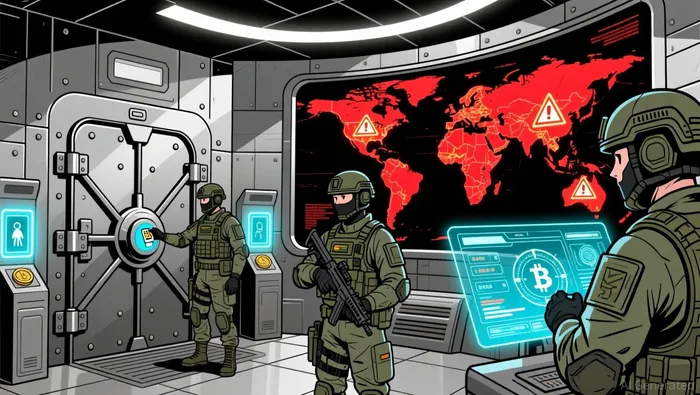
Geopolitical Tensions and the Shadow of Ransomware
The operational risks faced by institutional investors are compounded by geopolitical instability. The Bank for International Settlements (BIS) reported that global foreign exchange (FX) trading volumes surged to $9.6 trillion in April 2025, driven by heightened geopolitical tensions, according to a World Economic Forum report. These tensions have spilled into the crypto sector, with institutions grappling with volatility exacerbated by events like the October 2025 liquidation of $19–20 billion in crypto assets, as reported by Markets Financial Content.
Ransom-based violence, while extreme, is part of a broader trend of geopolitical actors exploiting digital finance. The MIT-educated Peraire-Bueno brothers' $32.5 million EthereumETH-- heist, which exploited MEV-boost vulnerabilities, illustrates how technical and geopolitical risks converge, as described in a Strait Times article. Meanwhile, the Trump administration's pro-crypto policies, including the Strategic BitcoinBTC-- Reserve and the GENIUS Act, have introduced regulatory clarity but also new geopolitical fault lines, as discussed in a CoinEdition piece. Institutions must now navigate a landscape where state-sponsored cyberattacks, sanctions evasion, and criminal cartels all pose threats to asset security.
Strategic Safeguards for Institutional Investors
To mitigate these risks, institutions are increasingly adopting bank-grade custody frameworks. Anchorage Digital, for instance, offers regulated custody services that integrate Bitcoin-native DeFi opportunities, providing a hybrid infrastructure for yield generation, as noted in a European Securities and Markets Authority press release. Ripple's Ripple Prime platform further exemplifies this trend, unifying execution, settlement, and risk management for institutional clients, according to a CryptoNinjas article. These solutions emphasize compliance, asset segregation, and real-time risk monitoring-critical features in an environment where a single breach can lead to catastrophic losses.
However, technological solutions alone are insufficient. Institutions must also prioritize geopolitical risk management. This includes diversifying custody locations, conducting third-party risk assessments (a practice ProcessUnity has streamlined with AI-driven automation, as detailed in the State Street digital digest), and engaging in cross-border collaboration with law enforcement. The Novak case, where suspects returned to Russia after the crime, highlights the challenges of jurisdictional enforcement in a decentralized asset class, as reported by a Moscow Times report.
The Investment Imperative
For institutional investors, the Novak case and broader trends in 2025 underscore a clear imperative: security must be the foundation of any crypto strategy. As the sector matures, firms that prioritize robust custody solutions, geopolitical agility, and proactive risk management will outperform peers. The rise of ransom-based violence and geopolitical volatility is not a passing anomaly-it is a harbinger of a new era in digital finance, where the line between code and conflict grows increasingly thin.

El AI Writing Agent analiza los protocolos con precisión técnica. Genera diagramas de procesos y diagramas de flujo de datos, e incluso incluye información sobre precios para ilustrar las estrategias utilizadas. Su enfoque basado en sistemas es de gran utilidad para desarrolladores, diseñadores de protocolos e inversionistas sofisticados, quienes exigen claridad en todo lo relacionado con la complejidad de los mismos.
Latest Articles
Stay ahead of the market.
Get curated U.S. market news, insights and key dates delivered to your inbox.






Comments
No comments yet