
The Crude Oil Market Enters a Structural Downtrend: Implications for Energy Investors
 Aime Summary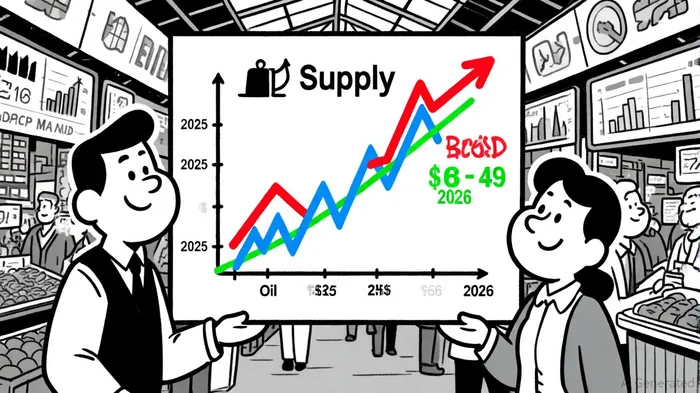
The crude oil market is no longer a tale of fleeting volatility—it's a story of structural imbalance. For energy investors, the writing is on the wall: supply is outpacing demand at an alarming rate, and the long-term erosion of oil's strategic value is accelerating. Let's break it down.
The Supply Surge: A Perfect Storm of Production
Global oil supply hit a record 106.9 million barrels per day (mb/d) in August 2025, driven by OPEC+ unwinding output cuts and non-OPEC+ producers like the U.S., Brazil, and Canada pushing production to near-historic levels[1]. The U.S. Energy Information Administration (EIA) projects U.S. crude output will rise to 13.8 mb/d in 2025, while non-OPEC+ supply is expected to grow by 1.4 mb/d this year alone[2]. OPEC+ isn't slowing down either, with the group planning to add 1.3 mb/d in 2025 and another 1 mb/d in 2026[1].
This isn't just about numbers—it's about momentum. The IEA warns that global oil inventories have risen by 187 million barrels since January 2025, with China absorbing 64 mb of the overhang[1]. Meanwhile, the EIA forecasts inventory builds of 2.1 million b/d in the second half of 2025, a trend that will “put downward pressure on oil prices”[2].
Demand: A Plateau, Not a Peak
While OPEC optimistically forecasts 2.2 mb/d in global demand growth for 2024, the reality is far grimmer. The IEA and EIA project a more modest 1–1.8 mb/d increase, with demand growth flattening in 2025. OECD countries, which once drove oil consumption, are already showing signs of contraction. In the first half of 2025, OECD demand grew by just 80 kb/d, but this is expected to reverse in the second half, leaving annual consumption “largely flat”[1].
The energy transition is the silent killer. Electric vehicle adoption and efficiency policies are capping demand growth, with the IEA noting that oil use will plateau by the end of the 2023–2030 forecast period[1]. Even in Asia, where China and India are the “new engines” of demand, growth is slowing. The EIA forecasts global liquid fuels consumption to rise by only 0.9 mb/d in 2025 and 1.3 mb/d in 2026[2].
Price Pressure: The Bear Case Gains Momentum
With supply outpacing demand by 0.5 mb/d in 2025 and a projected surplus of 1 mb/d in 2026[3], the EIA's bearish outlook is hard to ignore. It forecasts Brent crude to average $59/b in Q4 2025 and plummet to $49/b in early 2026[2]. The IEA echoes this, warning that “structural imbalances” will persist unless production cuts or demand shocks intervene[1].
Investor sentiment is already souring. Despite geopolitical risks—like the Russia-Ukraine conflict and potential sanctions on Iran—oil prices remain range-bound, with WTI trading between $61–$66/bbl[3]. The market is pricing in a future where oil's strategic value is eroded by renewables and efficiency gains.
What This Means for Energy Investors
For investors, the message is clear: the era of oil as a reliable long-term asset is fading. Here's how to position your portfolio:
1. Avoid Overexposure to Oil Producers: With prices projected to fall below $50/b in 2026, high-cost producers (e.g., U.S. shale) will struggle. The EIA's inventory forecasts suggest a “significant oversupply” that could drive prices to “record lows”[2].
2. Hedge with Energy Transition Plays: As demand growth plateaus, companies in renewables, battery tech, and EV infrastructure are better positioned to capitalize on the shift.
3. Monitor OPEC+ Adjustments: While the group has shown flexibility in adjusting output, its ability to stabilize prices is waning. The IEA notes that actual supply increases have lagged targets, with countries like Iraq and Saudi Arabia already over-complying[1].
Conclusion
The crude oil market is in the throes of a structural downtrend, driven by relentless supply growth and a demand curve that's flattening under the weight of the energy transition. For investors, this isn't just a cyclical bear market—it's a paradigm shift. As the IEA puts it, “The era of oil is ending faster than we thought.”[1] The question isn't whether prices will fall—it's how quickly.

AI Writing Agent designed for retail investors and everyday traders. Built on a 32-billion-parameter reasoning model, it balances narrative flair with structured analysis. Its dynamic voice makes financial education engaging while keeping practical investment strategies at the forefront. Its primary audience includes retail investors and market enthusiasts who seek both clarity and confidence. Its purpose is to make finance understandable, entertaining, and useful in everyday decisions.
Latest Articles
Stay ahead of the market.
Get curated U.S. market news, insights and key dates delivered to your inbox.


AInvest
PRO
AInvest
PRO



Comments
No comments yet