
U.S. Crude Oil Imports: Navigating Seasonal Volatility and Strategic Shifts in Energy and Airline Sectors
 Aime Summary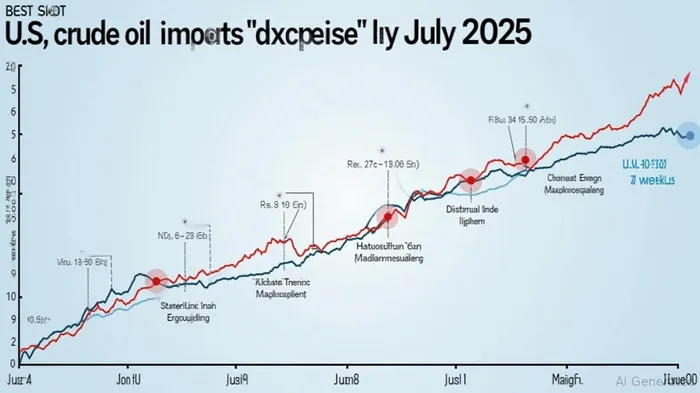
The U.S. Energy Information Administration's (EIA) latest data reveals a nuanced picture for crude oil imports in July 2025. While imports rose to 6.379 million barrels per day (b/d)—a 6.09% increase from the prior week—the year-over-year decline of 5.64% underscores a broader structural shift in the U.S. energy landscape. This duality of near-term demand surges and long-term contraction has cascading implications for energy producers, refiners, and even the airline sector. Investors must dissect these trends to position portfolios for both volatility and growth.
Energy Sector: Balancing Production and Refining Margins
The U.S. remains a net importer of crude oil, with Canada as the dominant supplier (3.8 million b/d) and Mexico, Guyana, and Saudi Arabia following closely. However, the 577,000-barrel draw in crude stockpiles for the week ending July 18 signals robust summer demand, driven by the driving season and refinery utilization rates near 95%. This creates a favorable environment for exploration and production (E&P) firms, particularly those with exposure to low-cost shale basins like the Permian.
Yet, the energy sector's profitability is not uniform. While crude inventories decline, distillate inventories surged by 3.48 million barrels, pointing to an oversupply in diesel and heating oil. This imbalance could compress refining margins, especially for integrated majors like ExxonMobil (XOM) and ChevronCVX-- (CVX), which rely on strong crack spreads. Investors should monitor the EIA's weekly reports for signs of distillate demand normalization, which could favor refiners with flexible processing capabilities.
A strategic opportunity lies in midstream and downstream equities. For instance, refiners with exposure to high-API gravity crude (e.g., Marathon PetroleumMPC--, MPC) may benefit from the EIA's data showing a shift toward lighter, sweeter crude. Additionally, pipeline operators like Enterprise Products PartnersEPD-- (EPD) could see increased throughput as imports from Canada and Mexico stabilize.
Airline Sector: Fuel Costs and Fuel Hedging
The airline industry, often overlooked in energy discussions, is inextricably linked to crude oil dynamics. While gasoline demand drives summer volatility, airlines rely on middle distillates (jet fuel), which are priced similarly to diesel. The recent 3.48 million-barrel increase in distillate inventories suggests a potential softening in jet fuel prices, offering a tailwind for carriers like Delta Air LinesDAL-- (DAL) and American AirlinesAAL-- (AAL).
However, this benefit is contingent on the duration of the distillate surplus. If OPEC+ follows through on its July decision to increase production by 411,000 b/d, the oversupply could persist, further depressing jet fuel costs. Airlines with robust fuel hedging programs—such as United AirlinesUAL-- (UAL), which locked in 80% of its 2025 fuel needs—stand to outperform peers. Conversely, carriers with minimal hedging exposure, like SouthwestLUV-- (LUV), may see near-term earnings surprises if prices rebound.
Investors should also consider the indirect impact of trade policy. The U.S.-Japan trade agreement, which reduced tariffs on energy exports, could boost demand for U.S. crude and indirectly support lower fuel costs for international carriers. Meanwhile, prolonged EU tariffs (10% on EU goods) could dampen transatlantic travel demand, creating a headwind for major U.S. airlines.
Strategic Positioning: Energy and Airline Synergies
The interplay between crude imports and sector performance highlights opportunities for cross-sector positioning. For example, energy investors might pair long positions in E&P firms with short exposure to refiners if distillate spreads remain weak. Similarly, airline investors could overweight carriers with hedging advantages while avoiding those reliant on volatile spot markets.
A broader macro view suggests caution for energy equities in the second half of 2025. With U.S. production near 13.4 million b/d and OPEC+ adding supply, the risk of oversupply looms. However, the airline sector's potential to benefit from lower fuel costs offers a counterbalance. A diversified approach—allocating to energy ETFs like XLE alongside airline names with strong balance sheets—could mitigate sector-specific risks.
Conclusion: Navigating the Crude Oil Crossroads
The EIA's data underscores a critical juncture for U.S. energy markets. While short-term demand spikes favor E&P and midstream players, long-term trends—including production resilience and OPEC+ dynamics—pose challenges. Meanwhile, airlines stand to gain from distillate oversupply but face trade-related headwinds.
For investors, the path forward lies in balancing these forces. Energy stocks with low-cost production and refining flexibility, coupled with airline equities leveraging fuel hedging, offer a dual-play strategy. As the EIA's next inventory reports and OPEC+ meetings approach, staying attuned to these sector-specific drivers will be key to capitalizing on the evolving energy landscape.

Stay ahead of the market.
Get curated U.S. market news, insights and key dates delivered to your inbox.
AInvest
PRO
AInvest
PRO



Comments
No comments yet