
Crude Calculus: Navigating Energy Sector Opportunities Amid U.S. Inventory Dynamics
 Aime Summary
The U.S. crude oil market is a chessboard of supply, demand, and infrastructure, where every move has cascading effects on energy sectors and their dependents. With the latest EIA data showing a 18.5-million-barrel decline in crude stocks year-over-year—highlighted by Cushing's 29% drop to 21.9 million barrels—investors must decode the implications for upstream, midstream, and downstream players. Let's dissect the numbers, identify the winners and losers, and map the path to profit.
Upstream: The Permian's Tightrope Act
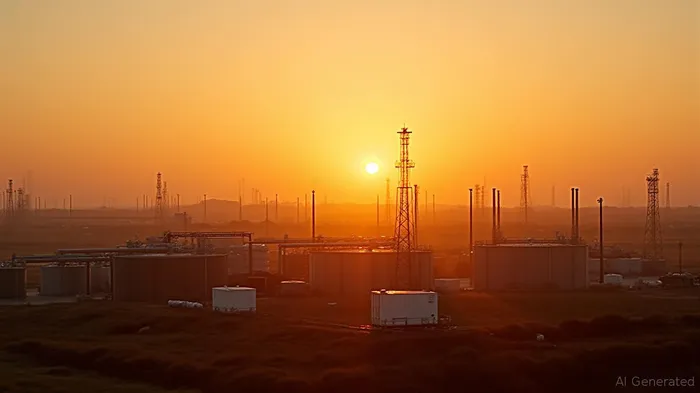
The Permian Basin remains the U.S. oil industry's beating heart, contributing 46% of total production. Yet its success is a double-edged sword. While output grows at 485 kbbl/d annually, the basin's natural gas oversupply has pushed Waha Hub prices below zero on 46% of trading days in 2024. Operators are prioritizing oil, but this creates a 40:1 oil-to-gas imbalance, straining midstream infrastructure.
Key Insight: Upstream E&Ps must balance production with takeaway capacity. For example, Pioneer Natural Resources (PXD) and Occidental (OXY) are investing in refracturing and enhanced recovery to boost returns from tier 2 and tier 3 acreage. However, flat production from prime tier 1 assets may force a shift toward Eagle Ford and Bakken, where acreage prices are rising.
Risk Alert: If shale growth slows, upstream capex could contract, dragging down service-sector stocks like HalliburtonHAL-- (HAL) and SchlumbergerSLB-- (SLB).
Midstream: The Pipeline Playbook
The Matterhorn Express Pipeline (2.5 Bcf/d) and three upcoming projects totaling 7.3 Bcf/d are critical to alleviating Permian gas bottlenecks. These projects, expected to come online by 2028, will stabilize pricing and unlock value for midstream operators.
Investment Angle: Midstream firms like Energy TransferET-- (ET) and Enterprise Products PartnersEPD-- (EPD) stand to benefit from infrastructure expansion. However, if upstream drilling slows, focus may shift to optimizing existing pipelines, reducing EBITDA growth potential.
Data Check: Midstream EBITDA margins have held steady at 45–50% despite higher interest costs. Watch for yield hikes in 2026 as projects ramp up.
Downstream: Refiners in the Crosshairs
The refining sector is under siege. WTI-US Gulf Coast crack spreads hit $12/bbl in September 2024, a 83% decline year-over-year. Global oversupply, new Asian refineries, and weak renewable credit prices (D4 RINs down 63% since 2023) are eroding margins.
Strategic Shift: Refiners like Marathon (MPC) and ValeroVLO-- (VLO) are pivoting to low-carbon fuels. Chevron's partnership with CortevaCTVA-- to secure biofuel feedstock and the EU's 2% sustainable aviation fuel mandate (2025+) offer long-term tailwinds.
Risk Factor: Electric vehicle adoption slowing to 13% y-o-y growth (vs. 30% in 2023) and data center demand driving 3 Bcf/d of natural gas use by 2030 could strain refining capacity.
Energy-Dependent Industries: The Ripple Effect
Inventory dynamics ripple beyond energy. Manufacturing, transportation, and data centers face energy cost volatility. For example, the 1.5 million bbl/d global liquids demand rebound in 2025 could push industrial energy prices higher, squeezing margins for companies like CaterpillarCAT-- (CAT) or FedExFDX-- (FDX).
Opportunity Zone: Energy-dependent sectors with pricing power—such as aluminum producers or railroads—could pass on higher costs. Watch AlcoaAA-- (AA) and Union PacificUNP-- (UNP) for resilience.
Data Query:
The Geopolitical Wild Card
OPEC+'s 2025 production cuts and potential U.S. policy shifts (post-2024 election) could disrupt inventory balances. A 10% swing in crude prices would ripple through energy stocks and energy-dependent sectors.
Investor Takeaway: Diversify across energy sectors and geographies. Hedge against volatility with ETPs like the Invesco S&P 500 Energy Portfolio (EPV) or energy infrastructure REITs.
Final Call: Position for the Long Game
The energy transition isn't a binary switch—it's a mosaic of infrastructure, innovation, and policy. For 2025, midstream and low-carbon downstream plays offer the most compelling risk/reward. Avoid overexposure to refining unless you see a green premium in biofuels. And for energy-dependent industries, lock in long-term energy contracts to shield against inventory-driven price swings.
In the end, the U.S. crude oil inventory isn't just a number—it's a barometer of resilience. And in markets, resilience is where the money is made.

Stay ahead of the market.
Get curated U.S. market news, insights and key dates delivered to your inbox.




Comments
No comments yet