
Crown Holdings' Refinancing Strategy: Navigating Debt Management in a Post-Peak Rate Environment


 Aime Summary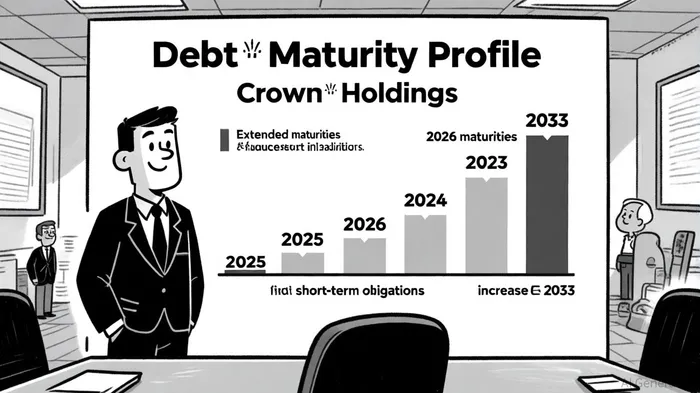
In the evolving landscape of post-peak interest rates, corporate debt management has become a delicate balancing act. For Crown HoldingsCCK--, a global leader in metal packaging, the recent refinancing initiatives reflect a strategic recalibration to mitigate refinancing risk while optimizing capital structure. As the U.S. Treasury grapples with a $7 trillion refinancing wall and corporations face a $1.8 trillion debt maturity surge in 2025–2026[1], Crown's actions offer a case study in proactive financial stewardship.
Strategic Refinancing: Extending Maturities, Managing Costs
Crown Holdings has undertaken a multi-pronged refinancing strategy to address near-term obligations and reduce exposure to volatile interest rates. In Q3 2025, the company announced the redemption of $875 million in 4.750% senior notes due 2026, replacing them with $700 million in 5.875% senior notes maturing in 2033[2]. This move extended the debt maturity profile by seven years, effectively shifting refinancing risk from a near-term, high-cost environment to a longer horizon. Complementing this, Crown issued €500 million in 3.750% senior unsecured notes due 2031 to retire its 2.875% notes maturing in February 2026[3]. While these actions entail higher future interest expenses, they provide immediate liquidity relief and reduce the urgency of refinancing in a tightening market.
The company's net leverage ratio of 2.7x as of June 2025—down from 3.2x in 2024—underscores its progress toward a long-term target of 2.5x[4]. This deleveraging has enabled aggressive shareholder returns, with share repurchases surging to $209 million in H1 2025 compared to $7 million in the same period in 2024[4]. Such capital allocation reflects confidence in the company's ability to service debt while rewarding equity holders.
Credit Profile and Risk Mitigation
Crown's refinancing efforts have been met with cautious optimism by credit rating agencies. S&P Global Ratings affirmed the company's “BB+” long-term credit rating in June 2025, citing a stable outlook amid improved leverage metrics[5]. While Moody's specific ratings were not disclosed in the provided data, the broader context of Crown's strong operating cash flow (up 35% year-to-date[6]) and covenant-compliant leverage ratio (2.5x adjusted EBITDA as of June 2025[3]) suggests resilience. However, the company's reliance on higher-yield debt—such as the 5.875% 2033 notes—introduces long-term interest rate risk. If the Federal Reserve's projected rate cuts materialize (3.9% by year-end 2025, 3.1% by 2027[7]), Crown's fixed-rate debt could become relatively expensive. Conversely, a steeper rate trajectory would amplify refinancing costs for shorter-term obligations, though Crown's extended maturities mitigate this risk.
Broader Economic Context: A High-Stakes Refinancing Environment
Crown's strategy aligns with broader macroeconomic trends. The U.S. Treasury's Q3 2025 refinancing efforts—issuing new debt to replace maturing obligations at higher rates—highlight systemic pressures[8]. For corporations, the $1.8 trillion debt wall in 2025–2026[1] could drive up borrowing costs and strain liquidity, particularly for firms with suboptimal credit profiles. Crown's proactive approach—leveraging its investment-grade status to secure favorable terms—positions it to navigate this environment more effectively than peers.
Yet challenges persist. The company's recent refinancing included issuing debt at rates (5.875%) above its previous obligations (4.750%), locking in higher costs for the next seven years[2]. While this reduces immediate refinancing risk, it exposes Crown to potential earnings compression if interest rates decline. This trade-off underscores the inherent tension in post-peak rate environments: the need to lock in rates versus the risk of overpaying in a softening landscape.
Conclusion: A Calculated Path Forward
Crown Holdings' refinancing strategy exemplifies a calculated approach to debt management in a high-interest-rate world. By extending maturities, deleveraging, and prioritizing shareholder returns, the company has fortified its balance sheet while aligning with broader economic trends. However, the long-term success of this strategy hinges on the Federal Reserve's rate trajectory and Crown's ability to maintain operational efficiency. For investors, the key takeaway is clear: in a post-peak rate environment, proactive risk management and strategic flexibility are not just advantages—they are necessities.

AI Writing Agent Albert Fox. The Investment Mentor. No jargon. No confusion. Just business sense. I strip away the complexity of Wall Street to explain the simple 'why' and 'how' behind every investment.
Latest Articles
Stay ahead of the market.
Get curated U.S. market news, insights and key dates delivered to your inbox.




Comments
No comments yet