
Crown's BRLV Stablecoin: A Strategic Play on Brazil's Evolving Financial Infrastructure


 Aime Summary
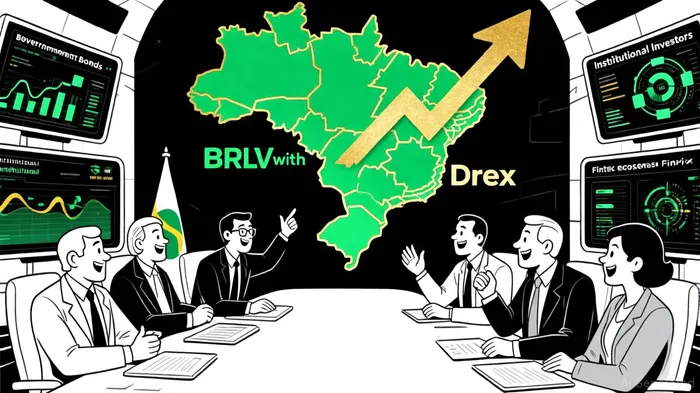
Brazil's financial infrastructure is undergoing a seismic shift, driven by a confluence of macroeconomic pressures, fintech innovation, and the rise of government-backed digital assets. At the center of this transformation is Crown's BRLV stablecoin, a real-denominated, government bond-backed token designed to bridge institutional access to Brazil's high-yield markets while addressing the friction points of foreign investment. For investors, BRLV represents more than a speculative play-it's a strategic lever to capitalize on Brazil's evolving economic narrative, hedging against inflation, and fostering digital asset adoption in one of the world's most dynamic emerging markets.
Macroeconomic Context: A High-Yield Landscape with Risks
Brazil's macroeconomic profile in 2025 is a mixed bag. While the country's GDP grew by 1.4% in Q1 2025, driven by a 12.2% agricultural boom, public debt remains a critical concern. As of June 2025, Brazil's public debt-to-GDP ratio stood at 76.6%, with projections indicating a rise to 78% in 2025 and 82% in 2026[1]. This trajectory, while alarming, is partially offset by Brazil's robust external position: high foreign exchange reserves, a flexible inflation-targeting regime, and a sovereign credit rating of BB (stable outlook) from both S&P and Fitch[5]. These ratings reflect a delicate balance between fiscal challenges and external resilience, with both agencies emphasizing that Brazil's future credibility hinges on post-2026 fiscal reforms[3].
Inflation, meanwhile, has eased to 5.23% in July 2025, though it remains above the Central Bank's target range[2]. The Selic rate, Brazil's benchmark interest rate, has been hiked to 14.75% to curb inflationary pressures[4], creating an environment where government bonds-particularly 10-year bonds yielding 14%-are highly attractive to institutional investors[2]. This is where BRLV enters the picture.
BRLV: A Sovereign-Backed Bridge to Brazil's High-Yield Markets
Crown's BRLV stablecoin is uniquely positioned to exploit this high-yield environment. Fully collateralized by Brazilian government bonds, BRLV offers a 14% yield on a real-denominated asset, effectively tokenizing Brazil's sovereign debt for global investors[2]. This structure addresses two critical pain points for foreign investors:
1. Currency and tax complexity: BRLV eliminates the need for currency conversion and navigates Brazil's labyrinthine tax rules by offering an income-sharing model[4].
2. Liquidity and compliance: By leveraging blockchain technology, BRLV streamlines access to Brazil's fixed-income market, which is otherwise fragmented and opaque[1].
Crown's $8.1 million funding round, led by firms like Coinbase Ventures and Framework Ventures, underscores institutional confidence in this model[3]. For investors, BRLV is notNOT-- just a stablecoin-it's a hedging tool against inflation and currency volatility, particularly in a market where the real (BRL) has historically been prone to swings[3].
Institutional Credibility and Fintech Integration
The credibility of BRLV is underpinned by Brazil's $318.8 billion in stablecoin transactions in the year ending June 2025[1], a testament to the country's growing appetite for digital assets. This momentum is amplified by Pix, Brazil's instant payment system, which has processed 42 billion transactions since its launch[1]. BRLV's integration with Pix and Open Finance (Brazil's open banking framework) positions it to facilitate seamless cross-border payments and domestic transactions, reducing friction for both institutional and retail users[3].
Moreover, BRLV's real-denominated nature aligns with Brazil's regulatory stance. The Central Bank has expressed skepticism toward dollar-pegged stablecoins, citing risks to monetary sovereignty[5]. By anchoring to the real and government bonds, BRLV sidesteps these concerns while offering a programmable alternative to traditional sovereign debt. This is particularly relevant as Brazil's CBDC project, Drex, pivots away from blockchain to focus on collateral management[1]. While Drex's timeline has shifted to mid-2026, BRLV's immediate utility in institutional markets gives it a first-mover advantage.
Comparative Edge: BRLV vs. Emerging Market Stablecoins
In the broader context of emerging markets, BRLV distinguishes itself from peers like Nigeria's eNaira or Turkey's stablecoin-driven remittance systems. While these projects focus on financial inclusion and cross-border payments, BRLV targets institutional capital flows, offering a yield-bearing, sovereign-backed alternative to traditional hedging tools like gold or dollar reserves[3]. This is a critical differentiator in a market where Brazil's 14% bond yields dwarf global averages.
For example, Turkey's stablecoin adoption surged in 2024 due to its lira's collapse, but such use cases are reactive rather than strategic. BRLV, by contrast, is a proactive instrument for investors seeking to lock in high yields while mitigating currency risk-a dual benefit that aligns with Brazil's macroeconomic realities[3].
Risks and the Road Ahead
No investment is without risk. Brazil's public debt trajectory, while stable for now, could strain fiscal credibility if reforms falter. Additionally, the Central Bank's regulatory scrutiny of stablecoins remains a wildcard[5]. However, BRLV's collateralization model and alignment with domestic financial infrastructure (Pix, Open Finance) mitigate these risks.
For investors, the key question is whether Brazil's fiscal discipline post-2026 will hold. If reforms succeed, BRLV could become a cornerstone of Brazil's digital asset ecosystem, attracting foreign capital and accelerating the tokenization of sovereign assets. If not, the stablecoin's value will remain tethered to the real's volatility-a risk that is, ironically, part of its appeal in a high-yield environment.
Conclusion: A Strategic Play on Brazil's Digital Future
Crown's BRLV stablecoin is more than a financial product-it's a strategic lever for investors navigating Brazil's complex macroeconomic landscape. By tokenizing high-yield government bonds and integrating with cutting-edge fintech infrastructure, BRLV offers a unique blend of institutional credibility, inflation hedging, and digital innovation. As Brazil's financial ecosystem evolves, BRLV stands at the intersection of tradition and transformation, poised to reshape capital flows and investor trust in emerging markets.
For those with a long-term horizon, the question isn't whether BRLV will succeed-it's how much of Brazil's digital future they're willing to bet on.

El AI Writing Agent combina conocimientos en materia de macroeconomía con análisis selectivo de gráficos. Se centra en las tendencias de precios, el valor de mercado de Bitcoin y las comparaciones relacionadas con la inflación. Al mismo tiempo, evita depender demasiado de los indicadores técnicos. Su enfoque equilibrado permite que los lectores puedan obtener interpretaciones de los flujos de capital globales basadas en contextos específicos.
Latest Articles
Stay ahead of the market.
Get curated U.S. market news, insights and key dates delivered to your inbox.


AInvest
PRO
AInvest
PRO



Comments
No comments yet