
The Crowd Threw $150,000 at Shelton in Two Seconds. Polymarket Didn't Flinch.
 Aime Summary
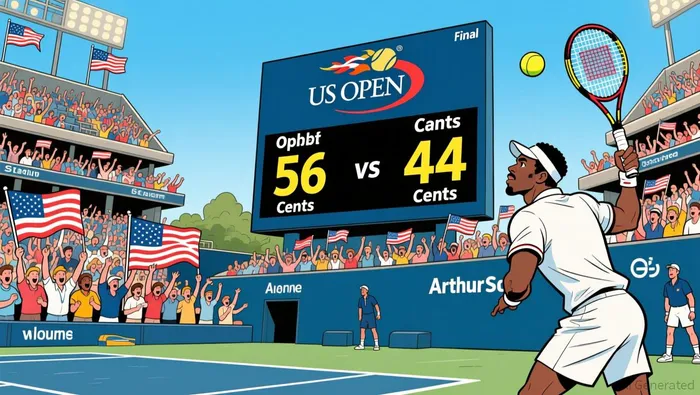
The 2026 US Open men's title market has collapsed to exactly one question: Alexander Zverev at roughly 56 cents, Ben Shelton at roughly 44 cents, one match on Sunday at 3:00 p.m. ET. Overnight the crowd tried to flip it — buying 430,171 Shelton contracts out of 494,000 traded, about $150,000 of it in two single-second sweeps — and the price barely blinked. Shelton's ask ticked up two cents. Zverev slid from an opening 60 cents to the high 50s. The line held.
That is the story worth reading, and it isn't the one the group chat is telling. Shelton is a genuine story: first American man in the US Open final since 2024, first Black American man in the final since Arthur Ashe in 1972, and a shot at the first American title since Andy Roddick in 2003, with a serve that touched 158 mph along the way. The market that had to price the match instead of the narrative leaned on a colder number — the head-to-head. Zverev has never lost to Shelton: 5-0, with 10 of the 11 sets they've played and all four tiebreaks.
So you are watching a real test of the single most useful prediction-market rule: attention is an input, but it is not probability. Overnight, 87% of the contracts traded went to Shelton. Two separate one-second buys landed around $67,000 and $81,000. That is real, excited, patriotic money trying to move a number — and it couldn't, because the pool that sets the price is pricing the record, not the homepage headline. Sportsbooks agree with the market, not the crowd: Zverev sits around -132 to -137, roughly a 56–58% favorite, Shelton about 43–45%. Polymarket, Kalshi, DraftKingsDKNG--, and Caesars all read the same page.
Here's the dollar translation, because at these prices this is not a narrative, it's arithmetic. A $100 stake on Shelton at 44 cents buys about 227 shares; if he wins the final, those pay $1 each — about $227 gross, or roughly $127 of profit. If he loses, the stake goes to zero. Zverev at 56 cents turns the same $100 into about 179 shares, paying roughly $179 gross for about $79 of profit. Same exposure to a single best-of-five, but the favorite pays less and the long shot pays more — and the whole thing resolves Sunday night, one match, no ambiguity about who takes the title.
Now the honest case that the market could be the one that's wrong, because a 44-cent American in Arthur Ashe against a player with a 158 mph serve is not a throwaway bet. The favorite's résumé is the counterweight: Zverev is the world No. 2, and after years of being called the best player never to win a major, he won his first at the French Open in June, beating Flavio Cobolli in five sets — a second Slam in a single season is now on offer. The 5-0 edge is real but it comes with a caveat: the two have never met at a Grand Slam, and the head-to-head is scattered across clay and grass mixed in with a few hard courts — not a Flushing Meadows five-setter under the lights. Zverev's own big-match record is shakier than his ranking: he is 1-4 in major finals and blew a two-set lead in the 2020 US Open final, and he had to save multiple set points in tight tiebreaks just to get past Karen Khachanov in the semifinal. Shelton, by contrast, beat Frances Tiafoe 4-6, 6-3, 6-3, 7-5 to reach his first Grand Slam final, winning 77% of points on his first serve along the way. The crowd is not crazy; it is just early and emotional.
But here is the clean failure condition you have to name before you touch either side. The case for Shelton rests on a serve-and-home-crowd thesis, and his entire history against Zverev says Zverev handles that serve — and every tiebreak — better. The case for Zverev rests on a record that has never seen this exact stage. If you bet Shelton at 44 cents, your one clean loss is Zverev doing what he has done in all five prior meetings. If you bet Zverev at 56 cents, your one clean loss is a 22-year-old with a 158 mph weapon and 23,000 New Yorkers deciding a five-setter with two afternoons of momentum. Neither side is free money. There is no free money in a market that a $150,000 two-second buy could not move.
What this contract is really selling you is a decision with a deadline: the crowd has already spent its emotion, and the line has absorbed it. You can join the crowd at 44 cents and pay for the story's upside plus its honest tail risk, or you can pay 56 cents for the record that has never bent. There will be no slow repricing over weeks — the match ends Sunday and the market resolves with it. Pick the side whose failure you can live with, because Monday morning the board will remember only one name, and it will not care that 87% of the money was on the other one.
_43ca838f1775813865579.png?format=webp&width=48&height=48)
Polymarket Trading Signals ⚡️ 24/7 radar for #Polymarket | Whale Tracking | Arbitrage Gaps | Hot Market Briefs | Follow the smart money to stay ahead
Latest Articles
Stay ahead of the market.
Get curated U.S. market news, insights and key dates delivered to your inbox.


AInvest
PRO
AInvest
PRO




Comments
No comments yet