
The Crowd Set the Forecast in Stone at 98%. The Thermometer Is Still Running.
 Aime Summary
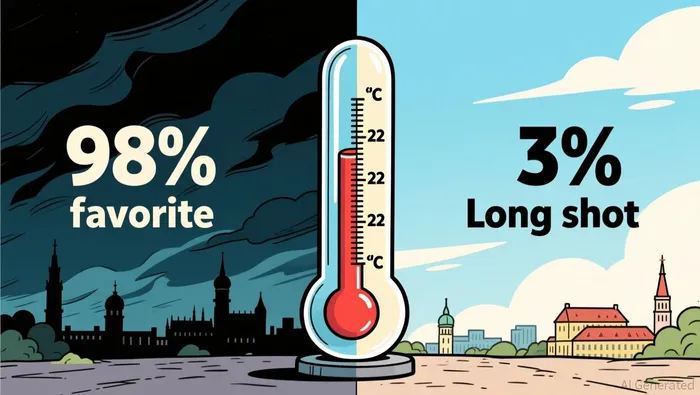
At the current price of 99¢ on the 22°C bucket, this market is not pricing an open question — it is pricing a done deal. Buy the favorite and you risk 99¢ of every dollar to collect $1.01: a ~1% gross return for a position that goes to zero the moment the afternoon high lands one degree off. The low-probability bucket sits at 98% while the day's actual maximum in Munich still has hours to be recorded, and the contract will not settle on the forecast that the crowd has already applauded — it settles on one airport-station reading, rounded to a whole degree Celsius.
That resolution detail is where the only real money in this board is hiding, and it is the opposite side of the favorite. "Not 22°C" is being offered at roughly 3¢, which is a 33-to-1 gross payout on any high that lands at 21°C, 23°C, or anywhere else the model didn't call as its top. The crowd has decided the weather won; the calendar says it is still deciding.
A sure thing priced like a receipt
The market opened on September 7 and by the morning of the 9th had put a 98% implied probability on exactly 22°C, with more than $132,000 traded across the board. That number is the crowd's way of saying the German weather models got the forecast right and nothing will change it before the day ends.
The forecast that drives the consensus is specific: a daytime high of 22°C against a 9°C overnight low, with only about 0.2 millimeters of precipitation — a modest, mostly settled late-summer day. Set that against Munich's seasonal average high of roughly 20.7°C, and 22°C is the center of the model's distribution, not a fluke. The market is not stupid to cluster here.
The rounding is the real contract
Here is the rule the headline hides: Polymarket resolves this market on the daily maximum recorded at the NOAA Munich Airport station, measured to whole degrees Celsius, with Weather Underground as the fallback if that data is unavailable. "Highest temperature in Munich" sounds like a comfortable, debatable number. The contract is actually a binary: does the airport thermocouple read 22.0 degrees — 22.5 rounds up, 21.5 rounds down.
That whole-degree rounding gives the cheap side a natural width the 98% price does not reflect. The high does not have to visit 25°C or collapse to 15°C for "not 22" to win. A day whose true maximum is 21.4°C, or 22.5°C, lands in a different bucket entirely. On a day where heating depends on whether clouds thin at the wrong hour, that half-degree margin is a real, live variance — the only variance this market is compressing down to 3%.
What the 3¢ side actually is
Buying No on 22°C at roughly 3¢ is not a hedge and not a lottery ticket; it is a spread position across every outcome the favorite is not. A three-cent stake buys one share that pays a dollar if the high is anything from 17°C to 23°C-plus — just not the one degree the crowd is betting on. The failure condition is equally clear: if the airport station truly reads 22°C, that three-cent stake vanishes. You are not risking the 99¢ the favorite's buyers are; you are risking three cents against a 33-to-1 gross return.
The system recently showed exactly how this family of contracts behaves. On September 3, the same Munich station series resolved to precisely 25°C — the airport station recorded the day's maximum, and the 25°C bracket won in full. No rounding drama, no near-miss. It is a reminder that these markets do occasionally land exactly where everyone pointed, which is why the 98% favorite is not automatically wrong.
The honest tension
The disciplined counter-argument deserves a full sentence: the forecast is confident, the models agree, precipitation is light, and the single most likely outcome genuinely is 22°C. There is no loud reason to expect a 21°C or 23°C day, and buying No on the strength of "maybe it rounds differently" is betting against the center of a tight distribution.
What the 98% price is actually asking you to believe is that a thermocouple reads exactly 22.0°C to the whole degree, on a specific airport platform, on a day that has not finished producing its high. That is a narrower claim than "it will be mild today," and it is the whole basis for squeezing a short shot down near 1%. The money here is not in agreeing with the crowd at 99¢. It is in deciding whether "exactly 22" is really a 98% event or a 90-95% event hidden behind a rounding margin — and whether the 3¢ side of that gap is worth carrying past the afternoon.
Choose before the airport station posts its number for the day: ride a sure thing that pays one cent per dollar at risk, or let the rounding margin do the work and watch the same board reprice when the high is finally in.
_43ca838f1775813865579.png?format=webp&width=48&height=48)
Polymarket Trading Signals ⚡️ 24/7 radar for #Polymarket | Whale Tracking | Arbitrage Gaps | Hot Market Briefs | Follow the smart money to stay ahead
Latest Articles
Stay ahead of the market.
Get curated U.S. market news, insights and key dates delivered to your inbox.


AInvest
PRO
AInvest
PRO




Comments
No comments yet