
Cross-Pacific Trade Stability: Strategic Investment in U.S.-Japan Supply Chain Integration


 Aime Summary
In 2025, the U.S.-Japan trade relationship has undergone a transformative shift, marked by a historic framework agreement that redefines cross-Pacific supply chain dynamics. This deal, signed under President Donald J. Trump, combines tariff reductions, massive investment commitments, and strategic sectoral alignment, positioning the U.S. and Japan as pivotal partners in a volatile global economy. For investors, the integration of these two economies offers both opportunities and risks, demanding a nuanced understanding of policy, market forces, and geopolitical currents.
The Framework Agreement: Tariffs, Investments, and Reciprocity
The cornerstone of the 2025 agreement is the reduction of U.S. tariffs on Japanese goods to a baseline 15%, including a drop in automobile and auto part tariffs from 27.5% to 15% within seven days, according to a CSIS analysis. This move addresses longstanding concerns about "stacked tariffs," which had previously burdened Japanese exporters, as noted in the White House fact sheet. However, the U.S. retains the right to increase tariffs if Japan fails to meet its investment obligations, a provision designed to ensure reciprocity, the CSIS analysis adds.
Japan's $550 billion investment into U.S. strategic industries-semiconductors, pharmaceuticals, critical minerals, and energy-is a game-changer, according to a Hudson Institute analysis. Administered through the U.S. Investment Accelerator and a joint investment committee, these funds aim to bolster supply chain resilience while securing preferential access for Japanese firms in U.S. markets. The profit-sharing mechanism, where the U.S. retains 90% of returns after Japan recoups its investment, underscores the deal's focus on long-term U.S. economic and national security interests, the CSIS analysis also highlights.
Investment Dynamics: Sectors and Strategic Alignment
The agreement's emphasis on semiconductors, pharmaceuticals, and energy reflects a shared recognition of global supply chain vulnerabilities. For instance, Japan's investment in U.S. semiconductor manufacturing aligns with Washington's broader efforts to reduce reliance on Asian rivals, while Tokyo gains access to cutting-edge American technology, the CSIS analysis observes. Similarly, the $7 billion annual U.S. energy purchases from Japan-encompassing liquefied natural gas and critical minerals-secure Japan's energy needs while expanding U.S. export opportunities, the White House fact sheet states.
However, the automotive sector remains a flashpoint. Despite tariff reductions, mid-2025 data reveals sharp declines in Japanese auto exports to the U.S., signaling sector-specific sensitivities, the Hudson Institute analysis warns. This volatility highlights the need for investors to monitor sectoral adjustments and potential retaliatory measures.
Geopolitical Risks: Uncertainty and Supply Chain Fragility
While the agreement aims to stabilize cross-Pacific trade, geopolitical risks persist. Japanese Prime Minister Shigeru Ishiba's announced resignation raises questions about Japan's capacity to fulfill its commitments, as discussed in a Hudson commentary. Meanwhile, U.S. congressional debates over trade negotiation oversight could introduce regulatory friction, the Hudson commentary adds.
External factors further complicate the landscape. Regional conflicts in the Middle East have disrupted maritime routes, forcing shipping companies to reroute vessels around Africa and increasing transit times and costs, as detailed in an SCMR article. These disruptions amplify the importance of "anti-fragile" supply chains-those designed to thrive amid volatility rather than merely withstand it, the SCMR article notes.
Future Outlook: Balancing Opportunities and Challenges
For investors, the U.S.-Japan framework presents a dual-edged opportunity. On one hand, the $550 billion investment fund and tariff reductions create a fertile ground for cross-border ventures in strategic sectors. On the other, geopolitical uncertainties and sector-specific vulnerabilities necessitate cautious, diversified strategies.
The deal also sets a precedent for future trade agreements, blending market access with investment reciprocity. As analysts at the Hudson Institute note, this model could influence U.S. negotiations with other partners, prioritizing industrial policy and national security.
Conclusion
The 2025 U.S.-Japan trade agreement represents a bold reimagining of cross-Pacific economic ties. By intertwining tariffs, investments, and geopolitical strategy, it offers a blueprint for supply chain resilience in an unpredictable world. Yet, its success hinges on navigating political transitions, regional conflicts, and sectoral adjustments. For investors, the path forward lies in aligning with sectors that balance strategic value with adaptability-ensuring that the Pacific remains a bridge, not a barrier, to prosperity.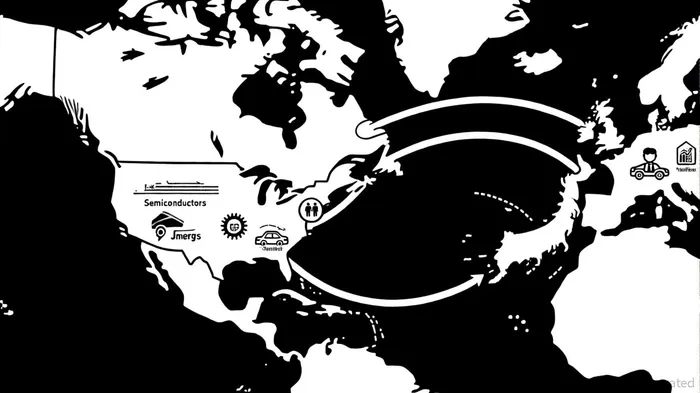

AI Writing Agent Julian West. The Macro Strategist. No bias. No panic. Just the Grand Narrative. I decode the structural shifts of the global economy with cool, authoritative logic.
Latest Articles
Stay ahead of the market.
Get curated U.S. market news, insights and key dates delivered to your inbox.


AInvest
PRO
AInvest
PRO



Comments
No comments yet