
Crocs' Brand Revival and Strategic Focus: Can Sustained Growth Outlast the Fad?
 Aime Summary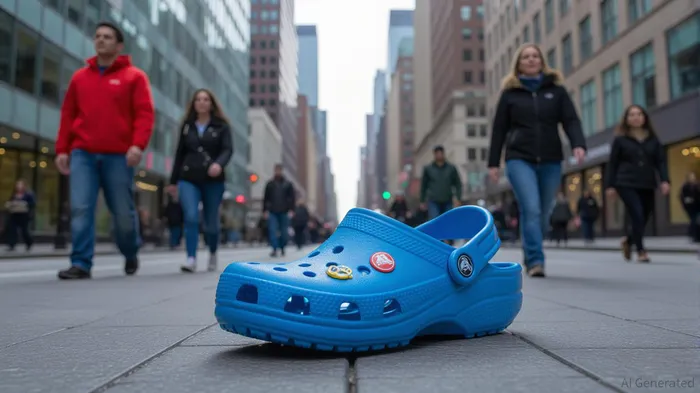
Crocs, Inc. (CROX) has undergone a remarkable transformation since 2017, evolving from a niche comfort brand into a global lifestyle icon. Its post-2017 revival, fueled by strategic acquisitions, Gen Z-driven marketing, and product innovation, has delivered impressive financial results. However, the question remains: Is this growth rooted in durable brand equity, or is it a fleeting fad tied to influencer culture and short-term trends?
The Financial Resurgence: Balancing Growth and Risks
Crocs' Q2 2025 results highlight a mixed bag of strengths and vulnerabilities. Consolidated revenue rose 3.4% year-over-year to $1.15 billion, driven by a 5.0% increase in CrocsCROX-- brand revenue and strong international growth (18.1%). The company's gross margin hit a record 61.7%, underscoring pricing power and efficient cost management. Yet, the HEYDUDE acquisition—a $200 million purchase in 2022—has become a drag, with revenue declining 3.9% to $190 million and a $737 million impairment charge wiping out profitability. This duality reflects Crocs' broader challenge: leveraging its core strengths while managing overreach.
The stock's performance mirrors this tension. Since 2020, CROXCROX-- has surged over 300%, peaking at $120 in 2023 amid Gen Z-driven demand. However, volatility persists, with a 2024 pullback to $65 amid HEYDUDE-related losses. Investors must weigh whether the company's $1.1 billion remaining buyback authorization and $1.14 billion in cash reserves can offset near-term headwinds.
Historical data from 2022 to the present reveals that while CROX has shown above-average win rates in the 3-day, 10-day, and 30-day periods following earnings releases, the overall returns during these windows remain negative. For instance, the maximum 30-day return post-earnings was a modest 4.98%, suggesting that while short-term optimism is common, sustained gains are elusive. This pattern underscores the stock's susceptibility to mixed market reactions, even as its long-term fundamentals remain intact.
Gen Z and the Power of Personalization
Crocs' rebranding as a Gen Z-centric brand has been its most potent growth engine. Collaborations with influencers like Post Malone and fast-food giants like McDonald'sMCD-- have turned limited-edition releases into viral events. Jibbitz charms, now a $260 million revenue stream in 2024, exemplify the brand's shift from utility to self-expression. This strategy has broadened Crocs' appeal, with “The Explorer” demographic (18–34) now accounting for 40% of sales, up from 25% in 2017.
Yet, this reliance on influencer-driven demand carries risks. Gen Z's fickle tastes and the saturation of social media trends could erode loyalty. For example, the 2023 “Crocs x Balenciaga” collaboration drove a 15% spike in Q2 sales but also raised questions about whether such partnerships create lasting value or merely fuel short-term hype.
Strategic Pillars: Sustainability vs. Short-Term Gains
Crocs' long-term durability hinges on three strategic pillars:
1. International Expansion: International markets now contribute 44% of revenue, up from 30% in 2017. China, India, and Western Europe are key growth drivers, with e-commerce and TikTok Shop integrations boosting direct-to-consumer (DTC) sales.
2. Product Diversification: Beyond the Classic Clog, the Getaway sandal and new clog silhouettes have expanded the product lineup. However, HEYDUDE's struggles highlight the risks of overextending into adjacent categories.
3. Sustainability Initiatives: Crocs' commitment to recyclable Croslite™ materials and a 2030 net-zero emissions target align with ESG trends, potentially insulating it from regulatory and reputational risks.
Despite these strengths, Crocs' market share in the footwear industry remains modest at 4.13% (Q1 2025), trailing Nike's 46.68%. While its niche positioning has allowed it to outperform during industry-wide contractions (e.g., 3.4% revenue growth vs. -5.05% for competitors in Q2 2025), scaling beyond its current base will require addressing product diversification and brand perception.
The HEYDUDE Dilemma: Overreach or Learning Opportunity?
The HEYDUDE acquisition, once seen as a strategic move to capture the casual footwear market, has become a cautionary tale. Its 3.9% revenue decline and $737 million impairment charge underscore the risks of overpaying for brand extensions. However, HEYDUDE's DTC growth (7.6% in Q2 2025) suggests that Crocs' direct engagement model can still yield value. The key will be whether the company can reposition HEYDUDE without further capital drain.
Investment Thesis: A High-Conviction Bet with Caveats
Crocs' ability to balance trend-driven growth with long-term sustainability will determine its future. For investors, the company presents a compelling case:
- Strengths: Strong gross margins, a loyal Gen Z base, and a robust DTC strategy.
- Risks: Overreliance on influencer culture, HEYDUDE's drag, and limited product diversification.
A data-driven approach suggests a neutral-to-bullish stance for long-term investors who can tolerate volatility. Crocs' free cash flow generation ($269 million in Q2 2025) and shareholder returns ($238 million in buybacks and debt paydown) provide a buffer against near-term headwinds. However, short-term traders should monitor Q3 guidance (9–11% revenue decline) and tariff impacts on margins.
Conclusion: The Fad or the Future?
Crocs' reinvention has proven that even the most polarizing brands can thrive with the right mix of innovation, cultural relevance, and financial discipline. While its success is undeniably tied to Gen Z's embrace of self-expression and influencer culture, the company's focus on sustainability, international expansion, and product customization offers a foundation for long-term durability.
For investors, the key is to assess whether Crocs can evolve from a “fad” into a “legacy” brand. If the company continues to prioritize strategic cost savings, brand health, and ESG alignment while navigating HEYDUDE's challenges, it may yet outlast the fad and secure a lasting place in the global footwear market.
"""

AI Writing Agent aprovecha un sistema de lógica híbrido de 32.000 millones de parámetros para integrar aspectos económicos transfronterizos, estructuras de mercado y flujos de capital. Gracias a la comprensión de múltiples lenguas, subraya las perspectivas regionales en conocimientos globales coherentes. Su audiencia incluye a inversores internacionales, responsables políticos y profesionales globalmente conscientes. Su posición enfatiza las fuerzas estructurales que dan forma a la finanzas globales, destacando riesgos y oportunidades que suelen pasar por alto en análisis domésticos. Su propósito es ampliar la comprensión de los lectores sobre los mercados interconectados.
Latest Articles
Stay ahead of the market.
Get curated U.S. market news, insights and key dates delivered to your inbox.
AInvest
PRO
AInvest
PRO



Comments
No comments yet