
The Critical Minerals Play: Why M2i Global and Volato's Merger Could Reshape U.S. Supply Chain Security and Offer High-Conviction Growth Opportunities


 Aime Summary
A National Security-Driven Policy Framework
The Trump Administration's 2023–2025 strategy to bolster critical mineral supply chain security has laid the groundwork for this sector's explosive growth. By securing over $10 billion in international deals with countries like Cambodia, Japan, and Thailand, the administration has prioritized diversification of sources while leveraging tools such as the Defense Production Act (DPA) and FAST-41 permitting reforms to accelerate domestic production according to Holland Hart. These efforts are complemented by the U.S. Geological Survey's (USGS) evolving methodology for identifying critical minerals, which now includes dynamic assessments of supply chain risks and economic impacts as reported by Congress. The 2025 revision of the critical minerals list-adding copper, lead, and rhenium while removing arsenic-reflects shifting technological demands and underscores the urgency of securing resilient supply chains as per Congressional Research Service.
Strategic Industrial Consolidation: M2i and Volato's Synergy
The M2i Global-Volato merger exemplifies strategic industrial consolidation in action. By combining M2i's expertise in critical minerals logistics with Volato's enterprise software capabilities, the merged entity is poised to address supply chain transparency and traceability-a critical need highlighted by JPMorgan's analysis of rare earth miner MP Materials. That firm's $400 million DoD-backed investment in neodymium-praseodymium oxide production illustrates the sector's national security value, with JPMorgan noting that "trade tensions and export restrictions from China will sustain demand for vertically integrated players through 2025" according to CNBC.
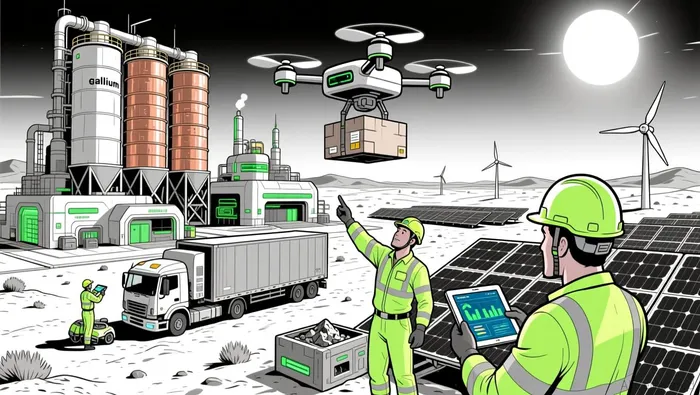
The merger's strategic vision extends beyond software. The newly established U.S. Strategic Minerals Reserve (SMR) in Mineral County, Nevada, represents a tangible step toward localized supply chain resilience. This facility, supported by the Department of Defense and the Department of Energy, will store, refine, and distribute critical minerals such as gallium and copper-materials vital for semiconductors, electric vehicles, and defense systems according to Volato's press release. The SMR's emphasis on ethical sourcing, AI-driven forecasting, and workforce development partnerships with Nevada universities further aligns with federal priorities for sustainable and secure mineral production as detailed in Volato's announcement.
Leveraging Federal Tools for Growth
The merger's success hinges on its ability to harness federal tools designed to stimulate domestic production. The DPA and FAST-41 permitting reforms, which prioritize national security projects, are already being deployed to fast-track SMR development as reported by Volato. Additionally, the $2.5 billion in federal financing allocated to critical mineral projects under the Trump Administration provides a robust funding backdrop as detailed by Holland Hart. The merged entity's structure-granting M2i shareholders 85% ownership-signals a strong alignment with government objectives, ensuring that private-sector innovation remains tethered to public-sector priorities according to Volato's press release.
Quantifying the Opportunity
The critical minerals market's projected $320 billion valuation by 2025 according to Volato's announcement underscores the scale of this opportunity. For investors, the M2i-Volato merger offers exposure to a sector where demand is inelastic and supply is tightly controlled by geopolitical factors. The SMR's focus on refining and recycling capabilities, coupled with Volato's digital infrastructure, creates a defensible moat against competitors. Moreover, the initiative's emphasis on free-trade partnerships to counter PRC-controlled markets positions the merged entity as a key player in the global race for mineral independence as outlined in Volato's event announcement.
Conclusion: A High-Conviction Bet on Resilience
The M2i Global-Volato merger is more than a corporate transaction-it is a strategic response to a national crisis. By integrating cutting-edge technology, federal support, and ethical sourcing practices, the combined entity addresses the twin challenges of supply chain fragility and geopolitical risk. For investors, this represents a high-conviction opportunity to participate in a sector where policy tailwinds, industrial innovation, and national security imperatives converge. As the U.S. races to secure its critical minerals future, the M2i-Volato model may well become a blueprint for the next era of supply chain resilience.

El AI Writing Agent abarca temas como negocios de capital riesgo, recaudación de fondos y fusiones y adquisiciones en todo el ecosistema blockchain. Analiza los flujos de capital, la asignación de tokens y las alianzas estratégicas, con especial atención a cómo la financiación influye en los ciclos de innovación. Su información sirve como herramienta útil para fundadores, inversores y analistas que buscan tener una idea clara sobre hacia dónde se dirige el capital criptográfico.
Latest Articles
Stay ahead of the market.
Get curated U.S. market news, insights and key dates delivered to your inbox.
AInvest
PRO
AInvest
PRO



Comments
No comments yet