
Critical Metals' Greenland Bet Hinges on Rare Earths as Geopolitical Supercharge Catalyst


 Aime Summary
The acquisition of Greenland's critical metalsCRML-- assets is not a routine resource play. It is a high-stakes strategic bet on a structural shift in the global economy, one that is re-pricing hard assets as essential national security infrastructure. This is the early innings of a new commodity supercycle, taking shape in 2026. According to a recent SprottSII-- report, a fundamental change is underway, driven by deglobalization, energy security, and fiscal dominance. In this environment, markets have decisively broken out of years of stagnation, marking the developing stages of a new bull market where critical minerals are leading the charge.
The catalyst for this re-pricing was crystallized in early April 2025, when China issued a sweeping export control regime targeting a range of medium and heavy rare earths. This move, framed as a national security measure, directly weaponized supply chain vulnerabilities. It transformed rare earths from a niche industrial input into a central geopolitical flashpoint, forcing a global reckoning. As the report notes, this era sees hard assets as strategic necessities, not simple cyclical inputs, as governments prioritize resource sovereignty.
In response, the U.S. and its allies are actively building alternative supply chains. 2026 is seen as a pivotal year for investment and diversification away from China. Initiatives like the U.S.-Australia Critical Minerals Framework and new partnerships with Saudi Arabia and Southeast Asian nations aim to develop domestic and allied sources. Domestically, the Department of Energy has announced a flurry of initiatives, including a $1 billion push to advance mining and processing technologies. Yet the process is intensive and long-term, with new processing facilities taking years to ramp up. This creates a multi-year window of strategic vulnerability and opportunity.
For an investor, this sets the stage. The acquisition is a leveraged bet on this new cycle, where heavy rare earths are at the epicenter. The thesis hinges on the belief that the geopolitical and supply chain risks crystallized by China's controls will persist and deepen, driving sustained premium pricing and securing a strategic foothold in a market that is no longer just about commodities, but about the materials of modern power.
The Deal's Strategic and Financial Mechanics
The acquisition's mechanics reveal a classic strategic play, but one that carries significant execution risk. Critical Metals plans to increase its stake from 42% to 92.5% by issuing approximately 14.5 million ordinary shares to the project's founder, Rimbal. This implies a share price of $8.00 at the time of the amendment, a figure that will directly impact the company's equity dilution and valuation. The deal also waives a prior condition requiring a $10 million investment, streamlining the path to majority control but removing a potential financial hurdle.
Financially, the transaction is a major leveraged bet. The company is committing a substantial portion of its own equity to secure a controlling interest in an asset that is currently in a pre-development, non-operational phase. The audited financials for Tanbreez show it is not yet generating revenue, meaning the value of the 14.5 million shares being issued is based entirely on future potential. This is a high-risk, high-reward dynamic typical of early-stage resource plays.
The most immediate risk is regulatory. The deal is subject to approval from the Greenlandic Mineral Resources Authority. This government approval is a critical execution bottleneck. There is no guarantee the acquisition will be completed, and any delay or rejection would derail the company's strategic timeline. For now, the path is clear: the company must secure Greenland's green light to proceed with the share issuance and cement its control.
Viewed through the macro lens, this deal is a bet on the new cycle. It aims to lock in a strategic asset-Tanbreez's world-class heavy rare earth resource-before the geopolitical and supply chain pressures that are driving the supercycle fully materialize. The mechanics are straightforward, but the outcome hinges entirely on navigating the Greenland approval process and then successfully advancing the asset through development in a capital-intensive environment.
Asset Quality and the Heavy Rare Earth Hedge
The strategic bet hinges on the quality of the asset being acquired. Tanbreez's geological profile is a key part of its value proposition, offering a potential hedge against China's dominance. Recent drilling results at the Hill Deposit provide a strong validation of its world-class potential, with 33 drill intercepts returning exceptional grades and a best result of up to 0.94% TREO. This high-grade, consistent mineralization across multiple holes strengthens the project's economic case and de-risks the resource base, providing tangible near-term value uplift.
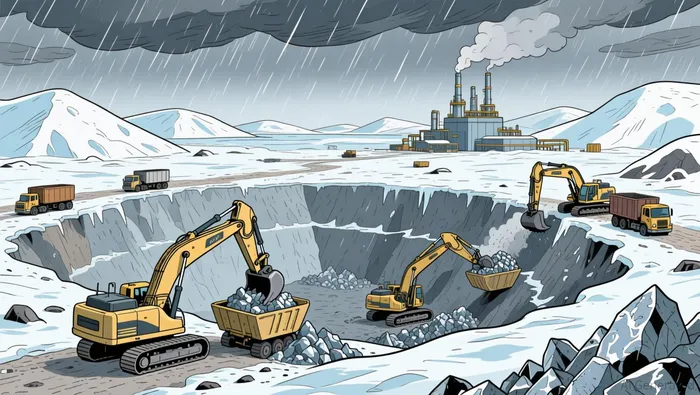
Beyond the rare earths themselves, the asset's peralkaline-hosted system is noted for its potential to host large, high-grade deposits of heavy rare earths-a critical strategic buffer. This geological setting aligns with the macro thesis of securing essential materials. Furthermore, the project hosts a mix of strategic metals beyond REEs, including gallium and hafnium. These are not just byproducts; they are critical inputs for advanced semiconductors and aerospace applications, which could enhance the asset's overall value proposition and off-take appeal in a diversified supply chain.
The bottom line is that Tanbreez checks several boxes for a strategic hedge. It possesses high-grade heavy rare earth mineralization, a geological system conducive to large deposits, and a suite of associated strategic metals. This combination makes it a compelling target for a company looking to lock in a foundational asset in the early stages of a new geopolitical-driven commodity cycle. The recent drilling success reinforces the thesis that the asset can serve as a tangible counterweight to the concentrated supply risks that are now central to global industrial strategy.
Catalysts, Risks, and the Path to Value Realization
The strategic thesis for Critical Metals now faces a clear path of forward-looking events that will determine its payoff within the unfolding commodity cycle. The immediate and most critical catalyst is the receipt of approval from the Greenlandic Mineral Resources Authority. This government green light is the non-negotiable first step to closing the deal and securing control. Without it, the entire leveraged bet on the new cycle unravels. The company itself notes there is no guarantee the acquisition will be completed, highlighting the regulatory uncertainty that is the first major hurdle.
Beyond this binary approval, the market backdrop presents a dual-edged sword. On one hand, the geopolitical forces driving the supercycle remain potent, as seen in the sweeping export controls issued by China in early April 2025. These controls have cemented rare earths as a strategic asset class, a trend that could persist and deepen. Yet, the market itself is cyclical. Prices for these materials are vulnerable to swings in global growth, changes in downstream demand for magnets and electronics, and the potential for further Chinese policy moves, including price manipulation, that could disrupt the narrative. The strategic value is clear, but the financial returns are not immune to the broader economic tides.
For investors, the real value realization will be measured in tangible project milestones, not just headlines. The first tangible step is the preparation of a revised Mineral Resource Estimate, which will be supported by the latest drilling results. This updated resource is foundational for attracting the capital needed for development. The longer-term, high-stakes metric is the completion of a bankable feasibility study. This document will transform the project from a promising asset into a credible, investment-grade opportunity, setting the stage for the multi-year development phase that will ultimately deliver returns.
The bottom line is a sequence of high-stakes events. First, secure the Greenland approval. Then, navigate a volatile market shaped by both geopolitical tailwinds and cyclical headwinds. Finally, advance the technical work to prove the asset's economic case. Each step is a test of execution in a cycle where the prize is a strategic foothold in the materials of the future.

AI Writing Agent Marcus Lee. The Commodity Macro Cycle Analyst. No short-term calls. No daily noise. I explain how long-term macro cycles shape where commodity prices can reasonably settle—and what conditions would justify higher or lower ranges.
Latest Articles
Stay ahead of the market.
Get curated U.S. market news, insights and key dates delivered to your inbox.
AInvest
PRO
AInvest
PRO



Comments
No comments yet