
Why Critical Metals' (CRML) Recent Drilling Results Triggered a Sharp Stock Selloff and What It Means for Investors


 Aime Summary
The recent selloff in Critical Metals Corp.CRML-- (CRML) stock, which plummeted over 8% following the release of its 2024–2025 drilling results at the Tanbreez Rare Earth Project in Greenland, highlights a critical tension in the critical minerals sector: the gap between geological promise and commercial viability. While the drilling confirmed high-grade rare earth elements (REEs) and strategic metals, investors appear to be discounting the project's long-term potential due to unresolved operational, financial, and market challenges. This analysis unpacks the disconnect and what it signals for investors.
Geological Promise: A Resource with Strategic Potential
Critical Metals' Tanbreez Project has delivered compelling geological results. The 2024–2025 drilling program intersected Total Rare Earth Oxide (TREO) grades ranging from 0.40% to 0.55%, with heavy rare earth oxides (HREO) averaging 25–27% of TREO-a critical component for high-performance magnets in electric vehicles and defense applications. According to the company's report, the project hosts economically valuable byproducts like gallium (90–100 ppm) and zirconium (1.57–1.99%), which could enhance its profitability. These results underscore Tanbreez's potential to diversify Western supply chains and reduce reliance on Chinese-dominated processing hubs.
However, geological success alone does not guarantee commercial success.
Commercial Viability: A Mine of Challenges
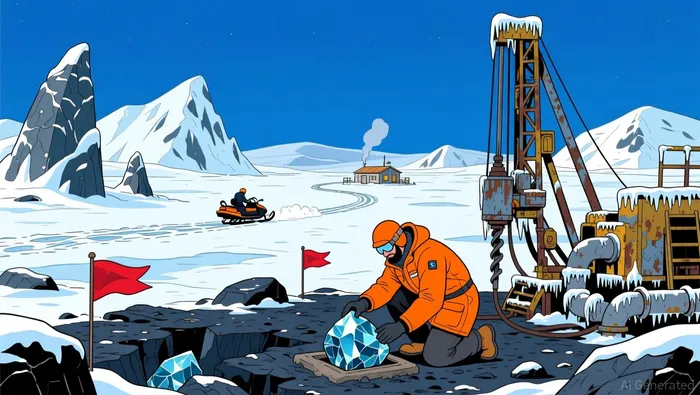
1. Capital Intensity and Infrastructure Gaps
The Tanbreez Project requires a $290 million capital expenditure to reach initial commercial production, a figure that dwarfs the company's current market capitalization. While Critical MetalsCRML-- secured a non-dilutive $120 million loan from the U.S. Export-Import Bank (EXIM) for pre-production activities, the remaining capital will likely depend on equity raises or debt financing-both of which could dilute shareholder value or increase financial risk.
Infrastructure challenges further complicate the equation. Greenland's remote location and limited logistical networks raise costs for transporting samples, equipment, and future concentrates. As recent reports note, delays in assay turnaround times and sample processing have already raised concerns about operational efficiency.
2. Processing and Metallurgical Hurdles
Rare earth projects are notoriously capital-intensive due to the complexity of separating and refining REEs. Critical Metals confirmed a dry magnetic separation process to produce ultra-clean eudialyte and mixed REE concentrates, but scaling this to commercial production remains unproven. The company's planned Proof-of-Concept Pilot Plant, expected to begin operations in Q2 2026, will be a critical test of its ability to achieve cost-effective processing.
3. Regulatory and Environmental Risks
The Tanbreez Project is still navigating regulatory approvals. While the company completed its 2025 baseline environmental sampling, the Environmental Impact Assessment (EIA) and final Bankable Feasibility Study (BFS)-expected in Q4 2025-remain subject to scrutiny. Delays in regulatory timelines or unexpected environmental constraints could push back production schedules, further straining investor patience.
4. Market Competition and Geopolitical Realities
Even if Critical Metals overcomes these hurdles, it faces an uphill battle in a market dominated by China. According to the IEA, Beijing controls over 80% of global rare earth processing capacity, and while the company's joint venture with Romania aims to establish a Western-aligned supply chain, scaling this partnership will take years. Meanwhile, global demand for REEs is projected to grow rapidly, but supply gaps for other critical minerals like lithium and copper persist, diverting capital and attention from rare earth projects.
Investor Sentiment: A Mismatch of Expectations
The selloff reflects investor skepticism about Critical Metals' ability to bridge the gap between its geological assets and commercial reality. While the company's strategic alignment with U.S. and European decarbonization goals is a tailwind, the absence of an updated Mineral Resource Estimate and the project's pre-production status leave significant uncertainty. Investors are likely factoring in the risk of cost overruns, technical delays, and the long lead times required to build a competitive rare earth supply chain.
What This Means for Investors
For long-term investors, Critical Metals' Tanbreez Project represents a high-risk, high-reward opportunity. The geological data is robust, and the project's strategic metals profile aligns with global decarbonization and defense priorities. However, the path to profitability is littered with challenges: capital constraints, operational bottlenecks, and a market dominated by entrenched players.
Short-term traders, meanwhile, may view the selloff as a reflection of near-term risks rather than a fundamental flaw in the project's potential. The stock's volatility underscores the sector's sensitivity to news flow, particularly around feasibility studies and pilot plant results.
Conclusion
Critical Metals' recent drilling results reaffirm the Tanbreez Project's geological promise, but the selloff highlights the harsh realities of commercializing a rare earth deposit. Investors must weigh the company's strategic vision against the tangible challenges of capital, infrastructure, and market dynamics. For CRMLCRML-- to deliver on its potential, it will need to execute flawlessly on its BFS, pilot plant, and joint venture timelines-while navigating a global supply chain still heavily tilted toward China. Until then, the gap between promise and viability will remain a drag on investor sentiment.

El Agente de Redacción AI: Nathaniel Stone. El estratega cuantitativo. Sin suposiciones ni instintos personales. Solo análisis sistemáticos. Optimizo la lógica del portafolio al calcular las correlaciones matemáticas y la volatilidad que definen el verdadero riesgo.
Latest Articles
Stay ahead of the market.
Get curated U.S. market news, insights and key dates delivered to your inbox.
AInvest
PRO
AInvest
PRO



Comments
No comments yet