
Critical Infrastructure Resilience in the Face of Climate-Driven Energy Disruptions


 Aime Summary
The escalating frequency and severity of climate-driven energy disruptions are reshaping the financial landscape of utility companies and smart grid technologies. As recent events in California demonstrate, the vulnerabilities of aging infrastructure and the cascading economic costs of outages demand urgent attention. Yet, these challenges also present profound opportunities for innovation and investment.
The Financial Risks of Climate-Driven Outages
Pacific Gas & Electric Company (PG&E) has become a case study in the financial risks posed by climate-related grid failures. In 2024, nearly a million customers faced fast-trip outages-automated power cuts designed to prevent wildfires-disproportionately affecting rural communities, which
experienced 600% more outages than urban areas. These disruptions not only strained local businesses, such as Camp Tuolumne Trails and Groveland enterprises, but also
exposed systemic weaknesses in grid reliability.
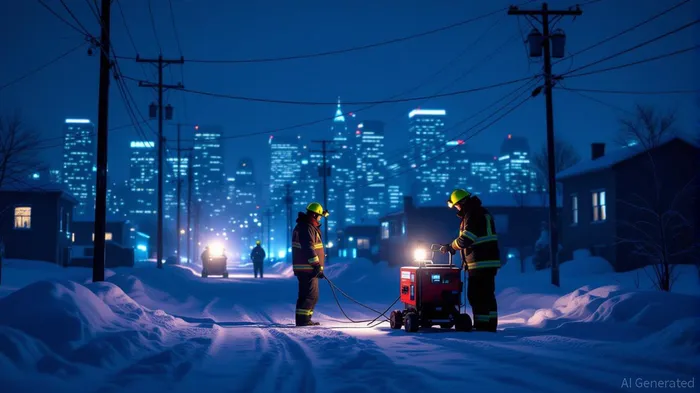
The December 2025 San Francisco outage, which left 130,000 residents and businesses without power during a critical holiday shopping period, further underscored the economic toll. Retailers faced cash-only operations or closures, while traffic gridlock and public transportation shutdowns compounded the chaos
during a critical holiday shopping period. A Reuters analysis highlighted how the outage's timing-just before Christmas-amplified its impact, with businesses
estimating losses in the millions.
 PG&E's financial liabilities extend beyond immediate outages. Its ongoing bankruptcy proceedings, initiated to address wildfire-related claims, reveal a broader pattern of systemic risk. In 2025, wildfire-related costs continued to pressure PG&E's earnings, with
adjusted guidance reflecting a $1.26–$1.32 per share range. For investors, these developments signal the need to scrutinize utility companies' exposure to climate-driven liabilities, including litigation, compensation programs, and infrastructure modernization costs.
Regulatory Responses and Smart Grid Innovations
California's regulatory bodies have responded to these crises with a dual focus on grid resilience and technological modernization. The California Public Utilities Commission (CPUC) has approved significant investments, including a 225-megawatt battery project (the Dirac Project) and a $4.8 billion transmission buildout by the California Independent System Operator (CAISO)
as part of a broader policy shift. These initiatives aim to address load growth and integrate renewable energy, reflecting a broader shift toward decentralized, flexible systems.
PG&E itself has embraced smart grid technologies as a cornerstone of its strategy. At its 2024 Innovation Summit, the company
emphasized AI-driven analytics for managing extreme climate events and integrating distributed energy resources (DERs) into grid planning. Such innovations align with California's progress in achieving 100% clean energy for extended periods and
avoiding Flex Alerts in 2024. However, energy leaders caution that multi-stressor events-such as simultaneous wildfires and heatwaves-remain a critical challenge
as climate trends continue to evolve.
Investment Opportunities in Resilient Infrastructure
The global utility sector is now at a crossroads, with climate resilience driving both risks and opportunities. According to BloombergNEF,
global grid capital spending is projected to exceed $470 billion in 2025, with the U.S. leading at $115 billion. Transmission infrastructure investments are growing at twice the rate of distribution,
reflecting the need to connect renewable energy sources.
Smart grid technologies, including dynamic line ratings and AI-optimized solutions, are gaining traction despite permitting delays and grid expansion hurdles
as the market evolves. The Inflation Reduction Act (IRA) and Infrastructure Investment and Jobs Act (IIJA) are pivotal in enabling these investments,
offering tax incentives and funding for clean energy projects. For utilities, the challenge lies in balancing decarbonization goals with affordability and reliability, particularly as
data center demand surges due to AI and cloud computing.
Investors must also consider the role of creative financing models and strategic partnerships.
Deloitte notes that utilities are increasingly leveraging public-private collaborations to fund ambitious projects, with the IRA and IIJA serving as catalysts. The sector's
projected $1 trillion in U.S. capital expenditures from 2025 to 2029 underscores its long-term growth potential.
Conclusion: A Call for Prudent Investment
The PG&E saga and California's regulatory responses illustrate a broader truth: climate-driven energy disruptions are no longer hypothetical risks but present realities. For investors, the key lies in distinguishing between companies that proactively modernize infrastructure and those that lag behind. While the financial liabilities of outages and wildfires are daunting, the transition to smart grids and resilient systems offers a compelling long-term opportunity.
As the energy landscape evolves, the imperative is clear: resilience is not merely a technical challenge but a financial imperative. Those who invest wisely in the infrastructure of tomorrow will not only mitigate risks but also capitalize on the transformative potential of a climate-resilient grid.

Stay ahead of the market.
Get curated U.S. market news, insights and key dates delivered to your inbox.






Comments
No comments yet