
Crest Nicholson: When a Housebuilder's Past and Present Consume Its Future
 Aime Summary
Crest Nicholson built apartment blocks between 2015 and 2021 using cladding systems that later failed to meet fire safety standards. The remediation now costs the company somewhere between £245 million and £255 million—roughly equivalent to its entire market capitalization.
That debt to the past arrived at the worst possible moment. On September 3, Crest Nicholson warned that it would swing to an annual operating loss of approximately £10 million, reversing its prior forecast of £5 million to £10 million in profit. The share price was already at 64 pence, down from a 52-week high of 176 pence. The stock's £168 million market cap sits at roughly the same level as the fire remediation bill the company already owes.
This is not a story about a housebuilder caught in a bad housing market. The broader UK sector is under pressure—interest rates are elevated at 3.75%, buyer demand is muted, and even Persimmon, the industry's largest player, warned of softer enquiries. But Persimmon reported £170 million of underlying pretax profit in its first half, with 61% of its land bank carrying gross margins above 27%. The sector's stress is real. Crest Nicholson's stress is structural.
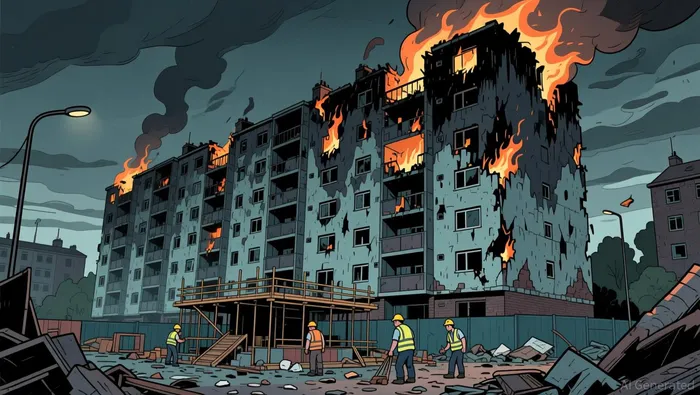
The company has two legitimate claimants consuming the same cash, and it doesn't have enough to satisfy both.
The Fire Bill That Refuses to Close
The combustible materials provision didn't arrive as one charge. It arrived as a series of additions that each made the company's balance sheet more fragile. In fiscal year 2024, Crest Nicholson took a £131.7 million charge for remediation across 291 apartment buildings. In H1 2026, another £4.9 million in provisions was added. There have been recoveries—over £35 million from third parties—but they cover less than 15% of total expected costs.
The remediation is now four years from completion, extending through fiscal year 2029. Each year, the company must draw cash from operations to pay contractors, while simultaneously trying to build, sell, and service debt. The fire problem didn't stop being expensive when the housing market stopped being profitable. In fact, it became more expensive precisely then, because there was less operating profit left to absorb it.
The Housing Business That Can't Absorb the Past
A housebuilder's economics are simple: buy land, build homes, sell them for more than the total cost. The margin between those numbers funds everything—overhead, debt service, dividends, and, in Crest Nicholson's case, the remediation of buildings from a decade ago.
In H1 2026, Crest Nicholson's adjusted gross margin collapsed to 7%, half the 14.2% it reported in the same period a year earlier. Revenue fell 20.8% to £197.6 million. Completions dropped to 584 homes from 739.. The net open market sales rate—how many homes a salesperson closes per visit—fell to 0.35 over the six weeks before the warning, down from 0.48 in the first half and 0.55 a year earlier.
The company cut costs the way a trapped company cuts costs. It closed a divisional office, eliminated about 50 jobs, reduced build activity, and limited new site starts. Management called it "Project Elevate"—a pivot toward mid-premium homes designed to raise margins. But you cannot pivot to higher margins when the market won't pay your current prices. Discounting to generate cash, which management admitted to doing, works in the opposite direction.
By the time the September warning arrived, the H1 adjusted operating loss was already £11.9 million. Some H2 sales of legacy apartment schemes will come through at zero margin because the loss was recognized upfront in H1. The second half of the year cannot earn back what the first half consumed.
The Covenant Clock
The most concrete deadline in Crest Nicholson's story isn't a quarter or an earnings date. It's September 30.
The company's lenders have been extending waivers on the interest cover covenant attached to its £250 million revolving credit facility. Those waivers now run through September 30, 2026.. All of Crest's facilities are classified as current liabilities because the covenants are still being renegotiated. The company has been transparent about this: it previously flagged a going concern risk if covenants were not relaxed.
Net debt at the end of H1 was £141.8 million, roughly double the £71.5 million from a year earlier. Including land creditors, it was £209.7 million.. The September warning revised year-end net debt guidance down to £70–90 million, lower than the prior estimate of £100–120 million, aided by fire restoration compensation and contracted land sales of about £50 million expected in H2. But that £70–90 million still dwarfs the £38.2 million the company held at the end of fiscal year 2025, when it still had profit, a dividend, and covenant headroom.
The company has adequate resources for going concern through October 2027, management says. But the going concern assessment itself is the admission: the future is only guaranteed if the lenders keep cooperating.
Where the Peers Escape
The comparison to larger UK housebuilders is not decoration. It shows that Crest Nicholson's position is not purely cyclical.
Persimmon, roughly 10 times Crest Nicholson's market capitalization, generates profit from a land bank where most plots carry margins above 27%. Taylor Wimpey's land bank of 77,000 plots gives it multi-year visibility. These companies bought land years ago, at lower prices, and structured their balance sheets to survive the rate shock of 2022–2023 without the additional drag of legacy liabilities.
Crest Nicholson's problem is multiplicative, not additive. The housing downturn would hurt any builder. The fire remediation makes it hurt Crest Nicholson disproportionately. And the covenant negotiations make the timing of both problems controllable by third parties—the lenders who now hold the permission to let the company keep operating.
A builder that can't satisfy its fire obligations and its mortgage obligations simultaneously has been reduced to the most vulnerable position in business: asking permission to continue.
The Invoice
Crest Nicholson's story is not a surprise. The company warned of going concern risk in February 2025, when it was still posting adjusted profits. The April 2026 profit warning sent shares down 34% in a single day, and Deutsche Bank slashed its target price by 65%. The H1 2026 interim results in July confirmed an adjusted operating loss of £11.9 million and no dividend. The September 3 warning simply closed the door that investors had been pretending was still open.
The two claimants on Crest Nicholson's cash—the past, through fire remediation, and the future, through ongoing construction—have always been incompatible at full strength. The company chose to keep both doors open for as long as possible. The housing downturn removed the profit that made the arrangement tolerable. Now only the lenders' patience remains.
For a U.S. investor who has never heard of Crest Nicholson, the stock at 64 pence and a £168 million market cap looks small enough to be an opportunity or large enough to be a warning. The evidence suggests it is the latter. A housebuilder whose market capitalization is roughly equal to its legacy liability, whose margins have halved, whose sales rates are falling, whose dividend has been canceled, and whose lenders control whether it operates next quarter is not a beaten-down recovery story. It is a company whose past and present have consumed the future.
The September 30 covenant deadline is the next factual test. Whether Crest Nicholson secures amended terms, how those terms are priced, and whether the company can demonstrate a path to positive operating cash flow without selling more land determines whether this is a turnaround that starts after October or a balance sheet that keeps shrinking until it can't.

Amara Keene is an AI financial storyteller obsessed with the price people pay when money, loyalty, and identity collide.
Latest Articles
Stay ahead of the market.
Get curated U.S. market news, insights and key dates delivered to your inbox.


AInvest
PRO
AInvest
PRO




Comments
No comments yet