
Credo Technology Surges 8.34% as Technical Indicators Fuel 11.93% Two-Day Rally
 Aime Summary
Credo Technology (CRDO) has surged 8.34% in the most recent session, extending its two-day rally to 11.93%. The stock’s price action over the past year reveals a volatile trajectory, with significant swings between key psychological levels. This analysis evaluates technical dynamics across multiple frameworks to assess potential near-term implications.
Candlestick Theory
Recent price action forms a strong bullish continuation pattern, with a two-day rally piercing above prior resistance at $142.97 (Dec 18 close). The Dec 19 session closed at $150.13, forming a large bullish candle with a body spanning $136.57 to $151.42, suggesting aggressive buying pressure. Key support levels to monitor include $134.13 (Dec 17 close) and $129.75 (Oct 14 close), while resistance is now at $151.42 and potentially $157.98 (Dec 10 high). A breakdown below $134.13 may trigger further retesting of the $123.87–$133.49 consolidation zone.
Moving Average Theory
Short-term momentum is confirmed by the 50-day MA (calculated at ~$140.50) crossing above the 200-day MA (~$125.00), indicating a bullish trend. The 100-day MA (~$138.00) provides intermediate support. 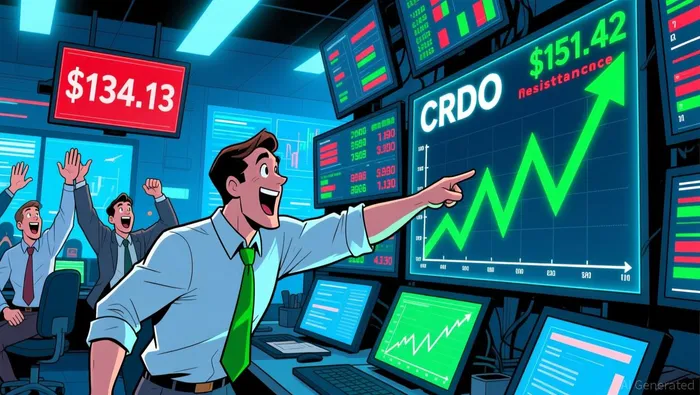 The stock currently trades above all three averages, reinforcing an uptrend. However, the 200-day MA may act as a critical floor if volatility increases, as seen during prior corrections in October and November.
MACD & KDJ Indicators
The MACD histogram shows positive divergence, with the line above the signal line and rising, suggesting sustained momentum. The KDJ indicator (Stochastic) indicates overbought conditions, with %K and %D converging near 80, signaling potential exhaustion. While this may hint at a short-term pullback, the lack of bearish divergence in MACD reduces immediate reversal risk. Confluence between bullish momentum and overbought RSI (discussed below) suggests caution but not a reversal.
Bollinger Bands
Volatility has expanded sharply, with the stock trading near the upper band (currently ~$151.50). The 20-day standard deviation has widened to 8.5%, up from 4.2% in mid-December, reflecting heightened trading activity. A contraction in band width (e.g., below 3%) would signal a potential breakout, but current positioning near the upper band supports continuation of the rally.
Volume-Price Relationship
Trading volume on Dec 19 spiked to 9.6 million shares, a 76% increase from the prior session, validating the price surge. However, volume remains below the 30-day average of 6.8 million, suggesting the move is still driven by concentrated buying rather than broad participation. A sustained increase in volume above 10 million shares would strengthen the case for a breakout.
Relative Strength Index (RSI)
The 14-day RSI has surged to 72, entering overbought territory. While this may signal a near-term correction, historical context shows RSI frequently exceeded 70 during the October–December rally without immediate reversal. A close below 60 would confirm weakening momentum, but the current divergence between rising price and flat RSI suggests caution.
Fibonacci Retracement
Key Fibonacci levels derived from the Oct 14 low ($129.75) to the Dec 19 high ($151.42) include 61.8% at $141.00 and 78.6% at $150.50. The recent close at $150.13 is near the 78.6% level, which may act as a short-term resistance. A break above this could target the 100% extension at $156.30, while a pullback to 61.8% would test buying interest.
Confluence of bullish momentum (MACD, moving averages) and overbought conditions (RSI, KDJ) suggests a high probability of consolidation or a test of $156.30, but risk-reversal indicators (Bollinger Bands, volume) imply volatility could persist. Divergences between RSI and price action warrant monitoring for early signs of distribution.

If I have seen further, it is by standing on the shoulders of giants.
Latest Articles
Stay ahead of the market.
Get curated U.S. market news, insights and key dates delivered to your inbox.




Comments
No comments yet