
Credo Technology (CRDO) Surges 3.31% as Bullish Candlestick Pattern Emerges Near Key $136.57 Support Level
 Aime Summary
Credo Technology (CRDO) closed the most recent session with a 3.31% increase, reflecting a short-term bullish bias. The price action suggests a potential breakout from a consolidation phase, as evidenced by a bullish candlestick pattern forming near a key support level at approximately $136.57. This level has historically acted as a psychological floor, with price rebounding twice in late December. Conversely, resistance is emerging around $143.99, where the stock faced rejection during a prior bearish correction. The recent candlestick formation—a piercing line—indicates a possible reversal from downward momentum, though confirmation via follow-through buying is required.
Candlestick Theory 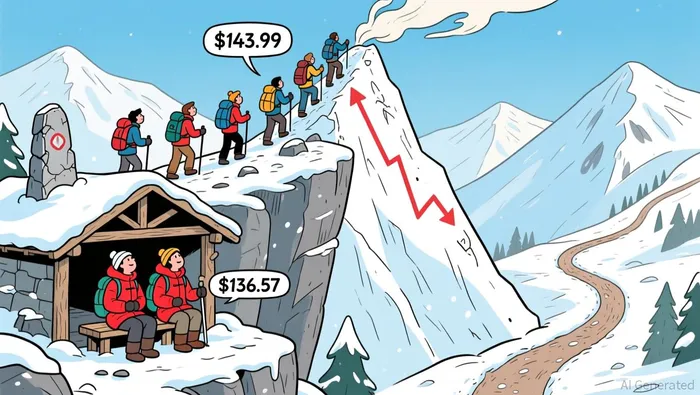 The price action over the past month reveals a series of bullish reversal patterns, including a morning star and a bullish harami, suggesting a shift in sentiment. Key support levels at $136.57 and $129.75 (identified through prior lows) coincide with Fibonacci retracement levels of 38.2% and 61.8%, respectively. Resistance is clustered around $143.99 and $154.47, with the latter acting as a critical psychological threshold. The convergence of these levels increases the probability of price consolidation or breakout attempts in the near term.
Moving Average Theory
Short-term momentum appears to be gaining traction, as the 50-day moving average (DMA) crossed above the 100-DMA in late November, signaling a potential uptrend. However, the 200-DMA remains a dominant bearish force, currently acting as a dynamic resistance at approximately $147.42. This suggests a tug-of-war between short-term optimism and long-term bearish sentiment. A sustained close above the 200-DMA would validate a structural shift in trend, while a pullback below the 50-DMA could reignite selling pressure.
MACD & KDJ Indicators
The MACD histogram has shown a narrowing divergence in recent sessions, indicating weakening bearish momentum. A potential bullish crossover of the MACD line above the signal line near $0.50 could confirm a short-term rally. The KDJ indicator, however, remains in overbought territory (K-line above 80), suggesting caution. While the MACD supports a near-term rally, the KDJ’s overbought condition implies a risk of short-term profit-taking. Divergence between these indicators highlights the need for caution, as the market may oscillate between bullish and bearish forces before finding direction.
Bollinger Bands
Volatility has expanded in recent weeks, with the upper band reaching $154.47 and the lower band contracting to $136.57. The current price of $138.57 sits near the 20-day Bollinger Band mean, suggesting a potential consolidation phase. A breakout above the upper band would require a sustained move beyond $143.99, while a breakdown below the lower band could retest the $129.75 level. The band’s width indicates elevated uncertainty, with traders likely anticipating a directional move.
Volume-Price Relationship
Trading volume has surged in recent sessions, with the most recent rally on $138.57 accompanied by a 53.74 million share turnover. This volume validates the strength of the upward move, particularly as it coincides with a breakout from a descending channel. However, volume during prior attempts to break above $143.99 was relatively lower, suggesting that institutional participation may be limited. A continuation of high-volume buying would reinforce the bullish case, while a divergence in volume could signal exhaustion.
Relative Strength Index (RSI)
The RSI has oscillated between 40 and 60 over the past month, indicating a balanced market. Currently at 58, it remains within neutral territory, avoiding overbought (>70) or oversold (<30) extremes. However, a recent divergence between the RSI and price action—a higher high in price without a corresponding rise in RSI—suggests weakening momentum. Traders should monitor the RSI for a potential crossover above 60 as a bullish trigger, but the lack of overbought conditions tempers expectations for a sharp rally.
Fibonacci Retracement
Fibonacci levels derived from the December 12–December 17 price swing (high of $154.47 to low of $132.76) align with key support and resistance clusters. The 38.2% retracement level at $143.99 coincides with prior resistance, while the 61.8% level at $136.57 has acted as a recurring floor. The current price of $138.57 sits between these levels, indicating a potential consolidation phase. A break below $136.57 could target the 78.6% retracement at $129.75, whereas a move above $143.99 could challenge the $154.47 psychological ceiling.
Confluence points between moving averages, Fibonacci levels, and Bollinger Bands suggest that $136.57 and $143.99 are critical junctures. While the MACD and candlestick patterns lean bullish, the KDJ’s overbought condition and RSI divergence introduce uncertainty. Traders should prioritize risk management, as volatility remains elevated and divergences between momentum indicators hint at potential whipsaws. A decisive close above $143.99 with expanding volume would strengthen the case for a sustained uptrend, but until then, the market may remain range-bound.

If I have seen further, it is by standing on the shoulders of giants.
Latest Articles
Stay ahead of the market.
Get curated U.S. market news, insights and key dates delivered to your inbox.




Comments
No comments yet