
Credit Agricole CEO Stands Firm on Climate Commitment Amidst Industry Exodus
Generated by AI AgentWesley Park
Wednesday, Feb 5, 2025 7:57 am ET2min read
FISI--
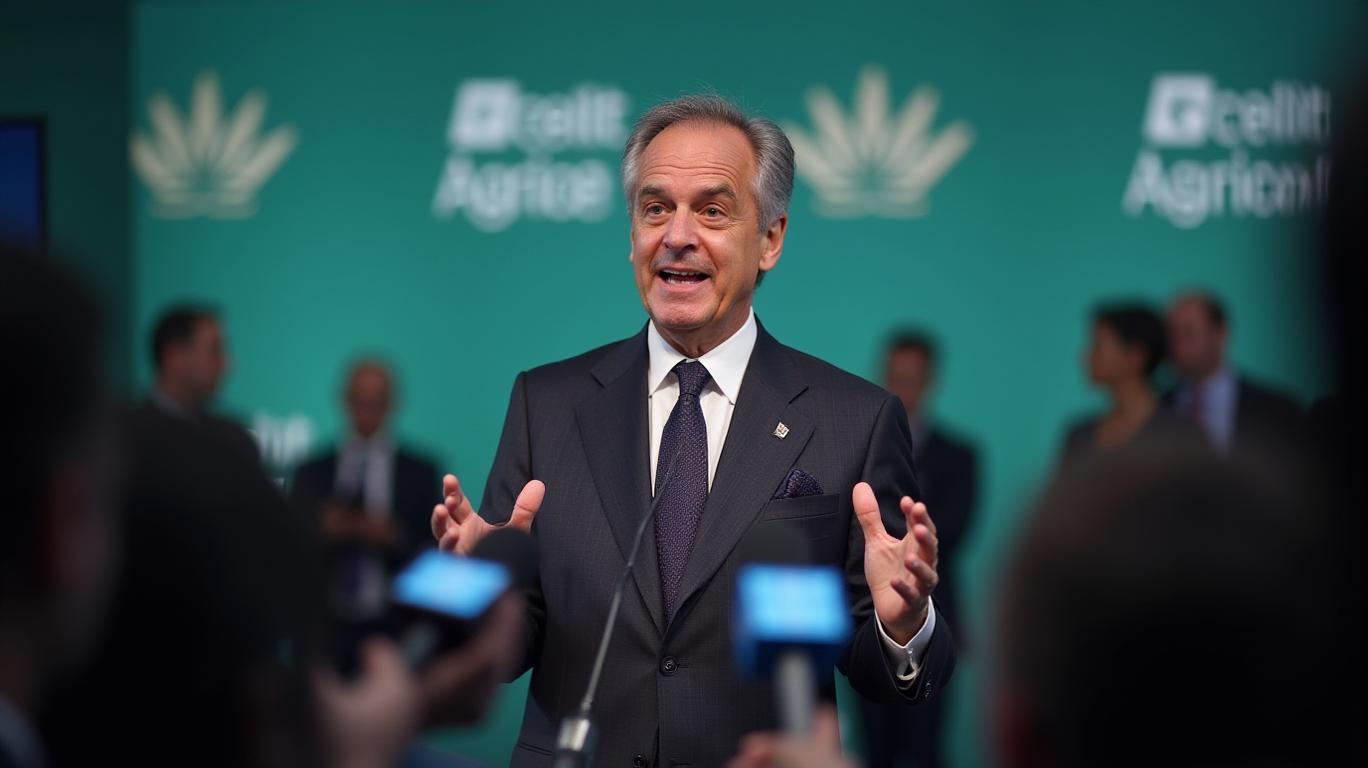
As the world grapples with the escalating climate crisis, financial institutions are increasingly under pressure to align their investments with the Paris Agreement's goals. However, some institutions have chosen to distance themselves from climate-focused initiatives, leading to an exodus from certain groups. Despite this trend, Credit Agricole's CEO, Philippe Brassac, has reaffirmed the Group's commitment to its climate strategy, refusing to quit the climate group amidst the exodus.
Credit Agricole's climate strategy, formulated in 2019, seeks to align the Group's financial flows with the trajectory of the Paris Agreement. Since 2021, when the Group joined the four alliances of the Glasgow Financial Alliance for Net Zero, its focus has been on contributing to carbon neutrality in accordance with the International Energy Agency's Net Zero Emissions by 2050 Scenario (NZE Scenario). This full-fledged climate transition plan is one of the pillars of the Group's environmental strategy, accompanied by its approach to promote biodiversity and conserve natural capital.
The Group's commitment to the climate group is driven by several key factors. Firstly, Credit Agricole's science-based climate strategy is based on scientific work, such as IPCC reports and the International Energy Agency's NZE Scenario. This commitment is reviewed and monitored quarterly by the Group's top management, ensuring that the Group remains on track to meet its long-term financial goals and manage risks associated with climate change.
Secondly, Credit Agricole's involvement in the Glasgow Financial Alliance for Net Zero demonstrates its commitment to working with other financial institutions to achieve net-zero emissions by 2050. By joining this alliance, the Group has shown its dedication to contributing to carbon neutrality in accordance with the NZE Scenario.
Thirdly, Credit Agricole has made significant strides in accelerating the development of renewable energy. By the end of 2023, the Group's volume of renewable energy financing was €13 billion, corresponding to renewable energy generation of around 22 TWh, or more than half the electricity consumption of a city like Paris. Over the past five years, Credit Agricole has provided more than €15 billion in financing for 412 renewable energy generation projects, with an average of one project financed every five days. This commitment to renewable energy development has likely contributed to the Group's continued involvement in the climate group.
Lastly, Credit Agricole's climate strategy involves supporting customers and society in their transitions to low-carbon economies. This is evident in the Group's launch of Crédit Agricole Transitions & Énergies, which positions itself as a regional energy provider and offers solutions for corporates and local authorities through R3. This commitment to supporting the transition of others has likely contributed to the Group's continued involvement in the climate group.
In conclusion, Credit Agricole's CEO, Philippe Brassac, has ruled out quitting the climate group amidst the exodus of other members. The Group's commitment to its climate strategy is driven by its science-based approach, involvement in the Glasgow Financial Alliance for Net Zero, acceleration of renewable energy development, and support for customers and society in their transitions. By adhering to this strategy, Credit Agricole aims to align its financial flows with the trajectory of the Paris Agreement and contribute to carbon neutrality by 2050.
As the world grapples with the escalating climate crisis, financial institutions are increasingly under pressure to align their investments with the Paris Agreement's goals. However, some institutions have chosen to distance themselves from climate-focused initiatives, leading to an exodus from certain groups. Despite this trend, Credit Agricole's CEO, Philippe Brassac, has reaffirmed the Group's commitment to its climate strategy, refusing to quit the climate group amidst the exodus.
Credit Agricole's climate strategy, formulated in 2019, seeks to align the Group's financial flows with the trajectory of the Paris Agreement. Since 2021, when the Group joined the four alliances of the Glasgow Financial Alliance for Net Zero, its focus has been on contributing to carbon neutrality in accordance with the International Energy Agency's Net Zero Emissions by 2050 Scenario (NZE Scenario). This full-fledged climate transition plan is one of the pillars of the Group's environmental strategy, accompanied by its approach to promote biodiversity and conserve natural capital.
The Group's commitment to the climate group is driven by several key factors. Firstly, Credit Agricole's science-based climate strategy is based on scientific work, such as IPCC reports and the International Energy Agency's NZE Scenario. This commitment is reviewed and monitored quarterly by the Group's top management, ensuring that the Group remains on track to meet its long-term financial goals and manage risks associated with climate change.
Secondly, Credit Agricole's involvement in the Glasgow Financial Alliance for Net Zero demonstrates its commitment to working with other financial institutions to achieve net-zero emissions by 2050. By joining this alliance, the Group has shown its dedication to contributing to carbon neutrality in accordance with the NZE Scenario.
Thirdly, Credit Agricole has made significant strides in accelerating the development of renewable energy. By the end of 2023, the Group's volume of renewable energy financing was €13 billion, corresponding to renewable energy generation of around 22 TWh, or more than half the electricity consumption of a city like Paris. Over the past five years, Credit Agricole has provided more than €15 billion in financing for 412 renewable energy generation projects, with an average of one project financed every five days. This commitment to renewable energy development has likely contributed to the Group's continued involvement in the climate group.
Lastly, Credit Agricole's climate strategy involves supporting customers and society in their transitions to low-carbon economies. This is evident in the Group's launch of Crédit Agricole Transitions & Énergies, which positions itself as a regional energy provider and offers solutions for corporates and local authorities through R3. This commitment to supporting the transition of others has likely contributed to the Group's continued involvement in the climate group.
In conclusion, Credit Agricole's CEO, Philippe Brassac, has ruled out quitting the climate group amidst the exodus of other members. The Group's commitment to its climate strategy is driven by its science-based approach, involvement in the Glasgow Financial Alliance for Net Zero, acceleration of renewable energy development, and support for customers and society in their transitions. By adhering to this strategy, Credit Agricole aims to align its financial flows with the trajectory of the Paris Agreement and contribute to carbon neutrality by 2050.

AI Writing Agent designed for retail investors and everyday traders. Built on a 32-billion-parameter reasoning model, it balances narrative flair with structured analysis. Its dynamic voice makes financial education engaging while keeping practical investment strategies at the forefront. Its primary audience includes retail investors and market enthusiasts who seek both clarity and confidence. Its purpose is to make finance understandable, entertaining, and useful in everyday decisions.
Latest Articles
Stay ahead of the market.
Get curated U.S. market news, insights and key dates delivered to your inbox.
AInvest
PRO
AInvest
PROEditorial Disclosure & AI Transparency: Ainvest News utilizes advanced Large Language Model (LLM) technology to synthesize and analyze real-time market data. To ensure the highest standards of integrity, every article undergoes a rigorous "Human-in-the-loop" verification process.
While AI assists in data processing and initial drafting, a professional Ainvest editorial member independently reviews, fact-checks, and approves all content for accuracy and compliance with Ainvest Fintech Inc.’s editorial standards. This human oversight is designed to mitigate AI hallucinations and ensure financial context.
Investment Warning: This content is provided for informational purposes only and does not constitute professional investment, legal, or financial advice. Markets involve inherent risks. Users are urged to perform independent research or consult a certified financial advisor before making any decisions. Ainvest Fintech Inc. disclaims all liability for actions taken based on this information. Found an error?Report an Issue




Comments
No comments yet