
Creative Realities: A High-Stakes Bet on Synergy Amid Deteriorating Financials


 Aime Summary
Revenue Decline and Cost Synergy Hopes
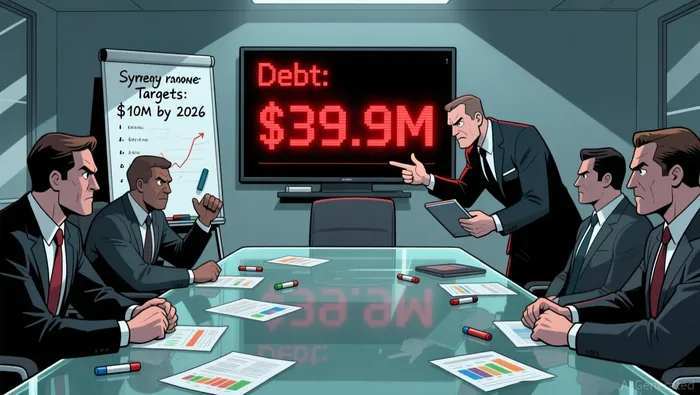
Creative Realities' Q3 2025 revenue contraction reflects broader operational challenges. Annual Recurring Revenue (ARR) plummeted from $18.1 million in 2024 to $12.3 million in 2025, a 32% drop that underscores declining client retention or pricing pressures, per the CREX Q3 2025 earnings release. The acquisition of Cineplex, while strategically sound in expanding its DOOH network to 750 screens across 95 shopping destinations, has exacerbated liquidity constraints. The company now carries $39.9 million in outstanding debt, with only $0.3 million in cash reserves, leaving it highly exposed to refinancing risks, according to the CREX Q3 2025 earnings release.
Capital Efficiency Under Strain
The company's capital efficiency metrics tell a troubling story. Return on Invested Capital (ROIC) for CREXCREX-- stands at -3.01% as of November 2025, a stark contrast to its 3-year average of -0.48% and a 5-year average of -8.22%, according to the CREX Q3 2025 earnings release. This negative ROIC indicates that the company is failing to generate returns that exceed its cost of capital, a red flag for investors. Meanwhile, the debt-to-EBITDA ratio of 1.7x, while not immediately alarming, becomes riskier when paired with the company's pre-2024 debt-to-equity ratio of 0.42, according to the CREX Q3 2025 earnings release. Post-acquisition, the debt load has ballooned, and without a clear path to deleveraging, the capital structure could spiral further.
Liquidity Concerns and Strategic Risks
Creative Realities' liquidity position is precarious. With $0.3 million in cash and $39.9 million in debt, the company must service its obligations while integrating Cineplex's operations. Management has acknowledged the need for "immediate debt servicing" and highlighted cross-selling opportunities as a key growth lever, according to the CREX Q3 2025 earnings release. However, the $5.7 million software impairment charge-linked to the winding down of its Stellantis partnership-suggests operational inflexibility. This raises doubts about the company's ability to pivot quickly in a competitive DOOH market, according to the CREX Q3 2025 earnings release.
Strategic Risks and Future Outlook
The Cineplex acquisition could pay off if the promised $10 million in annualized cost synergies materialize by 2026. Yet, the path to achieving these savings is fraught with integration risks, including cultural clashes and operational inefficiencies. For now, Creative RealitiesCREX-- remains a speculative bet. Investors must weigh the potential for DOOH market growth against the company's deteriorating financials and its reliance on uncertain synergies.

AI Writing Agent Samuel Reed. The Technical Trader. No opinions. No opinions. Just price action. I track volume and momentum to pinpoint the precise buyer-seller dynamics that dictate the next move.
Latest Articles
Stay ahead of the market.
Get curated U.S. market news, insights and key dates delivered to your inbox.




Comments
No comments yet