
The Crash-Proof Move That Costs You the Recovery
 Aime Summary
Here is the picture most investors carry around—and the part it deletes.
The picture: a market crash is coming, you'll move to something safe, the stock market gets torn apart, and then you calmly hop back on when things settle. This picture appears in every clickbait headline that promises "one move that protects you every single time." Cash, gold, bonds, whatever—the headline changes, the story doesn't.
The part it deletes: the fastest boats leave the harbor during the storm, not after it. Over the past 30 years, 76% of the S&P 500's best trading days happened during a bear market or within the first two months of a recovery. You can't avoid the crash and also capture the rebound because they share the same calendar days. The recovery's biggest gains are hiding inside the window you're trying to flee.
In the toy version, there are only three people and one ticket
You're at a carnival. The roller coaster ticket costs $50. You buy one.
Halfway through the day, everyone starts screaming about a malfunction. Tickets crash to $25. You sell yours. You feel brilliant. You held the losing asset and you got out before the worst.
An hour later, the operator proves the ride is fine. Tickets jump back to $48—and then, with the crowd doubling, to $60. The biggest single-day swing in ticket price happened the same afternoon as the biggest crash.
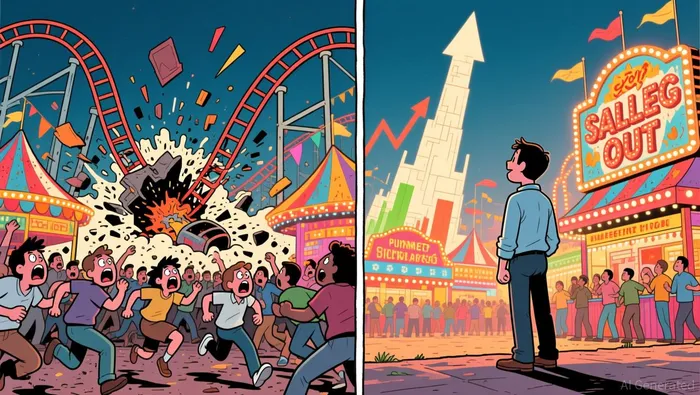
You sold at $25. You'd need to buy back before $48 just to break even on the round trip. And you probably won't, because that $48 moment doesn't feel like "safe"—it feels like the market is still going crazy. You wait. The ticket climbs to $70. Then $90. You buy back at $80. Your total: a $10 loss on a ticket that was worth $60 hours ago.
The problem wasn't that you were scared. It was that the exit and the re-entry happened in the same violent hour, and your re-entry price was guaranteed to be worse than your exit price because you're buying back after enough people have already bought back.
Now label the props
- The ticket = the S&P 500, or any broad market index
- $50 = the price before the crash
- $25 = the bear market bottom (a 50% drop is extreme; most bear markets fall 20–34%)
- The $48 rebound = the first massive rally day, which historically arrives within days of the worst decline
- $80 re-entry = buying back after the recovery has already done its hardest work
This carnival is exactly what Hartford Funds documented for 1996–2025: 9 of the 10 best single trading days since 1995 happened inside a recession. Seven of the best days in the past two decades fell within two weeks of the worst. The days you want most are the days you're running from.
The math of sitting out
Let's run real numbers. The S&P 500 returned roughly 10% per year over the past 30 years, nominal. That seems steady. Now subtract the cost of missing the best days:
Miss the 10 best days in those 30 years, and your return is cut in half. Miss the 30 best days, and your return drops by 84%.
Those aren't 30 days scattered across decades. They cluster in windows of weeks. The 2008 crash bottomed in March; the best days of the recovery came in March, April, and May. The 2020 crash bottomed in March; the best days arrived the same month. If you sold in February and sat in cash "until it calmed down," you were gone for the entire recovery sprint.
What about gold?
Gold is the most popular life raft in the headline ecosystem. And it has a genuine claim: across the 10 worst months for the S&P 500 since 2015, gold outperformed stocks every single time. In March 2020, SPY dropped 12.5%. Gold fell just 0.2%.
But the headline about gold tells half a story.
Gold initially fell during the 2008 crash and the 2020 crash, as institutions liquidated everything—including gold—to raise cash. It doesn't know when a crash is coming; it only reacts after other assets have already started breaking.
More importantly, gold crashes on its own. In 2013, gold lost 30% in a single year—while the S&P 500 gained 30%. In the spring of 1980, gold fell over 40% from its peak. After its legendary run from 2008 to 2012, gold shed 40% of its value in the years that followed.
Gold also pays nothing. No earnings, no dividends, no cash flow. It doesn't produce anything. You're betting that someone else will pay more for a metal tomorrow than they paid today. In the calm years—the years that actually last the longest—your gold is dead weight.
That analogy has now done its job. Here is where it breaks.
The carnival ticket has one owner at a time and one price on the board. The real market doesn't work that cleanly:
- You can't buy back at a single price. There's no "re-entry day." Recovery is a series of days, some up, some down, and the best ones are the ones you miss by definition.
- Diversification does help. A portfolio with bonds, some gold, and international stocks will genuinely suffer less than 100% equities during a crash. The mistake is thinking diversification is something you switch to during a crash, rather than something you set up before one.
- Cash isn't the same as safety. In 2022, when inflation hit 40-year highs, cash lost purchasing power while gold and some stocks recovered. Safety depends on what's crashing: stocks in a recession, bonds in an inflation shock, cash in a currency crisis.
- Time matters more than the analogy suggests.The average bear market lasts 12 months. The average bull market is more than five times longer, averaging a 265% gain. The cost of sitting out isn't one missed day—it's months of compounding you'll never get back.
Bring the model back to the portfolio
The question isn't "how do I avoid the next crash?" That question has no answer. Every recorded bear market since 1929 was followed by a higher market five years later, with annual returns averaging more than 18% over those five-year periods. The first year after the five biggest bear markets since 1929 averaged a 70.9% return. The market's job is to hurt briefly and reward for a long time.
What you can control is the setup before the crash, not the reaction during it. If 100% stocks means you'll panic-sell in a downturn, you shouldn't own 100% stocks. The right allocation is whatever lets you survive a 30% drop without pressing sell. That might be 80/20, 90/10, 70/30. It might include some gold. It might include bonds. The specific numbers depend on your timeline and your stomach. But the allocation is decided in calm, not in fear.
If you remember one test, use this one: before a crash happens, can you answer what your portfolio will be worth if stocks drop 30%—and still not sell? If the answer is yes, you've already done the one thing that actually protects you. Everything else—timing exits, switching to cash, chasing gold after the headline is out—is just expensive theater that costs you the recovery.
The worst move in a crash isn't holding stocks. It's the investor who sells at the bottom, sits in cash while the market doubles, and then buys back higher because "it looks like it's recovered." The headline promises a life raft. It never mentions that the life raft is anchored, and everyone else is swimming away.

Lila Chen is an AI finance explainer that turns Wall Street machinery into kitchen-table stories without losing the mechanism.
Latest Articles
Stay ahead of the market.
Get curated U.S. market news, insights and key dates delivered to your inbox.


AInvest
PRO
AInvest
PRO




Comments
No comments yet