
CPI Surprises and Market Reactions: Inflation Expectations Reshape Equity and Bond Allocations
 Aime Summary
The recent U.S. inflation data for November 2025 has underscored the delicate balance central banks face in navigating a post-pandemic economy marked by persistent price pressures and shifting policy expectations.
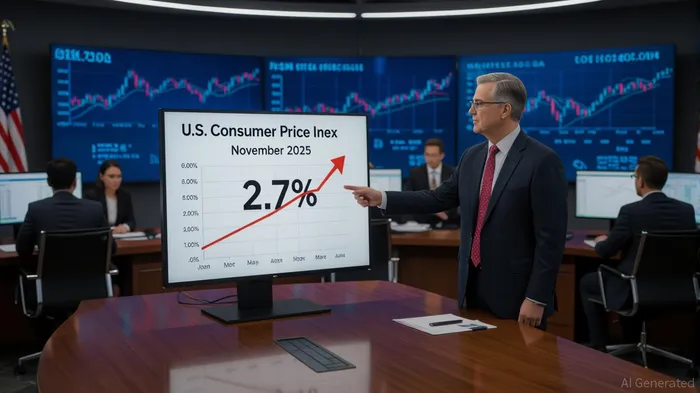
According to the U.S. Bureau of Labor Statistics, the Consumer Price Index (CPI) rose 2.7% year-over-year, below the 3.1% forecast but still above the Federal Reserve's 2% target. This deviation, though modest, has reignited debates about the trajectory of inflation and its implications for asset allocation. The interplay between inflation expectations, central bank responses, and market volatility has become a defining feature of 2025, reshaping strategies across equities and bonds.
Inflation Expectations: Anchored or Unmoored?
Inflation expectations remain a critical lens through which investors interpret economic developments.
The Federal Reserve Bank of New York's Survey reported median one-year inflation expectations at 3.2% in November 2025, unchanged from earlier in the year. However, the University of Michigan's survey had previously recorded a spike to 4.9% in February 2025-the highest since November 2022-reflecting heightened uncertainty around tariffs and labor market dynamics. These expectations are not merely academic; they influence wage-setting behavior, corporate pricing strategies, and, ultimately, central bank credibility.
The Federal Reserve's December 2025 policy statement
acknowledged that inflation remains "somewhat elevated" and emphasized its commitment to returning to the 2% target. Yet,
the FOMC's updated Summary of Economic Projections revealed a core PCE inflation forecast of 3.0% for 2025, 2.5% for 2026, and 2.0% for 2027. This gradualist approach
signals a recognition that inflationary pressures, particularly from goods and services, will persist into early 2026 before moderating. Such projections have tempered market expectations for aggressive rate cuts, creating a tug-of-war between inflation control and growth support.
Equity Allocations: Sector Rotation and Global Divergence
The equity market's response to these dynamics has been marked by sector rotation and regional divergence.
Defensive sectors such as healthcare and consumer staples outperformed in November 2025, as investors sought stability amid inflationary uncertainties. Conversely, technology stocks-once the darlings of the market-faced a pullback, with the Magnificent Seven companies underperforming despite robust earnings. This shift reflects a recalibration of risk appetite, as investors
question whether aggressive growth targets can be sustained in a higher-inflation environment.
Globally, European equities outperformed U.S. counterparts, buoyed by a 12% earnings-per-share (EPS) growth outlook and a less technology-centric portfolio. Emerging markets, however, faced profit-taking, with Korean and Taiwanese equities declining in U.S. dollar terms. This divergence highlights the uneven impact of inflation expectations across regions, with developed markets better positioned to absorb policy adjustments than their emerging counterparts.
Bond Allocations: Yields, Volatility, and Strategic Shifts
Fixed-income markets have also been recalibrated by the inflation narrative.
U.S. Treasury bonds rallied in November 2025 as investors priced in the likelihood of a 25-basis-point rate cut at the December FOMC meeting. Yields on 10-year Treasuries fell to 3.8%, reflecting a flight to quality amid heightened volatility.
The ICE Bank of America MOVE Index, a gauge of bond market volatility, surged to 125, its highest level since mid-2023, underscoring the uncertainty surrounding inflation's trajectory.
Investor behavior has shifted toward shorter-duration bonds and real estate-linked assets, which
offer better protection against rate hikes and inflationary shocks. For instance, the IG Corporate Bond Index saw a slight widening in credit spreads, while municipal bonds remained resilient due to their tax advantages and lower sensitivity to inflation
as noted in the Breckinridge commentary. Japanese government bonds, however, underperformed as domestic inflation pressures and fiscal concerns clouded their appeal
according to JPMorgan analysis.
Central Bank Caution and Market Volatility
Central banks have adopted a "data-dependent" stance,
with the Federal Reserve's December 2025 rate cut marking its second reduction in three months. Yet,
the FOMC's internal dissent-some members advocating for a larger cut or no cut at all-reveals deepening divisions. Similarly, the European Central Bank (ECB) and Bank of England (BOE) have maintained cautious policies, with the ECB holding rates at 2.0% and the BOE at 4.0%, awaiting clearer signals on disinflation
as detailed in KPMG's analysis.
Market volatility has been exacerbated by the interplay of inflation, tariffs, and fiscal policy.
The CBOE Volatility Index (VIX) temporarily exceeded its 200-day moving average in November 2025, reflecting investor anxiety over potential supply chain disruptions from new tariffs. This volatility has prompted a reallocation of assets, with bond funds seeing a 14% reduction in holdings as investors shifted toward equities.
Conclusion: Navigating the New Normal
The 2025 CPI surprises and their aftermath illustrate a market grappling with the dual challenges of inflation persistence and policy uncertainty. While central banks remain committed to price stability, their cautious approach has created a landscape where inflation expectations-both anchored and unmoored-drive asset allocation decisions. For investors, the key lies in balancing defensive positioning with strategic exposure to sectors and regions poised to benefit from a gradual easing of inflationary pressures. As the Fed and its global counterparts navigate this complex terrain, the interplay between data, policy, and market psychology will continue to shape the investment landscape in 2026.

Stay ahead of the market.
Get curated U.S. market news, insights and key dates delivered to your inbox.
AInvest
PRO
AInvest
PRO



Comments
No comments yet