
The CPI Surprise and Its Implications for Inflation and Central Bank Policy


 Aime Summary
The November 2025 Consumer Price Index (CPI) report delivered a mixed signal for investors and policymakers alike.
According to a Bloomberg report, the year-over-year inflation rate slowed to 2.7%, down from 3.0% in September and below economists' expectations of 3.1%. 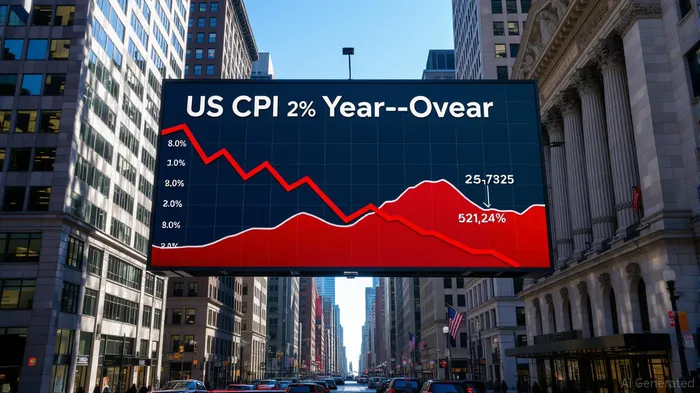 This deceleration, however, was clouded by methodological distortions caused by the October 2025 government shutdown, which disrupted data collection and
forced the Bureau of Labor Statistics to rely on assumptions like "carrying forward" previous prices for critical categories such as shelter. While the core CPI (excluding food and energy) rose 2.6% annually, driven by housing costs and used vehicles, economists
warned that the data's reliability remains questionable.
Data Reliability and Policy Implications
The Federal Reserve's response to this CPI surprise has been cautious.
As stated by the New York Fed's November 2025 Survey, median inflation expectations held steady at 3.2% for the one-year horizon, with medical care costs reaching their highest projected level since 2014. Fed Chair Jerome Powell adopted a "wait-and-see" approach, acknowledging the potential distortions in the data but
emphasizing the need to monitor labor market dynamics, which remain a critical determinant of services-sector inflation. Meanwhile, the Federal Open Market Committee (FOMC)
announced a 25-basis-point rate cut, lowering the federal funds rate to a target range of 3.5%–3.75%, as part of its ongoing effort to balance inflation control with employment goals.
Historical precedents underscore the complexity of interpreting CPI surprises. For instance, during the post-pandemic inflation surge of 2021–2022, surges in salient goods like gasoline and food
drove household inflation expectations above 8%, prompting aggressive rate hikes from central banks. Similarly, the November 2025 data
highlights the risk of "de-anchoring" expectations, particularly as tariffs on goods like beef and coffee continue to exert upward pressure on prices. These examples illustrate how central banks must navigate not only headline inflation but also the psychological and structural factors that shape consumer behavior.
Strategic Asset Positioning Ahead of the Next Rate Cycle
For investors, the November CPI report underscores the need for agility in asset allocation.
According to a study by the Boston Federal Reserve, inflation expectations have increasingly dominated stock market returns in advanced economies, outpacing the influence of interest rates in recent years. This shift suggests that traditional duration-based strategies may need reevaluation, as inflation-linked assets-such as Treasury Inflation-Protected Securities (TIPS) and real estate-could offer better hedges against persistent price pressures.
Moreover, the Fed's conditional approach to rate cuts
highlights the importance of positioning for multiple scenarios. While the November rate cut signals a potential easing cycle, the central bank's focus on labor market cooling and wage growth implies that further cuts may hinge on incoming data. Investors should consider diversifying across sectors with varying inflation sensitivities, such as utilities (which tend to perform well in high-inflation environments) and technology (which may benefit from accommodative monetary policy).
Conclusion
The November 2025 CPI report, though marred by data collection challenges, provides a critical inflection point for central banks and investors. While the Fed's rate cut reflects a measured response to inflationary trends, the broader uncertainty surrounding the data-and the lingering effects of tariffs and consumer expectations-demands a nuanced approach to asset positioning. As the next rate cycle unfolds, strategic allocations must balance the risks of overreacting to distorted data with the need to prepare for a potential shift toward accommodative policy.

Stay ahead of the market.
Get curated U.S. market news, insights and key dates delivered to your inbox.






Comments
No comments yet