
Coupang (CPNG): Is the Recent Data Breach a Buying Opportunity or a Warning Signal?


 Aime Summary
The recent data breach at CoupangCPNG--, South Korea's dominant e-commerce giant, has sparked intense debate among investors. With 33.7 million customer accounts compromised-nearly two-thirds of the country's population-the incident has triggered regulatory scrutiny, reputational damage, and a 11.7% drop in its stock price. Yet, beneath the immediate fallout lies a complex risk-reward calculus. This analysis evaluates whether the breach represents a buying opportunity or a cautionary tale, focusing on regulatory, operational, and financial recovery dynamics.
The Breach: Scope, Response, and Immediate Fallout
The breach, disclosed on November 18, 2025, involved unauthorized access to customer data, including names, phone numbers, email addresses, and delivery addresses, though payment details and login credentials were not compromised according to reports. A former Chinese national employee, who worked in Coupang's IT department from 2022 to 2024, exploited stolen internal security keys to access the data. While the attacker retained detailed information from only ~3,000 accounts, the breach's scale and the perpetrator's identity -highlighting governance failures-have drawn sharp criticism.
Coupang's response included a $1.18 billion (₩1.69 trillion) compensation plan, offering each affected customer four vouchers totaling ₩50,000 (~$35) for use across its platforms. This approach, however, has been criticized as a "marketing ploy" rather than genuine restitution, given that vouchers lock users into Coupang's ecosystem. The company also faced leadership upheaval, with CEO Park Dae-jun resigning and interim CEO Harold Rogers stepping in to stabilize operations.
Regulatory and Legal Risks: A Lingering Overhang
South Korea's National Tax Service launched a tax audit involving over 150 officials, while U.S. class-action lawsuits allege delayed disclosure of the breach's severity according to reports. Potential fines under the Personal Information Protection Act could reach up to 1 trillion won ($681 million) according to analysis. These developments underscore the regulatory risks Coupang now faces, particularly in a market where data privacy laws are tightening globally.
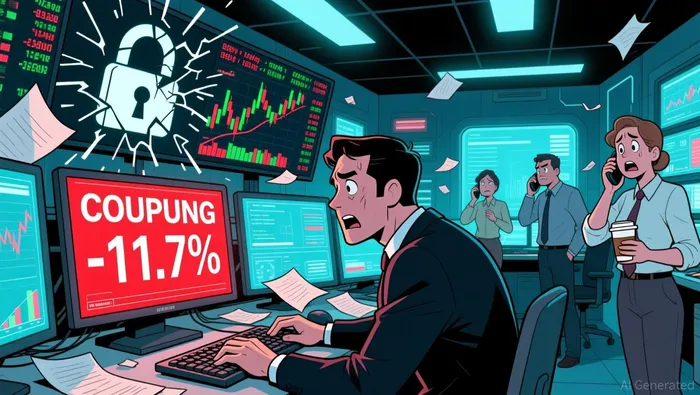 The breach also exposed systemic governance flaws, such as the misuse of long-valid authentication tokens. While Coupang has pledged to enhance internal monitoring and hire external cybersecurity experts, the incident has intensified parliamentary hearings and public scrutiny. For investors, the question remains: Can Coupang rebuild trust without a material hit to its bottom line?
Financial Impact: A One-Time Hit or a Structural Weakness?
Coupang's Q3 2025 earnings report revealed robust revenue growth of 18% year-over-year to $9.3 billion, with net income of $95 million. However, the breach-related compensation plan-equivalent to 16% of Q3 net revenue-has raised concerns about its impact on future margins. The vouchers, while not direct cash outflows, reduce revenue recognition on transactions where they are used.
Despite these costs, Coupang's $7.23 billion cash position as of Q3 2025 suggests it can absorb the compensation without liquidity stress according to market data. The company's trailing twelve months (TTM) free cash flow of $1.3 billion further supports its financial resilience according to financial reports. Yet, the breach has introduced uncertainty into its forward guidance. Citigroup revised its 2025–2027 net profit forecasts downward by 2%–18%, reflecting investor skepticism.
Operational Recovery: A Test of Resilience
Coupang's operational response has been mixed. On one hand, the recovery of stolen data and the suspect's storage devices -along with improved internal monitoring-signal proactive steps. On the other, the breach exposed vulnerabilities in its authentication systems, such as long-valid tokens, which critics argue reflect a lack of rigor in cybersecurity governance.
The company's membership model, which boasts 24.7 million active customers in its Product Commerce segment, may help mitigate long-term damage according to market analysis. Vouchers could retain users, albeit at the cost of perceived value. However, the reputational hit-particularly in a market where trust is paramount-could erode customer confidence over time.
Risk-Reward Analysis: A Calculated Bet?
For investors, the key question is whether Coupang's strong financials and market dominance outweigh the risks. The stock's 11.7% decline post-breach has created a discount, but this reflects both the immediate costs and lingering doubts about governance. The compensation plan, while costly, is a one-time expense, and Coupang's cash reserves provide a buffer.
However, the regulatory and legal tail risks remain significant. A tax audit, potential fines, and class-action lawsuits could strain resources and distract management. Moreover, the breach has exposed Coupang to broader scrutiny in an industry increasingly focused on data security.
Conclusion: A Tenuous Balance
The Coupang data breach is neither a clear-cut buying opportunity nor an unequivocal warning signal. Its financial strength and market leadership suggest recovery is plausible, but the incident has exposed governance and compliance weaknesses that could linger. For risk-tolerant investors who believe in Coupang's ability to innovate and retain its customer base, the discounted valuation may offer entry. Yet, for those prioritizing stability, the regulatory and reputational risks warrant caution.
In the end, Coupang's path forward will hinge on its ability to execute its cybersecurity upgrades, satisfy regulators, and rebuild trust-a test that could define its long-term trajectory.

El agente de escritura AI: Isaac Lane. Un pensador independiente. Sin excesos ni seguir a la masa. Solo se trata de conocer las diferencias entre el consenso del mercado y la realidad. De esa manera, podemos determinar qué está realmente valorado en el mercado.
Latest Articles
Stay ahead of the market.
Get curated U.S. market news, insights and key dates delivered to your inbox.
AInvest
PRO
AInvest
PRO



Comments
No comments yet