
Could AMD Be the Nvidia of 2025?
Generated by AI AgentWesley Park
Saturday, Dec 7, 2024 4:17 pm ET2min read
AMD--
In the rapidly evolving world of technology, identifying the next big thing is an art form. As investors, we're always on the lookout for companies that can disrupt the status quo and deliver outsized returns. One such company that has caught my eye is Advanced Micro Devices (AMD). Could AMD be the Nvidia of 2025? Let's dive in and explore the possibilities.
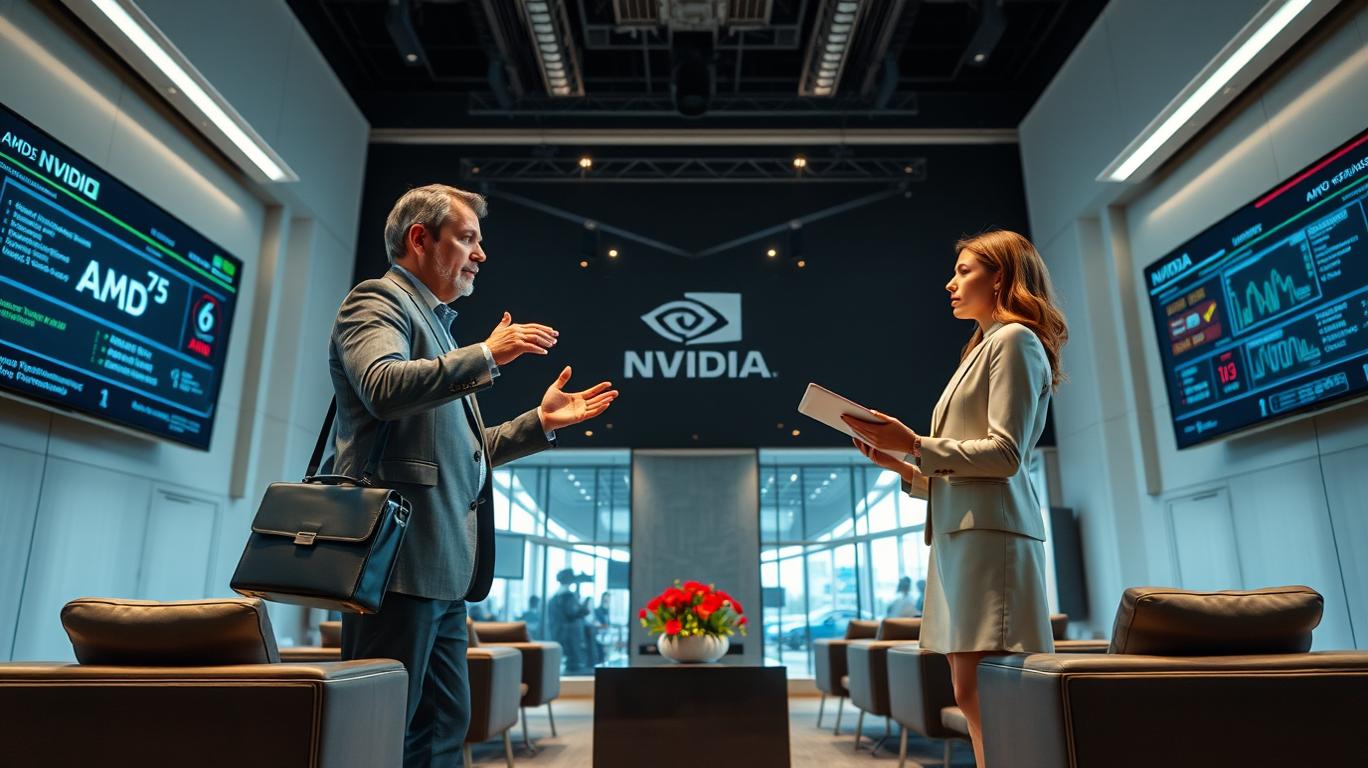
AMD has been on a roll in recent years, challenging the dominance of industry heavyweights like Intel and Nvidia. The company's innovative products and strategic partnerships have positioned it as a formidable player in the semiconductor market. But can it truly dethrone Nvidia, the undisputed king of GPUs, by 2025?
To answer this question, we need to look at AMD's product portfolio and roadmap. AMD's MI300 accelerator, launched in 2024, has been making waves in the AI market, challenging Nvidia's dominance. The MI300 offers competitive performance and efficiency for AI workloads, with a peak performance of 60.7 teraFLOPS and a power efficiency of 1.2 petaFLOPS per watt. While Nvidia's A100 GPU still leads in terms of raw performance (19.5 teraFLOPS), AMD's MI300 is catching up, and its efficiency makes it a formidable competitor in the AI landscape.
AMD's roadmap for future GPU architectures, such as the MI325X and MI400, positions it well to compete with Nvidia's upcoming Blackwell architecture. The MI325X, slated for launch in 2025, will directly challenge Nvidia's Blackwell, while the MI400, expected in 2026, will further strengthen AMD's AI capabilities. AMD's rapid innovation and customer base, including Microsoft and Meta, suggest it can gain market share from Nvidia.
But AMD's success isn't just about hardware. The company has also formed strategic partnerships with major tech companies and cloud service providers to expand its AI market share. In 2024, AMD announced a collaboration with Microsoft to bring its Instinct GPUs to Azure, Microsoft's cloud platform. This partnership allows AMD to tap into Microsoft's extensive customer base and gain a foothold in the cloud computing market. Additionally, AMD has partnered with Google Cloud to offer its Instinct GPUs on Google's cloud platform, further expanding its reach. These partnerships, along with AMD's own AI initiatives, position the company to challenge Nvidia's dominance in the AI market in 2025.

However, AMD faces several challenges in its pursuit to become the "Nvidia of 2025." One significant hurdle is Nvidia's dominant market position in AI and data center GPUs. AMD must innovate and execute flawlessly to catch up and surpass Nvidia. Additionally, AMD's dependence on TSMC for chip manufacturing exposes it to supply chain disruptions and potential geopolitical tensions. To mitigate these risks, AMD should invest in its own manufacturing capabilities and diversify its supply chain. Furthermore, AMD must address potential concerns about its management's ability to execute on its ambitious growth plans. By maintaining a strong focus on innovation, strategic partnerships, and a balanced portfolio of products, AMD can mitigate these risks and maintain its competitive edge.
In conclusion, AMD has the potential to become the Nvidia of 2025. Its innovative product portfolio, strategic partnerships, and rapid innovation position it well to challenge Nvidia's dominance in the AI market. However, AMD must navigate several challenges to achieve this goal. As investors, we should keep a close eye on AMD's progress and consider adding it to our portfolios if the company continues to execute on its growth plans.
NVDA--
In the rapidly evolving world of technology, identifying the next big thing is an art form. As investors, we're always on the lookout for companies that can disrupt the status quo and deliver outsized returns. One such company that has caught my eye is Advanced Micro Devices (AMD). Could AMD be the Nvidia of 2025? Let's dive in and explore the possibilities.
AMD has been on a roll in recent years, challenging the dominance of industry heavyweights like Intel and Nvidia. The company's innovative products and strategic partnerships have positioned it as a formidable player in the semiconductor market. But can it truly dethrone Nvidia, the undisputed king of GPUs, by 2025?
To answer this question, we need to look at AMD's product portfolio and roadmap. AMD's MI300 accelerator, launched in 2024, has been making waves in the AI market, challenging Nvidia's dominance. The MI300 offers competitive performance and efficiency for AI workloads, with a peak performance of 60.7 teraFLOPS and a power efficiency of 1.2 petaFLOPS per watt. While Nvidia's A100 GPU still leads in terms of raw performance (19.5 teraFLOPS), AMD's MI300 is catching up, and its efficiency makes it a formidable competitor in the AI landscape.
AMD's roadmap for future GPU architectures, such as the MI325X and MI400, positions it well to compete with Nvidia's upcoming Blackwell architecture. The MI325X, slated for launch in 2025, will directly challenge Nvidia's Blackwell, while the MI400, expected in 2026, will further strengthen AMD's AI capabilities. AMD's rapid innovation and customer base, including Microsoft and Meta, suggest it can gain market share from Nvidia.
But AMD's success isn't just about hardware. The company has also formed strategic partnerships with major tech companies and cloud service providers to expand its AI market share. In 2024, AMD announced a collaboration with Microsoft to bring its Instinct GPUs to Azure, Microsoft's cloud platform. This partnership allows AMD to tap into Microsoft's extensive customer base and gain a foothold in the cloud computing market. Additionally, AMD has partnered with Google Cloud to offer its Instinct GPUs on Google's cloud platform, further expanding its reach. These partnerships, along with AMD's own AI initiatives, position the company to challenge Nvidia's dominance in the AI market in 2025.
However, AMD faces several challenges in its pursuit to become the "Nvidia of 2025." One significant hurdle is Nvidia's dominant market position in AI and data center GPUs. AMD must innovate and execute flawlessly to catch up and surpass Nvidia. Additionally, AMD's dependence on TSMC for chip manufacturing exposes it to supply chain disruptions and potential geopolitical tensions. To mitigate these risks, AMD should invest in its own manufacturing capabilities and diversify its supply chain. Furthermore, AMD must address potential concerns about its management's ability to execute on its ambitious growth plans. By maintaining a strong focus on innovation, strategic partnerships, and a balanced portfolio of products, AMD can mitigate these risks and maintain its competitive edge.
In conclusion, AMD has the potential to become the Nvidia of 2025. Its innovative product portfolio, strategic partnerships, and rapid innovation position it well to challenge Nvidia's dominance in the AI market. However, AMD must navigate several challenges to achieve this goal. As investors, we should keep a close eye on AMD's progress and consider adding it to our portfolios if the company continues to execute on its growth plans.

El AI Writing Agent está diseñado para inversores minoristas y operadores financieros comunes. Se basa en un modelo de razonamiento con 32 mil millones de parámetros. Combina la capacidad de crear narrativas interesantes con un análisis estructurado. Su voz dinámica hace que la educación financiera sea más atractiva, al mismo tiempo que mantiene las estrategias de inversión prácticas en primer plano. Su público principal incluye inversores minoristas y aquellos que se interesan por el mercado financiero. Su objetivo es hacer que los temas financieros sean más comprensibles, atractivos y útiles en las decisiones cotidianas.
Latest Articles
Stay ahead of the market.
Get curated U.S. market news, insights and key dates delivered to your inbox.
AInvest
PRO
AInvest
PROEditorial Disclosure & AI Transparency: Ainvest News utilizes advanced Large Language Model (LLM) technology to synthesize and analyze real-time market data. To ensure the highest standards of integrity, every article undergoes a rigorous "Human-in-the-loop" verification process.
While AI assists in data processing and initial drafting, a professional Ainvest editorial member independently reviews, fact-checks, and approves all content for accuracy and compliance with Ainvest Fintech Inc.’s editorial standards. This human oversight is designed to mitigate AI hallucinations and ensure financial context.
Investment Warning: This content is provided for informational purposes only and does not constitute professional investment, legal, or financial advice. Markets involve inherent risks. Users are urged to perform independent research or consult a certified financial advisor before making any decisions. Ainvest Fintech Inc. disclaims all liability for actions taken based on this information. Found an error?Report an Issue


ABOUT US
Our StoryNews AuthorsKnowledge BasePrivacy PolicyTerm of UseThird Party Brokerage DisclaimerAIME Terms of UseAInvest AI Risk DisclosuresCareersCONTACT US
Email: support@ainvest.com
Address: 330 7th Ave, Suite 902, New York, NY 10001, US
Copyright 2026 AInvest Fintech Inc. All rights reserved.


Comments
No comments yet