
COTI Expands Privacy-on-Demand to Ethereum and Implements Token Burn Mechanism
 Aime Summary
- COTI is rolling out its Privacy-on-Demand stack to EthereumETH-- and other leading chains, enabling confidential transactions without asset bridging.
- The project is implementing a buyback and burn mechanism targeting the permanent removal of 100 million COTICOTI-- tokens from circulation.
- A mandatory migration from the legacy V1 network to the upgraded V2 network is scheduled for completion by September 2026.
- On-chain data reveals extreme wealth concentration, with the top 53 wallets controlling over 80% of the market cap.
- Recent price volatility is driven by derivatives trading volume that exceeds the spot market cap, indicating high speculative leverage.
COTI has officially expanded its Privacy-on-Demand privacy stack to Ethereum and other leading blockchain networks on July 31, 2026 . This strategic rollout allows applications, tokens, and stablecoins to utilize encrypted computation for confidential balances and transaction amounts directly on their native chains . By making privacy available on existing networks, COTI shifts its positioning from a single-chain tool to a broader cross-chain infrastructure provider . This development addresses a significant operational requirement for applications that need privacy without moving assets to a separate, isolated chain .
The introduction of encrypted computation on Ethereum marks a pivotal shift for the project, which previously focused on a standalone payment rail. The COTI Foundation highlights that stablecoin transaction volumes reached $33 trillion in 2025, yet approximately 99% of these transactions remain public . This lack of privacy exposes every balance and payment amount, creating a barrier for institutional adoption . The new infrastructure enables private stablecoins and confidential decentralized finance (DeFi) activities while maintaining the security and verifiability of the underlying public ledgers.
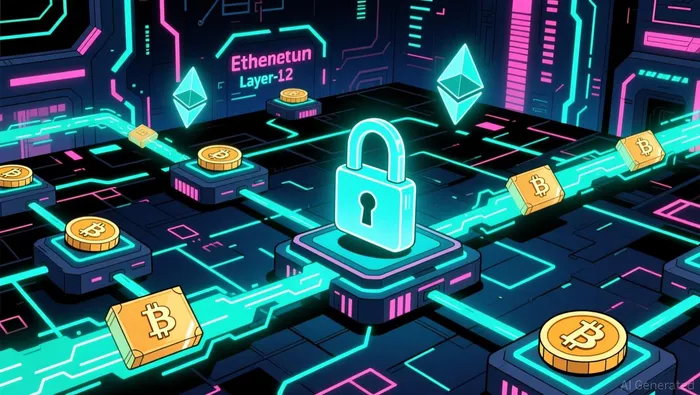
Technologically, COTI operates as an Ethereum Layer-2 protocol secured by the base layer, utilizing Garbled Circuits (GC) core cryptographic innovation. This protocol allows computation on encrypted data and is claimed to be 3,000 times faster than traditional zero-knowledge proofs (ZK-SNARKs).
The network is EVM-compatible and features a Multi-DAG framework to support multiple token ecosystems simultaneously . The Garbled Circuits mainnet has already processed over 125 million transactions, driven largely by private transfers of USDT and USDC .
What Is the V2 Network Migration and Token Burn Strategy?
COTI is executing a significant network transition by sunsetting its legacy V1 network by the end of Q3 2026 . Users are required to migrate to the new V2 network, which aims to streamline operations and reduce the circulating supply . This migration is a critical driver for supply dynamics, as the upgrade supports private DeFi, stablecoins, and RWA tokenization. The transition represents a complete pivot from a standalone payment network to a full-stack privacy infrastructure .
To further influence supply and demand, COTI has strengthened its tokenomics by implementing a buyback and burn mechanism . A portion of fees collected from network transactions, the Privacy PortalPORTAL--, and decentralized applications will be used to permanently remove 100 million COTI tokens from circulation . This deflationary pressure is designed to support higher valuations if adoption continues to grow . The native COTI token is utilized for paying network fees, staking, and governance, anchoring the ecosystem's economics .
The Privacy Portal, launched in May 2026, allows users to convert assets like USDC and wETH into private versions . Additionally, the Nightfall ZK rollup, launched in March 2026, targets confidential enterprise transactions and private RWAs . These developments align with institutional demand for compliant privacy solutions . The project has also integrated with MetaMask Snap and expanded to networks like Arbitrum and Polygon .
How Do Whale Concentration and Leverage Impact COTI's Market Risk?
Despite the bullish narrative surrounding its infrastructure pivot, COTI faces significant on-chain risks . Data reveals extreme wealth concentration, with the top 53 wallets controlling 80.52% of the market cap . This results in a Gini score of 0.9812, indicating a high degree of inequality in token distribution . Such concentration creates high systemic risk, as coordinated selling by a few large holders could trigger severe price drops .
Furthermore, derivatives trading volume currently exceeds the spot market cap, indicating that recent rallies have been amplified by leveraged speculation . This high leverage and short squeeze activity suggest that price movements may not reflect organic demand . The recent technical breakout from a downtrend has pushed the token into heavily overbought conditions, with the RSI exceeding 90 . This increases the probability of a short-term pullback before testing key resistance levels .
Execution risks also loom large for the project . The mandatory migration from the V1 network to V2 requires careful management to avoid network fragmentation . Frustrated users may sell their tokens during the transition, creating additional selling pressure . While successful adoption of the Privacy Portal could drive sustained token utility and fee revenue, the current market structure suggests that long-term price support requires demonstrable, decentralized adoption .
The availability of these privacy tools does not guarantee immediate adoption by stablecoin issuers and applications . Practical reach will depend on further integrations and actual usage volume . Investors should monitor the successful completion of the V2 migration and the uptake of the Privacy Portal as key indicators of the project's fundamental strength . The interplay between deflationary tokenomics and extreme whale concentration will likely dictate the token's volatility in the near term .

Blending traditional trading wisdom with cutting-edge cryptocurrency insights.
Latest Articles
Stay ahead of the market.
Get curated U.S. market news, insights and key dates delivered to your inbox.


AInvest
PRO
AInvest
PRO




Comments
No comments yet