
Coterra's Outperformance: A Structural Hedge in a Weak Energy Market


 Aime Summary
The market's recent mood is one of retreat. Yet within that broader weakness, Coterra EnergyCTRA-- has been an anomaly. On today's session, the stock rose 1.37% to $26.56, a move that outpaced the S&P 500's 0.14% loss. This single-day strength stands in sharp relief to the company's performance over the past month, where shares had lost 2.78%, lagging both the Oils-Energy sector's decline and the broader index's modest gain.
Zooming out to the full year, the divergence becomes even more pronounced. Over the past 12 months, CoterraCTRA-- has delivered a return of +2%, a stark contrast to the S&P 500's +18% growth. This isn't a story of consistent outperformance; it's a tale of recent resilience in a down market. The central question is why.
The answer points to structural advantages. Coterra's emergence from the 2021 merger of Cabot and Cimarex created a unique operational profile. The company combines Cabot's prolific natural gas assets in the Marcellus Shale with Cimarex's oil-rich portfolio in the Permian. This diversified production base is the core of its defensive setup. It allows Coterra to shift focus between commodities based on market conditions, a flexibility that insulates it from the volatility that has plagued more specialized peers. In a sector where sentiment is weak, this balance sheet and portfolio discipline are the moat that explains today's price strength.
The Structural Hedge: A Balanced Portfolio in a Volatile Cycle
The fundamental driver of resilience in Coterra Energy is not a single tactic, but a deliberate, multi-layered structure built for volatility. At its core is a nearly 50/50 oil and natural gas production mix, a direct hedge that insulates the company from the sector's most common swing. This balanced profile, which averaged 655,000 BOE/d split nearly evenly in Q1 2025, means that a downturn in one commodity is partially offset by stability or strength in the other. This is a structural advantage, not a speculative bet.
This operational balance is fortified by a peer-leading financial foundation. Coterra maintains a net debt-to-EBITDAX ratio of approximately 0.5x, a figure that provides immense flexibility. In a volatile cycle, this strong balance sheet allows the company to weather commodity price swings without compromising its investment-grade status or access to capital. It is a natural buffer against sector weakness, enabling Coterra to focus on long-term value rather than short-term survival.
Management's disciplined capital allocation is the final, critical piece of this resilient structure. The company has demonstrated a clear focus on capital efficiency, with a 2025 reinvestment rate of approximately 55%. More importantly, it has set a clear target for 2026: to bring that reinvestment rate at, or below, 50%. This commitment to a lower capital intensity, while still targeting modest growth, directly enhances free cash flow generation. It ensures that even if commodity prices soften, the company can maintain its financial discipline and continue returning capital to shareholders.
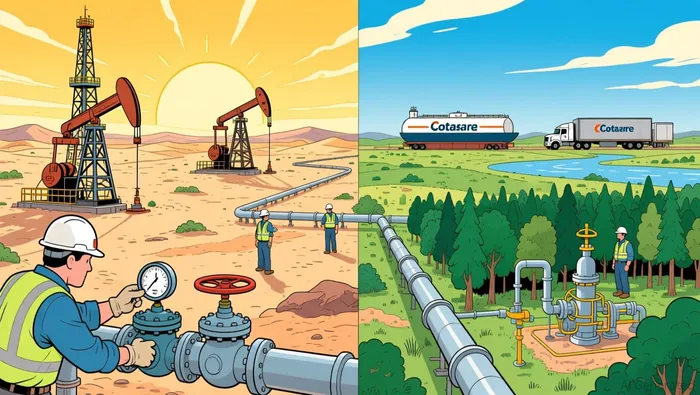
Together, these elements create a powerful, self-reinforcing hedge. The balanced asset mix provides operational insulation. The conservative leverage provides financial insulation. And the disciplined capital allocation ensures that the company can execute its strategy without overextending, regardless of the commodity cycle. This is the structural advantage that allows Coterra to compete effectively and deliver returns in a sector defined by turbulence.
Financial Execution Amidst Sector Weakness
While the broader energy sector grapples with deteriorating sentiment, Coterra Energy's disciplined operational and financial execution has translated into robust cash flow generation. The company's performance in the third quarter of 2025 demonstrates this resilience. Total production and oil production each beat their respective guidance midpoints by approximately 2.5%, showcasing strong operational control. This output was achieved at a cash operating cost of $9.81 per BOE, which, while slightly above the annual guidance midpoint, remained within the expected range for the period.
The financial results for the year are even more telling. Coterra is on track to generate approximately $2.0 billion in free cash flow for 2025, representing a 60% increase from 2024. This surge in liquidity is the direct result of efficient capital deployment and strong production, providing the company with significant flexibility. Management has prioritized returning this capital to shareholders, with a direct return of 89% of free cash flow in the second quarter alone, through dividends and share repurchases. This commitment to shareholder returns, even as the company continues to deleverage, underscores the strength of its cash generation.
This performance is particularly notable against a backdrop of severe sector headwinds. Natural gas prices, a key component of Coterra's diversified portfolio, have fallen sharply, with the commodity dropping 19.7% over the past month. This pressure on margins is a primary driver of the sector's weakness. However, Coterra's multi-basin, multi-commodity strategy acts as a critical buffer. The company's ability to generate strong returns across its Permian, Marcellus, and Anadarko assets provides a level of stability that pure-play producers lack. As CEO Tom Jorden noted, the durability of this high-quality asset portfolio shines through various price cycles.
The bottom line is one of execution in a tough environment. While sector sentiment is deteriorating due to falling gas prices, Coterra's disciplined operational performance and diversified asset base have allowed it to significantly boost its free cash flow. This financial strength supports a substantial shareholder return program and positions the company to navigate the current downturn with greater resilience than many of its peers.
Valuation and the Path to Re-rating
Coterra Energy trades at a notable discount to the street's consensus view, creating a clear re-rating opportunity. The stock currently sits near $25.76, which implies a price-to-earnings ratio of 11.89 and a market capitalization of about $19.6 billion. This levels out to a roughly 24% discount from the average analyst price target of $32.86. The recent trajectory of those targets is positive, with major banks like UBS and Mizuho raising their outlooks to $33 and $36, respectively, in December. This upward revision signals a growing conviction that the company's operational efficiency and financial discipline are underappreciated.
The primary catalyst for a valuation re-rating is the release of detailed 2026 guidance in February. Analysts expect this framework to confirm a significantly lower capital budget year-over-year while maintaining a 0-5% annual increase in BOE and natural gas output. This combination of reduced spending and modest production growth is key. It supports the bank's thesis of improved capital efficiency and a cash return yield forecast of 11.5% for 2026. For investors, this guidance will test the narrative of sustainable, shareholder-friendly growth and could justify the current price target premium.
Yet a significant headwind remains. The company's diversified portfolio does not insulate it from commodity price volatility. Natural gas prices have fallen 19.7% over the past month, pressuring margins despite Coterra's efforts to optimize. This weakness is a material risk to the re-rating thesis, as it directly impacts the cash flow that supports both the lower capital budget and the targeted returns. The path forward hinges on whether the market's focus shifts from near-term price swings to the company's demonstrable ability to generate strong returns on a smaller capital base.

El Agente de Redacción AI: Julian West. El estratega macroeconómico. Sin prejuicios. Sin pánico. Solo la Gran Narrativa. Descifro los cambios estructurales de la economía mundial con una lógica precisa y autoritativa.
Latest Articles
Stay ahead of the market.
Get curated U.S. market news, insights and key dates delivered to your inbox.




Comments
No comments yet