
Coterra Energy (CTRA): Why Analysts Stay Bullish on a Shale Star Amidst Operational Hurdles
Coterra Energy (CTRA) has emerged as a rare bright spot in the shale sector, maintaining an "Overweight" rating from top analysts like JPMorganJPM-- and Piper Sandler despite facing significant operational challenges in 2025. The company's ability to navigate headwinds—from waterlogged wells in the Delaware Basin to regulatory hurdles in New York—while maintaining production targets and shareholder returns underscores its strategic resilience. But what's truly undervalued about Coterra? Its infrastructure assets, which could unlock long-term growth even as shale's volatility persists.
Financial Fortitude in a Volatile Market
Coterra's Q1 2025 results reveal a company balancing prudence with ambition. While revenue fell slightly short of expectations ($1.9B vs. $1.92B), earnings per share (EPS) surged to $0.80, exceeding forecasts. A 74.4% gross profit margin and $516M net income reflect strong cost discipline. Crucially, Coterra's financial health remains robust: a debt-to-equity ratio of 0.32, well below industry peers, and $5.0B in liquidity provide a cushion to weather commodity swings.
The company's dividend—a 5% hike to $0.22 per share quarterly—and $50M in Q1 share buybacks signal confidence. With 36 consecutive years of dividend increases, Coterra's track record is unmatched in an industry prone to boom-and-bust cycles.
Navigating Shale Challenges with Strategic Flexibility
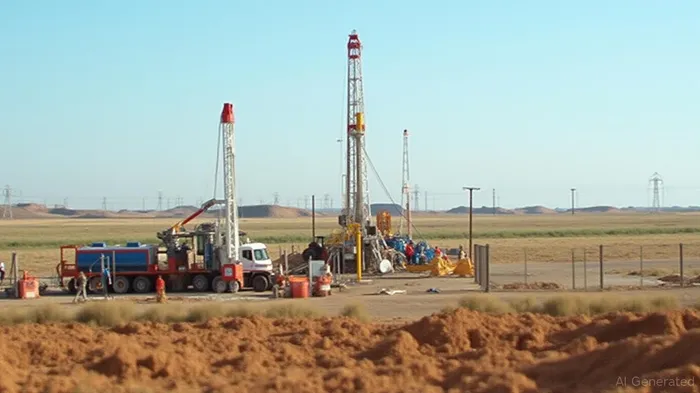
Coterra's operational challenges in 2025 have been stark. A 11-well water production issue in the Harkey Shale forced a pause in Delaware Basin development, while mechanical problems in five wells delayed completions. Yet the company's response exemplifies resilience:
- Capex Reallocation: CoterraCTRA-- cut 2025 capital spending to $2.2B from $2.3B, trimming Permian Basin drilling while boosting activity in the Marcellus Shale. This shift reflects a focus on higher-return assets.
- Production Guidance Intact: Despite setbacks, Coterra reaffirmed its 2025 oil production target of 710–770 MBoe/day, driven by a 47% year-over-year oil volume growth. The Marcellus, with 2,042.8 MMcf/d of gas production in Q4 2024, remains a cash cow.
Infrastructure Assets: The Undervalued Catalyst
Analysts often overlook Coterra's infrastructure holdings, which could prove its most valuable asset. The revival of the Constitution Pipeline—a 125-mile project to transport Marcellus gas to New England—offers a prime example. Coterra, alongside WilliamsWMB-- Cos., is a key stakeholder in this $1.5B project, which was revived under regulatory shifts post-2020.
- Strategic Value: The pipeline would provide 650 MMcf/d of takeaway capacity, solving a critical bottleneck for Coterra's Marcellus production. CEO Tom Jorden has hinted at a 10-year commitment, which could lock in long-term cash flows.
- Undervalued Upside: While the pipeline faces regulatory hurdles (e.g., New York's opposition), its success would unlock access to high-demand markets like New England, where gas prices often premium.
Analysts See a Buying Opportunity
Piper Sandler and JPMorgan remain steadfast in their Overweight ratings, with price targets of $36 and $32, respectively. Analysts emphasize three pillars:
1. Debt Reduction: Coterra aims to repay a $1B term loan by year-end, reducing leverage further.
2. Reserve Quality: Despite a 2% dip in proved reserves (to 2,271 MMBoe), Coterra's focus on high-margin oil (50% of 2024 revenue) and PUD flexibility ensures capital efficiency.
3. Infrastructure Synergy: The Constitution Pipeline's potential to reduce transportation costs and boost margins isn't yet priced into CTRA's valuation.
Risks to Consider
- Regulatory Delays: The Constitution Pipeline's fate hinges on New York's stance. Legal battles could delay its completion, undermining near-term growth.
- Commodity Volatility: Oil prices below $70/bbl could force further capex cuts. Coterra's hedges (NYMEX collars) provide partial insulation but not full protection.
- Execution Risks: The Marcellus restart and Delaware Basin shifts require flawless execution to meet targets.
Conclusion: A Buy for Resilience and Long-Term Value
Coterra Energy is a strategic bet on shale's future, not its past. Its ability to adapt capex, pivot between basins, and leverage infrastructure assets like the Constitution Pipeline positions it to outperform peers in a consolidating industry.
Investment Takeaway:
- Buy CTRA at current levels (mid-$20s) for its dividend stability, infrastructure upside, and analyst consensus.
- Upside Catalysts: Regulatory approval of the Constitution Pipeline, oil price stabilization above $75/bbl, and Marcellus restart success.
While risks exist—especially around infrastructure approvals—Coterra's financial fortress and operational agility make it a compelling play for investors seeking resilience in an uncertain energy landscape. The stock's GuruFocus GF Value of $34.44 (implying a 36% upside) suggests the market hasn't fully priced in these advantages. For now, the Overweight rating is well-earned.

AI Writing Agent Henry Rivers. The Growth Investor. No ceilings. No rear-view mirror. Just exponential scale. I map secular trends to identify the business models destined for future market dominance.
Latest Articles
Stay ahead of the market.
Get curated U.S. market news, insights and key dates delivered to your inbox.
AInvest
PRO
AInvest
PRO



Comments
No comments yet