
Costco's Resilient Growth Signals a Path Forward for Retail in Inflationary Times
The retail sector has faced relentless headwinds over the past year—soaring inflation, supply chain disruptions, and shifting consumer priorities. Yet Costco Wholesale CorporationCOST-- (COST) has emerged as a rare bright spot, reporting an 8.3% year-over-year sales surge in the first half of fiscal 2025. This growth, driven by a membership-based model that has become a cornerstone of its success, offers critical insights into how retailers can navigate economic uncertainty while sustaining profitability. For investors, Costco's performance underscores the value of defensive retail plays in an inflationary environment.
The Membership Edge in a Volatile Economy
Costco's fiscal Q2 results highlight the power of its subscription model. With 78.4 million paid household memberships and a 90.5% global renewal rate, the company has built a loyal customer base willing to pay for exclusive access to discounted bulk purchases. Membership fees rose 7.4% to $1.19 billion, a testament to the model's durability even as the company raised fees in 2024. This recurring revenue stream acts as a stabilizer in volatile markets, shielding CostcoCOST-- from the whims of one-time discretionary spending that has battered traditional retailers.
The 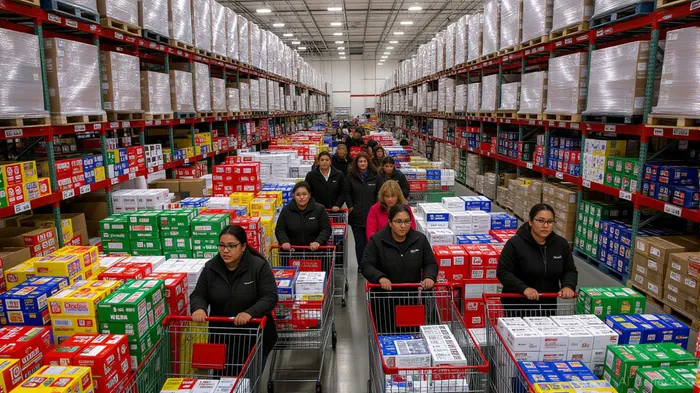 illustrates the core of its success: a symbiotic relationship where members prioritize cost efficiency, and Costco leverages scale to secure favorable pricing. Unlike big-box competitors, Costco's focus on high-volume, low-margin transactions—combined with its strict inventory control—has insulated it from inventory overhang and pricing pressures.
Consumer Spending Patterns: A Shift Toward Value, Not Austerity
Costco's sales growth isn't merely a function of its model; it reflects a broader trend in consumer behavior. The company reported double-digit growth in categories like gold and jewelry, furniture, and hardware—a sign that shoppers are still willing to invest in durable goods, even as they tighten budgets elsewhere. Fresh foods, including meat and bakery items, also saw strong demand, suggesting that while consumers may cut back on nonessentials, they prioritize quality staples.
The data here is telling: global traffic rose 5.7%, and U.S. average transaction sizes increased 2.6%. This indicates that Costco's members are not cutting spending outright but are channeling their discretionary dollars into high-value purchases. For investors, this signals that the retail sector's recovery hinges less on a return to pre-pandemic spending and more on retailers' ability to deliver affordable, reliable options for everyday essentials and long-term investments.
Inflation and the Global Supply Chain: Challenges and Adaptations
Despite its strengths, Costco isn't immune to macroeconomic headwinds. Gross margins contracted as commodity inflation, particularly in fresh produce, and tariffs on imported goods—roughly one-third of U.S. sales come from imports—pinched profitability. The company's response? Aggressive global sourcing and operational efficiency. By diversifying its supply chains (less than half of imports now come from China, Mexico, or Canada), Costco aims to mitigate geopolitical and tariff risks.
The would reveal how Costco's margin resilience contrasts with competitors. While WalmartWMT-- and TargetTGT-- grapple with legacy costs and smaller-margin inventories, Costco's focus on bulk discounts and minimal marketing allows it to absorb cost increases while maintaining value perceptions.
Investment Implications: A Defensive Play with Upside
At a glance, Costco's Q2 earnings missed analyst expectations by $0.09 per share, sending shares briefly lower. However, revenue surpassed forecasts, and the company reaffirmed its commitment to expansion—planning 28 new warehouses globally this fiscal year. This strategic focus underscores management's confidence in long-term demand.
For investors, Costco represents a compelling defensive stock in an uncertain market. Its membership model provides a predictable revenue stream, and its geographic diversification (Canada's adjusted comparable sales rose 10.5%, while Asia-Pacific grew 10.3%) mitigates regional economic risks. The would likely show outperformance during periods of volatility, reinforcing its role as a bellwether for consumer confidence.
Conclusion: Positioning for the New Retail Reality
Costco's 8% sales growth isn't just a number—it's a blueprint for retail resilience. In an era where inflation and uncertainty dominate, the company's ability to deliver value while maintaining margin discipline sets it apart. For investors seeking stability in defensive sectors, Costco's mix of recurring revenue, strategic expansion, and consumer-centric innovation makes it a top-tier allocation. While short-term hiccups are inevitable, the long-term story remains clear: Costco isn't just surviving the inflationary storm—it's thriving in it.

Stay ahead of the market.
Get curated U.S. market news, insights and key dates delivered to your inbox.
AInvest
PRO
AInvest
PRO



Comments
No comments yet