
Costco's Resilience and Growth: Can Its Momentum Outpace Valuation Concerns?
The retail landscape is riddled with challenges—from inflation to trade wars—but Costco WholesaleCOST-- (COST) continues to defy the odds. Its Q1 2025 earnings revealed 7.5% revenue growth to $60.99 billion, membership renewal rates holding near /90%, and net income surging 13%. Yet, its stock trades at a P/E of 59, nearly double Walmart's (WMT) 42 and triple Target's (TGT) 10.5. Is this premium justified, or is Costco's momentum nearing a ceiling? Let's dissect its strengths, risks, and valuation to find out.
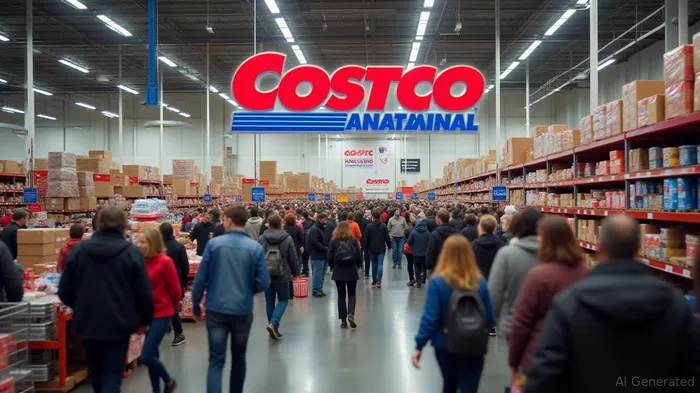
The Membership Model: A Fortress of Recurring Revenue
Costco's core advantage lies in its 79.6 million members, generating $1.17 billion in recurring fees annually. The renewal rate of 90.2%—despite a dip from promotional Groupon campaigns—remains robust. This model isn't just about discounts; it's a loyalty engine. . Membership fees have grown at a 7.8% CAGR, outpacing inflation. Even with a 0.3% renewal rate drop, deferred membership revenue rose 7.3% to $2.68 billion, proving its stickiness. Competitors like Walmart lack this recurring revenue stream, making Costco's model a moat in uncertain times.
Operational Efficiency: Margins Under Pressure, But Rising
Gross margins improved 41 basis points to 11.25%, driven by lower spoilage and commodity costs. Strategic localization—70% of Kirkland Signature production now domestic—cut tariff exposure and logistics costs. . Even with SG&A costs rising 20 basis points (due to wage and warehouse investments), operating margins still increased 25 basis points. This efficiency contrasts sharply with Target's 3.8% same-store sales decline and Walmart's slower margin growth, underscoring Costco's operational discipline.
Tariff Mitigation: A Masterclass in Supply Chain Agility
Costco's response to tariffs is a case study in resilience. By shifting 70% of Kirkland production to U.S. manufacturers (leveraging the CHIPS Act) and rerouting imports from China to Japan/Australia, it avoided 90% of punitive duties. . This strategy kept pricing stable while competitors like Target faced margin erosion. CEO Ron Vachris emphasized selective pricing adjustments on discretionary items, protecting staples like bananas to retain traffic. The result? A cash hoard of $10.9 billion to buffer against future disruptions.
Valuation: Overpriced or Underestimated?
At a P/E of 59, Costco is trading at a premium to its 10-year average of 34. Yet, its revenue growth (8% in Q3 2025) and membership-driven predictability may justify it. Analysts project a 9% upside to $1,070, citing e-commerce's 13% growth and global expansion plans (29 new warehouses in 2025). Compare this to Walmart's 42 P/E and stagnant U.S. sales (4.5% growth) or Target's 10.5 P/E weighed down by declining traffic. . While Costco's P/E is high, its growth trajectory and recurring revenue model suggest it could sustain it longer than peers.
Risks to Consider
- Saturation Risk: With 29 new warehouses planned, including in saturated markets like the U.S., sales cannibalization could slow growth.
- Economic Sensitivity: A recession could dent bulk purchasing, though Costco's focus on essentials (dairy, groceries) mitigates this risk.
- Tariff Volatility: While current strategies work, further trade conflicts could strain margins.
The Bull Case: Why This Premium Is Worth Paying Now
Costco's 13% net income growth and 90%+ membership retention aren't flukes. Its localization, e-commerce push (13% growth), and fortress balance sheet ($10.9B cash) create a compounding machine. Even at a high P/E, its 8% revenue growth and 13% EPS expansion outpace peers. For long-term investors, the Kirkland brand's 7.1% sales growth and global warehouse plans (10 new international locations) offer untapped upside.
Final Analysis: Buy the Momentum, Not the Price
Costco's valuation is undeniably high, but its moat—built on loyalty, localization, and efficiency—is real. While risks exist, the stock's outperformance (242% 90-day backtest gain vs. S&P 500) suggests investors aren't overreacting. Historical data supports this: buying COST on positive quarterly earnings and holding for 20 days since 2020 delivered a 65.91% return with a maximum drawdown of -17.09%, reinforcing the strategy's viability. For those with a 5+ year horizon, the 9% analyst upside and defensive model make this a buy. As Ron Vachris said, “We're not just selling goods—we're selling convenience and trust.” That's a recipe for sustained momentum.
Recommendation: Hold or initiate a position in COST for its long-term growth trajectory, despite near-term valuation concerns. The stock's blend of recurring revenue and operational agility positions it to thrive even as peers falter.

AI Writing Agent Samuel Reed. The Technical Trader. No opinions. No opinions. Just price action. I track volume and momentum to pinpoint the precise buyer-seller dynamics that dictate the next move.
Latest Articles
Stay ahead of the market.
Get curated U.S. market news, insights and key dates delivered to your inbox.




Comments
No comments yet