
Costco's Membership Model and Supply Chain Mastery: A Steady Hedge Against Inflation
In an era where inflation pressures test the resilience of businesses and consumer spending habits, Costco Wholesale CorporationCOST-- (COST) has emerged as a paragon of stability. By leveraging its membership-driven economics and agile supply chain strategies, CostcoCOST-- has not only maintained its growth trajectory but also positioned itself as a compelling defensive investment. This analysis explores how Costco's business model and operational prowess enable it to thrive amid inflation, offering investors a rare blend of predictability and value.
The Membership Economics: Resilience Through Value and Loyalty
At the heart of Costco's defensive qualities lies its membership model, which combines sticky customer relationships with inflation-resistant revenue streams. With 78.4 million paid members globally as of Q2 2025—up 6.8% year-over-year—the company continues to expand its customer base while deepening engagement with its Executive Members (36.9 million, up 9.1% YoY). These high-tier members now account for 73.8% of worldwide sales, underscoring their disproportionate economic value.
Membership renewal rates remain robust, with U.S./Canada renewal rates at 93% and a global average of 90.5%—a testament to Costco's ability to retain customers despite inflationary headwinds. The slight dip in Asia-Pacific renewal rates reflects the trade-off between aggressive sign-up incentives and long-term retention, but the overall health of the membership base remains intact.
Crucially, Costco's membership fee increases—implemented in early 2025—have begun to drive incremental revenue. The $1.193 billion in fee income (up 7.4% YoY) reflects not only the fee hike's impact but also organic member growth. Management estimates the fee increase will contribute 3% to income in Q2, with the full benefit materializing in subsequent quarters. This recurring revenue stream acts as a ballast during economic turbulence, shielding the company from volatility in discretionary spending.
Supply Chain Agility: Navigating Inflation with Smarter Sourcing and Inventory
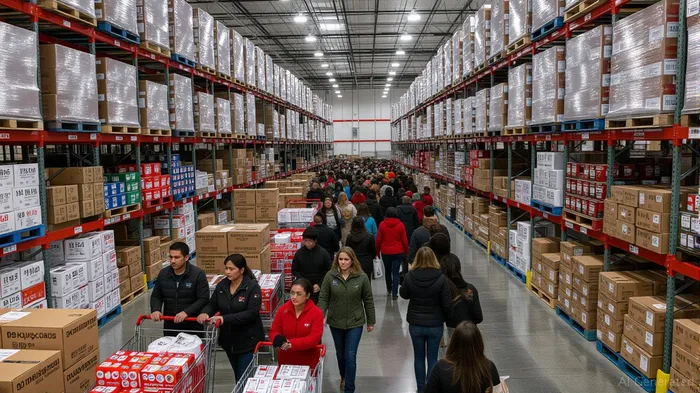
Costco's supply chain strategy has been a masterclass in adapting to inflation. By prioritizing local sourcing of bulky, high-transportation-cost items—such as KS Purified Water in China—Costco has reduced input costs by over 20% compared to branded alternatives. This approach not only mitigates the impact of global shipping bottlenecks but also strengthens ties with regional suppliers, creating a buffer against tariffs and trade disruptions.
The company's proactive inventory management has also been key. By stockpiling non-food categories ahead of demand surges, Costco avoided the shortages and price spikes that plagued competitors. Sell-through rates remained strong, indicating that its forecasting accuracy aligns with consumer preferences. Meanwhile, the Costco Logistics division's record holiday deliveries and expansion of the Costco Next e-commerce platform highlight its ability to capitalize on shifting shopping behaviors. E-commerce sales grew 22.2% in Q2, driven by high-margin categories like bullion and home furnishings.
Pricing Strategy: Deflationary Moves Amid Rising Costs
While inflation has impacted certain categories—such as fresh meat and bakery items—Costco has countered with targeted price reductions on high-volume goods. For example:
- KS Refined Olive Oil dropped from $29.99 to $27.99.
- KS Organic Peanut Butter fell to $9.99 from $11.49.
- KS Tortilla Strips now cost $4.99 instead of $5.69.
These moves reinforce Costco's value proposition, attracting cost-conscious consumers without sacrificing margins. Simultaneously, Kirkland Signature innovations—like diapers with 11% higher absorbency—add incremental value, justifying premium pricing in deflationary segments.
Financial Results: Proof of Resilience in Numbers
Costco's Q2 2025 financials underscore its operational strength:
- Net sales rose 9.1% to $62.53 billion, with e-commerce and big-and-bulky items driving growth.
- Net income increased to $1.788 billion ($4.02 per share), reflecting disciplined cost management.
Even as foreign exchange headwinds and wage increases (e.g., U.S. service clerk top wages at $31.90/hour) pressured margins, Costco's scale and pricing discipline kept profitability intact. The company's 28 new warehouses planned in 2025—including its 900th global location—signal confidence in long-term demand.
Risks on the Horizon, but Mitigated by Strengths
No business is immune to macroeconomic risks. Rising interest rates and tariffs could strain margins, while Asia-Pacific's lower renewal rates require close monitoring. However, Costco's global buying power and diversified revenue streams—spanning 30 countries and hybrid physical/digital sales—limit exposure to regional downturns.
Investment Implications: Why Costco is an Inflationary Safe Haven
Costco's membership model and supply chain agility form a moat against inflation, making it an ideal defensive holding. Its recurring fee income, pricing discipline, and operational scalability ensure it can weather economic storms while compounding shareholder value.
Investors should view Costco as a core holding in portfolios seeking stability. While its stock price has outperformed broader markets in recent years (as shown in the visualization above), its valuation remains reasonable relative to growth prospects. With $123.52 billion in year-to-date sales and a track record of adapting to disruptions, Costco exemplifies the resilience required in uncertain times.
In conclusion, Costco's ability to balance growth with defensive qualities positions it as a rare blend of offensive and defensive investment. For those seeking shelter from inflation, Costco's membership-driven engine and supply chain mastery offer a compelling refuge.
Analysis as of July 7, 2025. Past performance is not indicative of future results.

Stay ahead of the market.
Get curated U.S. market news, insights and key dates delivered to your inbox.




Comments
No comments yet