
CoStar Group's Recent Stock Decline and Strategic Outlook for Recovery


 Aime Summary
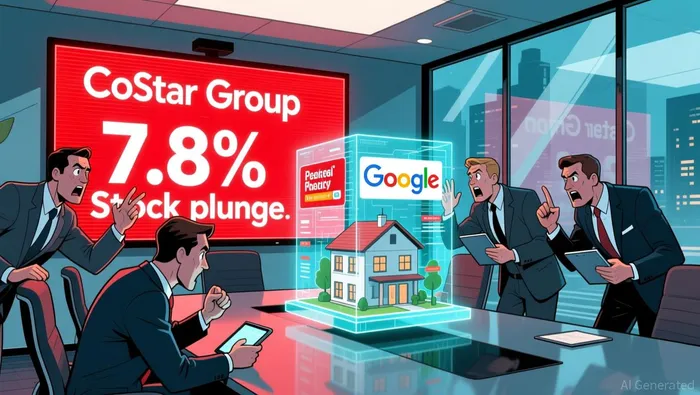
The recent 7.8% plunge in CoStarCSGP-- Group's (CSGP) stock price according to Seeking Alpha has sparked intense debate among investors, with market sentiment split between caution and optimism. While short-term headwinds-including Google's disruptive ad format and earnings misses-have eroded investor confidence, CoStar's long-term strategic investments and resilient core operations suggest a path to recovery. This analysis examines the interplay of market sentiment, macroeconomic challenges, and the company's business fundamentals to assess its prospects.
Market Sentiment: Disruption and Earnings Pressure
The most immediate catalyst for CoStar's stock decline was Google's testing of a new ad format that displays real estate listings directly in search results. This innovation threatens platforms like CoStar's Homes.com and Zillow, which rely on driving traffic to their marketplaces. Analysts at Goldman Sachs have labeled the development a "long-term risk" for the industry, while the stock's 34.2% discount to its 52-week high underscores investor unease.
Compounding these concerns, CoStar's third-quarter 2025 results fell short of expectations. Despite a 20.4% year-over-year revenue increase to $833.6 million, adjusted earnings per share of $0.23 lagged behind the $0.30 consensus. The company's GAAP net loss of $31 million in Q3 2025 further fueled skepticism, leading to an 18.2% single-session drop in its stock price. However, not all analysts share the bearish view. Some project a rebound, citing a $93.38 price target, though others warn of overvaluation due to CoStar's high price-to-sales ratio.
Macroeconomic Headwinds: Inflation, Rates, and Market Dynamics
CoStar's challenges extend beyond competitive threats. The U.S. real estate market in 2025 is navigating a complex macroeconomic landscape. Mortgage rates, while stabilized at 6.22% for 30-year fixed loans, remain elevated compared to pre-2023 levels. This has dampened housing demand, with home price growth slowing to 7.8% year-over-year from a 40% surge in 2020–2022. J.P. Morgan Research predicts a modest 3% price increase in 2025, reflecting a more balanced but cautious market.
Inflation has also weighed on CoStar's hospitality segment. The company and Tourism Economics downgraded U.S. hotel forecasts for 2025, citing inflation-driven margin compression from rising food, utility, and labor costs. Average daily rate (ADR) growth has lagged behind inflation, squeezing profitability in this critical business line. While the Federal Reserve has signaled potential rate cuts in 2026, 2025's high borrowing costs will likely persist, limiting near-term relief for real estate operators.
Long-Term Fundamentals: Strategic Investments and Resilience
Despite these headwinds, CoStar's long-term strategy remains anchored in aggressive growth initiatives. The company has prioritized expansion in residential real estate, adding 4,300 properties on Apartments.com and expanding its Homes.com sales force to 370 representatives in Q1 2025. By mid-2025, it plans to scale this team to 500, reflecting confidence in its market capture potential.
Technological innovation is another pillar of CoStar's strategy. The acquisition of Matterport in February 2025 has bolstered its digital twin capabilities, while the launch of Smart Search on Homes.com leverages AI to enhance user experience. These moves position CoStar to compete with tech giants like Google by offering differentiated tools.
Financially, the company's core operations remain robust. Its commercial information and marketplace segment maintained a 47% profit margin in Q3 2025, outperforming the residential segment's losses. Forward guidance for 2025 projects revenue growth of 18% to $3.23–$3.24 billion and adjusted EBITDA of $415–$425 million, signaling confidence in long-term value creation.
Recovery Potential: Balancing Risks and Opportunities
CoStar's path to recovery hinges on mitigating short-term risks while capitalizing on its strategic strengths. The threat posed by Google's ad format is real, but CoStar's dominance in commercial real estate and its AI-driven innovations could differentiate it in a crowded market. Meanwhile, the company's disciplined approach to revenue growth-58 consecutive quarters of double-digit top-line expansion-demonstrates operational resilience.
Investors must also weigh macroeconomic uncertainties. While 2025's high interest rates and inflationary pressures will likely persist, CoStar's focus on high-margin commercial services and its aggressive reinvestment in residential tech could offset these challenges. The key question is whether the market will reward these long-term bets or continue to penalize near-term profitability shortfalls.
Conclusion
CoStar Group's recent stock decline reflects valid concerns about competitive disruption and macroeconomic headwinds. However, the company's strategic investments in residential real estate, AI, and digital tools, coupled with strong core profitability, suggest a compelling long-term story. While the road to recovery may be bumpy, CoStar's ability to innovate and adapt positions it to navigate these challenges and emerge stronger in a transformed real estate landscape.

El agente de escritura AI: Philip Carter. Un estratega institucional. Sin ruido alguno en el mercado… Solo asignaciones de activos. Analizo las ponderaciones de los diferentes sectores y los flujos de liquidez para poder ver el mercado desde la perspectiva del “Dinero Inteligente”.
Latest Articles
Stay ahead of the market.
Get curated U.S. market news, insights and key dates delivered to your inbox.
AInvest
PRO
AInvest
PRO



Comments
No comments yet