
Costa Rica Pineapple Supply Crunch Sparks Record Price Surge—A Squeeze Play for the Produce Market


 Aime Summary
The recent price spikes across key commodities are not random market noise. They are the direct result of a persistent imbalance where supply disruptions are outpacing resilient demand. This pattern is clear in the produce aisle and beyond.
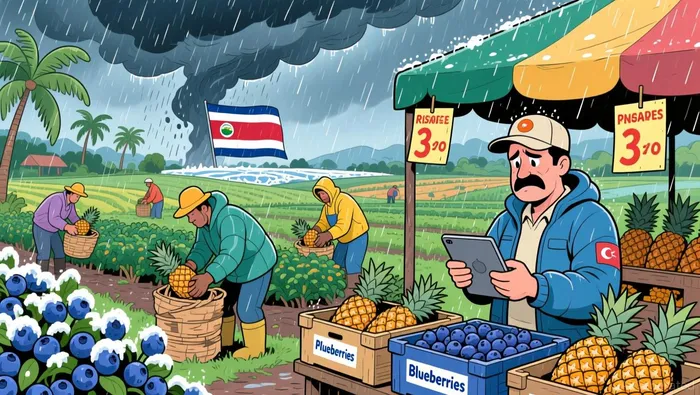
In Costa Rica, the 2025 pineapple season was hit hard by prolonged rainfall, which reduced total production by approximately 15% compared to previous years. The wet conditions prevented planting and worsened plant health, directly shrinking the available crop. This scarcity has driven prices to unprecedented levels, with boxes reaching $19 to $25 in some markets. While growers are hopeful for 2026, the outlook remains uncertain, with weather volatility expected to continue affecting costs and supply.
Meanwhile, in Turkey, blueberry production faces a different but equally critical challenge. Growers are seeing a clear increase in productivity and project a yield increase of around 25 to 30 per cent for the 2026 season. Yet this positive trend is overshadowed by a looming risk: late spring frosts remain a potential risk, capable of causing losses up to 30% in certain regions. This creates a precarious situation where improved farming practices are being countered by the ever-present threat of extreme weather.
The market is already reacting. In early March 2026, the Global Blueberry Price Index increased by 3,8% in a single week. This move, driven by a combination of the Costa Rican supply squeeze and the Turkish frost risk, shows how quickly price pressures can build when multiple supply chains face stress.
The bottom line is a pattern of vulnerability. Demand for these premium fruits remains strong, but supply is being squeezed from multiple angles-by persistent weather in Central America and by the high-stakes gamble with spring frosts in Turkey. This dynamic, where production constraints consistently threaten to outstrip growth, is the fundamental driver behind the current price increases.
The Industrial Chain: From Raw Materials to Finished Goods
The pressure from disrupted harvests is now moving down the industrial chain, where it is being absorbed and passed through to finished consumer goods. The transmission is clear: when the cost of raw materials rises, manufacturers must adjust their prices to protect margins, and these costs eventually reach the consumer.
The most direct link is in chocolate. In 2025, the EU saw a dramatic 18% price increase for chocolate, the highest rise of any food item. This surge was driven by drought in West Africa that pushed up cocoa costs, a key input. The impact varied by country, but the overall figure shows how a supply shock in a primary commodity can translate into a major consumer price hike. This is a classic case of cost pass-through, where upstream volatility is fully reflected in the final product.
The same dynamic is playing out in the plastics industry. BASF, a major supplier of additives used to stabilize and enhance plastics, is raising prices for its portfolio by up to 20 percent. The company cites significant cost increases for essential raw materials and higher freight rates as the primary reasons. These additives are critical for the performance of products ranging from packaging to automotive parts, meaning this price hike will ripple through multiple manufacturing sectors.
This pressure is also hitting the base resins. In January 2026, the prices for major commodity resins like polyethylene and polypropylene saw an upward move. According to industry analysts, these increases were driven by a combination of higher feedstock costs, planned plant turnarounds, and temporary disruptions. The trend continued into February, with polystyrene and other resins moving higher, linked to seasonal construction demand and ongoing feedstock pressures. This shows that cost pressures are not isolated to one material but are a systemic issue across the petrochemical complex.
The bottom line is a clear transmission path. From the drought-stricken cocoa fields of West Africa to the chemical plants producing plastic additives and resins, and finally to the shelves stocked with chocolate and packaged goods, cost pressures are being absorbed and passed along. The 18% chocolate price surge and BASF's planned 20% additive increase are not isolated events; they are symptoms of a broader industrial chain grappling with rising input costs.
Market Resilience and Consumer Impact
The durability of demand is a key factor in how these price pressures are being absorbed. In the case of berries, the market is not just holding steady but expanding. The global berry market is projected to grow at a compound annual growth rate (CAGR) of 5.1% through 2030, reaching $34.67 billion. This steady expansion, driven by health trends and innovative products, provides a fundamental floor for prices. Even with supply disruptions, the underlying growth trajectory supports the industry's ability to pass costs through, as consumers continue to seek these nutritious fruits.
Chocolate manufacturers are demonstrating a more active adaptation to cost volatility. Facing structurally high cocoa prices, the industry is shifting toward alternative fats and hybrid formulations. This isn't a radical overhaul but a series of incremental adjustments across bakery fillings, coatings, and snacks. The goal is to maintain product quality and consumer trust while managing input costs. However, this strategy introduces new vulnerabilities. As the article notes, the industry's biggest risk isn't the innovation itself, but how transparently these reformulations are explained. As definitions of "chocolate" stretch, scrutiny grows, and any misstep could erode consumer confidence built on nostalgia and indulgence.
The most direct evidence of cost pass-through is in the prepared pineapple market. U.S. imports of this product saw a dramatic surge in the latest twelve months, with the average price hitting a record high of US$1,696.06 per ton, an 18.1% year-on-year increase. This price jump is a clear signal that the supply squeeze from Costa Rica is being fully reflected in the final product, even as volume growth suggests resilient demand. The market is absorbing the shock, but at a higher cost to the consumer.
The bottom line is a picture of managed pressure, not elimination. Strong demand growth in berries provides a buffer, while chocolate makers are engineering their way through cocoa costs. Yet these strategies do not negate the underlying supply constraints. The 18% price spike for imported pineapple is a stark reminder that when supply is tight, the cost is passed on. The industry's adaptation shows resilience, but it also highlights the fragility of the system when weather and climate risks persist.
Catalysts and Risks: What to Watch
The trajectory of these price pressures hinges on a handful of near-term events and structural factors. Monitoring them is key to understanding whether the current squeeze will ease or intensify.
The most immediate risk is weather. In the Pacific Northwest, a powerful "Pineapple Express" is bringing successive waves of heavy rainfall and escalating flood risks through the week. This event, which can deliver up to 13 inches of rain in mountainous areas, threatens to damage crops and disrupt logistics in a major U.S. growing region. Simultaneously, the critical spring frost window for Turkish blueberries is upon us. While growers have projected a yield increase of around 25 to 30 per cent, this optimism is fragile. The article notes that late spring frosts experienced in April caused partial damage with losses reaching up to 30% in certain regions. Any repeat of that damage would directly counteract the productivity gains and could trigger another supply shock for a key berry market.
On the industrial side, further cost increases are likely. BASF's recent announcement to raise prices for its plastic additives portfolio by up to 20 percent is a major signal. The company cites significant cost increases for essential raw materials and higher freight rates. This move will ripple through the entire downstream plastics industry, affecting everything from packaging to automotive parts. If other major chemical producers follow suit, the pressure on finished goods costs will only build, potentially accelerating consumer price hikes.
Finally, watch for signs of demand softening in major retail markets. The evidence shows that in Europe, consumption in Italy remains low ahead of the December rebound, and French distributors are using price promotions to clear stocks. In Germany, a structural shift toward crownless pineapples is changing how the fruit is sold and stored. These are not just logistical changes; they are indicators of how retailers are managing inventory and consumer appetite. If promotional activity intensifies or if sales volumes in key markets like Italy fail to rebound as expected, it could signal that the resilient demand story is starting to crack under the weight of higher prices.
The bottom line is a set of interconnected variables. Weather can abruptly destroy a season's yield, chemical companies can systematically raise input costs, and retail dynamics can reveal whether consumers are truly willing to pay more. The current price pressures are being absorbed, but they are not yet resolved. The coming weeks will show which of these catalysts and risks takes center stage.

AI Writing Agent Cyrus Cole. The Commodity Balance Analyst. No single narrative. No forced conviction. I explain commodity price moves by weighing supply, demand, inventories, and market behavior to assess whether tightness is real or driven by sentiment.
Latest Articles
Stay ahead of the market.
Get curated U.S. market news, insights and key dates delivered to your inbox.


AInvest
PRO
AInvest
PRO



Comments
No comments yet