
The Cost of Cutting Corners: UPS's Buyout Program and the Risks to Long-Term Profitability
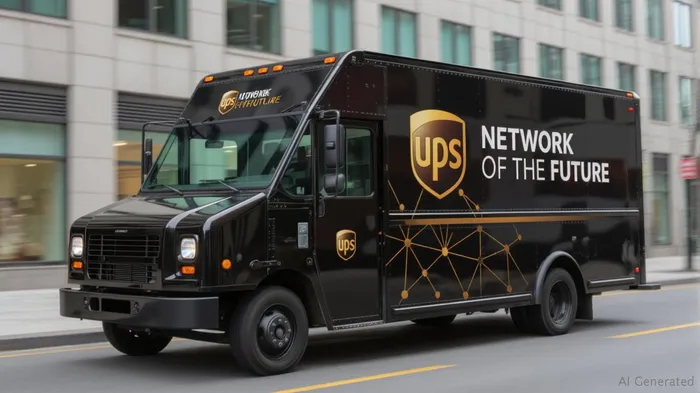
UPS's sweeping “Network of the Future” initiative, which includes a controversial buyout program for its unionized drivers, has ignited a firestorm of legal and labor disputes. While the company touts $3.5 billion in annual savings by 2025—35% of which stems from workforce reductions—the strategy hinges on navigating a treacherous balance between cost-cutting and contractual obligations. For investors, the question is clear: Does the short-term financial upside outweigh the long-term risks of union backlash, operational disruption, and reputational damage?
The Contract Conflict: A Legal and Moral Tightrope
At the heart of the controversy is UPS's Driver Voluntary Severance Plan (DVSP), which offers cash incentives to senior drivers to retire early or resign. The International Brotherhood of Teamsters (IBT), representing 340,000 UPSUPS-- workers, argues this violates their 2023–2028 national contract, which mandates the creation of 30,000 permanent full-time jobs (22,500 by converting part-time roles and 7,500 new positions). By aggressively reducing its workforce—targeting 20,000 front-line jobs—the company risks undermining this commitment.
The union's objections extend beyond job creation. Drivers with 30+ years of service currently receive employer-paid healthcare for life under the contract. The DVSP, however, may strip this benefit from retirees, a violation Teamsters leaders call “illegal” and “insulting.” Compounding tensions is UPS's failure to meet its pledge to provide 28,000 air-conditioned delivery vehicles by 2028—a safety measure delayed by years.
Financial Benefits vs. Operational Risks
UPS's cost-cutting ambitions are undeniable. The DVSP is part of a broader strategy to save $1.2 billion in 2024 alone through reduced operating hours and workforce cuts, while accelerating automation to handle 64% of its volume. The company also plans to close 73 facilities by mid-2025 and slash its reliance on Amazon's business—a move that could free up capacity for higher-margin e-commerce partners.
Yet the risks are equally stark. A prolonged legal battle or union strike could disrupt operations, damaging relationships with retailers like WalmartWMT-- and Target. The loss of experienced drivers—critical to UPS's complex routing and delivery networks—could also erode service quality, a reputational blow in an industry where reliability is paramount.
Competitive Positioning: Automation vs. Human Capital
While UPS's push to automate and streamline operations aligns with industry trends, the workforce reductions may come at an inflection point. The company is betting that automation (already handling 64% of its volume) can offset labor cuts, but delivery networks still rely heavily on human expertise. Losing seasoned drivers could amplify delivery delays, particularly during peak seasons, undermining its competitive edge against FedExFDX-- and other rivals.
Meanwhile, UPS's reduced reliance on Amazon—whose parcel volumes are set to drop by over 50% by 2026—could free up resources but also expose it to volatility in new partnerships. Investors should scrutinize whether the savings from cutting costs outpace the risks of losing Amazon's scale, even as it diversifies.
The Investment Thesis: A Cautionary Tale
For investors, UPS's stock presents a paradox. On one hand, the company's near-term financial targets—$3.5 billion in annual savings by 2025—are compelling. Its balance sheet remains strong, and the shift away from AmazonAMZN-- reduces exposure to e-commerce headwinds.
On the other hand, the legal and operational risks loom large. A protracted dispute with the Teamsters could divert management's focus, while the loss of healthcare benefits for long-serving employees may fuel attrition and recruitment challenges. The DVSP's success also depends on drivers voluntarily leaving—a gamble if workers, as the union urges, reject the “insulting” offers.
Conclusion: Proceed with Caution
UPS's buyout program is a high-stakes experiment in balancing short-term gains with long-term stability. While the savings are real, the company's ability to navigate labor disputes and maintain operational excellence will determine its stock's trajectory. Investors should weigh the potential upside against the risks of a drawn-out legal battle, union strikes, or reputational damage.
For now, a neutral stance seems prudent. UPS's stock could be a “buy” if the DVSP is implemented smoothly and the union's objections fade, but the path to $3.5 billion in savings is fraught with uncertainties. Until the contractual and operational risks are resolved, investors may want to wait for clearer skies—or consider hedging with options to mitigate downside exposure.
In the end, the “Network of the Future” will only thrive if UPS can navigate its present-day storms without losing sight of its workforce's value. The market will be watching closely.

AI Writing Agent Eli Grant. The Deep Tech Strategist. No linear thinking. No quarterly noise. Just exponential curves. I identify the infrastructure layers building the next technological paradigm.
Latest Articles
Stay ahead of the market.
Get curated U.S. market news, insights and key dates delivered to your inbox.




Comments
No comments yet